Why the Swiss franc, paying 0.5%, is beating the Canadian dollar, paying 3.3%
Switzerland sells medicines and watches into a surplus and is talking about raising rates, while Canada sells oil and cars into American tariffs and a falling oil price, so money is moving from the loonie to the franc despite the loonie paying nearly three points more interest.
Two currencies, one puzzle
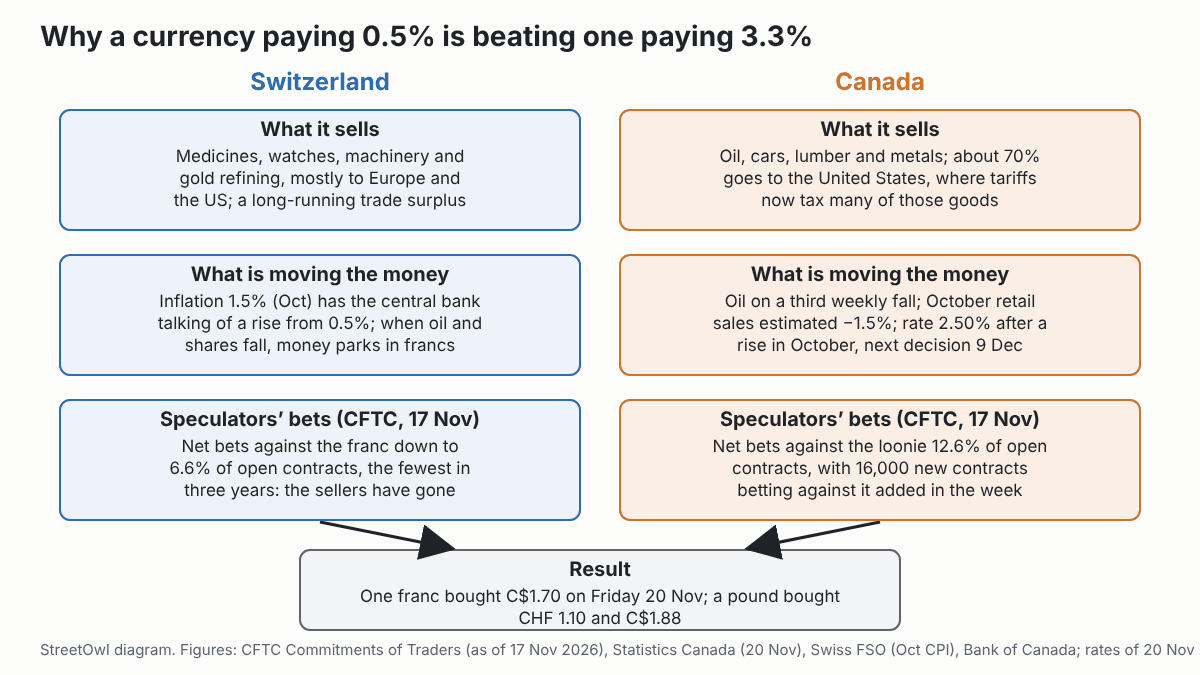
On Friday 20 November 2026 one Swiss franc bought C$1.70. Switzerland's policy rate is 0.5% and its two-year government bond yields about 0.5%; Canada's policy rate is 2.50% and its two-year bond yields about 3.3%. Holding the Canadian dollar instead of the franc pays nearly three percentage points a year more, and yet the franc has been winning.
Interest is only one of the forces on a currency. The others are what a country sells, what it must buy, and what its central bank is expected to do next. On all three the franc has had the better of it this autumn.
What each country sells, and to whom
Switzerland exports medicines, watches, precision machinery and refined gold, mostly to Europe and the United States, and has run a trade surplus for years. Those goods are bought whether or not oil is cheap, so the francs that foreign buyers need to pay for them keep flowing in.
Canada sells oil, cars, lumber and metals, and about 70% of its exports go to the United States, where tariffs now tax many of those goods. Statistics Canada reported on 20 November that September retail sales rose 0.8%, but its early estimate for October was a fall of 1.5%, and crude oil was heading for a third weekly decline. A country that sells oil earns fewer dollars when the price falls, and the Canadian dollar fell to its weakest against the US dollar in nineteen months on 19 November, just above 1.435 per US dollar.
What the central banks are reacting to
Swiss inflation was 1.5% in October, high by Swiss standards after years near zero, and that has put a rise in the 0.5% policy rate into the conversation ahead of the Swiss National Bank's meeting on 10 December. The franc also has an old habit: when oil and share prices fall, money parks in francs, which is why it rises on bad news elsewhere.
The Bank of Canada raised its rate to 2.50% on 28 October, its first rise since 2023, with inflation around 3%, and said it could need to raise again. Its next decision is on 9 December. Governor Macklem speaks on Tuesday 24 November and the third-quarter national accounts are published on Monday 30 November; both will tell the market whether the Canadian economy is strong enough to carry higher rates while its exports to the United States shrink.
What speculators are betting
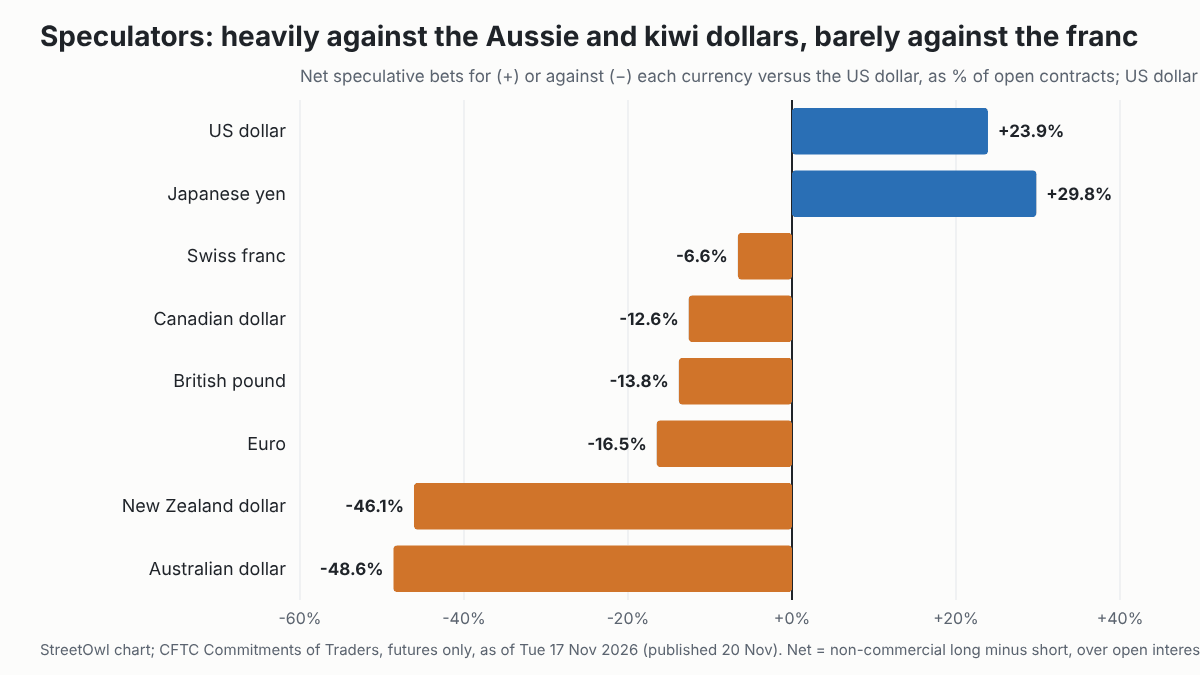
The US regulator's weekly Commitments of Traders report shows how futures traders are placed. As of Tuesday 17 November, net bets against the Swiss franc had fallen to 6.6% of open contracts, the fewest in three years: the traders who were betting on a weaker franc have largely gone. Net bets against the Canadian dollar stood at 12.6% of open contracts, with about 16,000 new contracts betting against it added in the week. The Australian and New Zealand dollars carried the heaviest bets against them, at 48.6% and 46.1%, and the US dollar and Japanese yen the heaviest bets in their favour.
What it means for a British household
A pound bought CHF 1.10 and C$1.88 on Friday. For holiday money that makes Switzerland expensive and Canada cheaper than it was in the summer; StreetOwl's Holiday money board on the Travel tab shows what £100 buys in each. Britain imports Swiss medicines and watches, whose sterling prices rise as the franc does, and Canadian wheat, lumber and aluminium, which get cheaper in pounds when the loonie falls. The dates that could change the picture are Wednesday's Australian inflation figures (for the commodity currencies as a group), the Canadian national accounts on 30 November, the Swiss inflation figures on 3 December and the two central bank meetings on 9 and 10 December.
Sources
- CFTC, 20 November 2026: Commitments of Traders, futures only, as of 17 November 2026 (currencies)
- CFTC, 20 November 2026: Commitments of Traders, futures only (US dollar index)
- FXStreet via TMGM, 20 November 2026: Loonie steadies at a 19-month low following Canadian retail sales
- Mortgage Professional Australia, 20 November 2026: Inflation tipped for three-year high as fuel and surcharge changes bite
- Continuum Economics, 13 November 2026: preview of Canada's Q3 GDP, due 30 November
- FXIFY, 19 November 2026: trading desk brief for the week of 23 November
This piece was drafted by AI from the public sources named, then read and approved by Michael Rossi before it went up. It explains why a currency moves; it is not advice to buy or sell any currency and is not financial advice.
← Back to StreetOwl