Why the Swiss franc keeps rising on an interest rate of nothing
Switzerland pays no interest, so for six months the world borrowed francs to buy higher-yielding currencies and the franc fell; one inflation figure in October changed the assumption behind those loans, and repaying them means buying francs back, which is why the franc has had its strongest five weeks of the year.
A currency that pays nothing
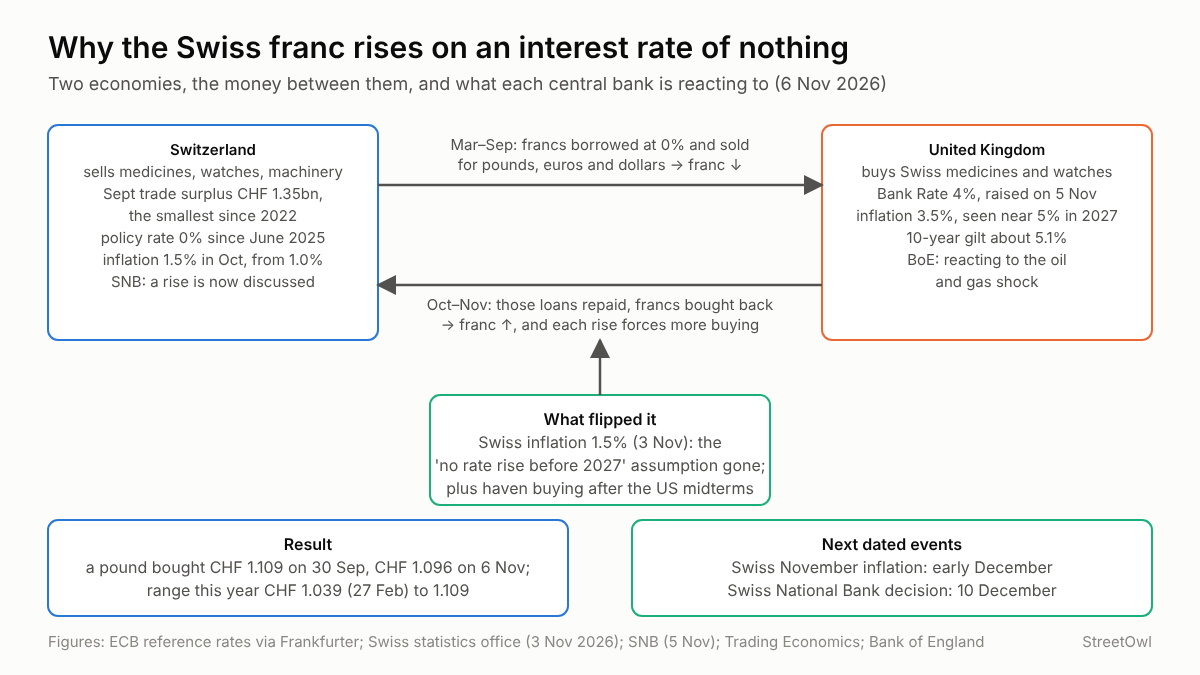
The Swiss National Bank's policy rate has been 0 per cent since June 2025, the lowest in the world. The Bank of England's is 4 per cent, raised on 5 November; Australia's is 4.85 per cent; New Zealand's 2.75 per cent. A yield gap that wide is an invitation: borrow in the currency that charges nothing, sell it, and park the money where it earns four or five per cent. That is called a carry trade, and from March to the end of September it was the main thing happening to the franc.
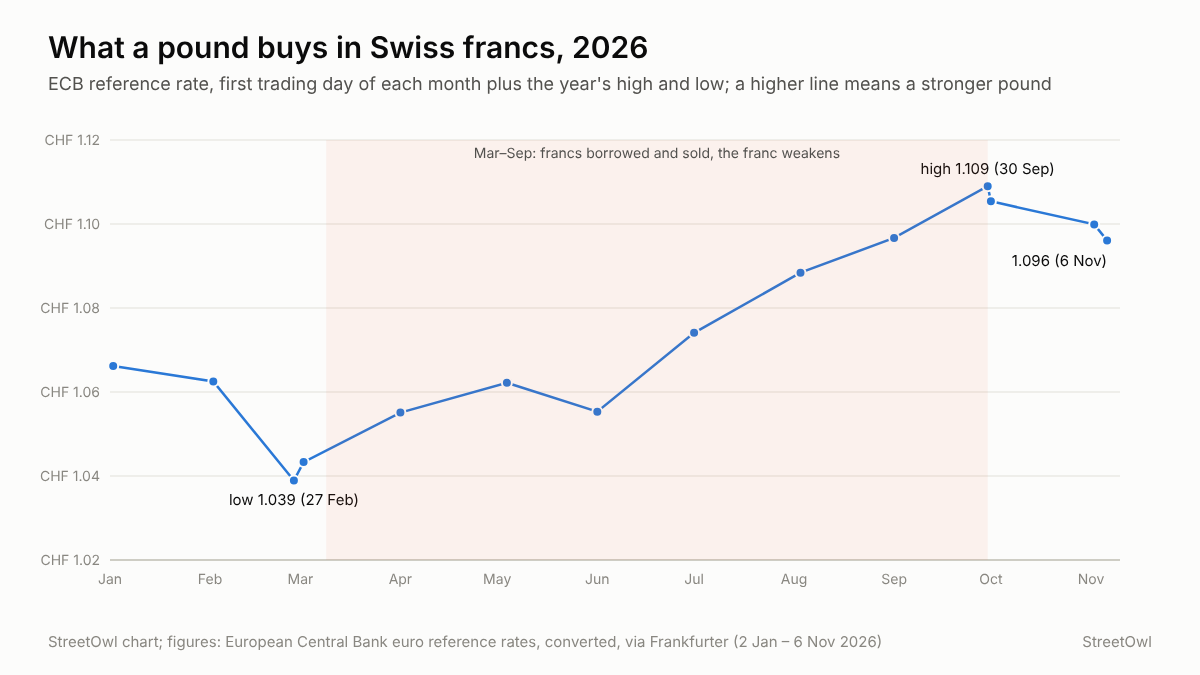
The record of it is in the exchange rate. On 27 February a pound bought CHF 1.039, the low of the year; on 30 September it bought CHF 1.109, the high. The euro went the same way, from CHF 0.901 on 9 March to CHF 0.948 on 30 September. The franc was not weakening because Switzerland was selling less abroad. It was weakening because it was being lent.
What flipped it
A carry trade rests on an assumption: that the cheap currency stays cheap. Swiss inflation was 1.0 per cent in September and the market assumed no rate rise before 2027. On 3 November the October figure came in at 1.5 per cent, the highest in nearly three years, lifted by fuel. That is still inside the SNB's 0 to 2 per cent target range, and its chairman, Martin Schlegel, said on 5 November only that the range lets the bank tolerate temporary swings. But markets now price a rise in early 2027 and some economists put it at the 10 December meeting. Swiss two-year yields rose 27 basis points in twenty days, more than any other major currency's.
That is enough. A loan in francs that was free is now expected to cost something, and the currency it was swapped into no longer looks as safe to hold against it. Loans are repaid, and repaying a franc loan means buying francs. Every franc bought pushes the currency up, which makes the remaining loans dearer to close, which prompts more buying. The move feeds itself. Haven demand added to it: after the Democrats' sweep of the US midterms on 3 November and a sell-off in technology shares, money moved into the franc as it does in any scare. By Friday 6 November a pound bought CHF 1.096 and a euro CHF 0.914, the franc up about 1.4 per cent against a basket of currencies in twenty days, the most of any of the eight big ones.
What trade says, and why it does not matter this month
Switzerland sells medicines, watches and machinery and usually runs a large surplus, which over years holds the franc up. This autumn the surplus has done the opposite: it shrank to CHF 1.35 billion in September, the smallest since November 2022, because pharmaceutical imports jumped 88 per cent in the month, after a record CHF 8.1 billion in July when exporters rushed goods to America ahead of a 39 per cent tariff. On trade alone the franc should be softening. It is rising because a crowded financial bet is being unwound, and financial flows move in weeks while trade flows move in years.
The dates that decide what happens next are the Swiss inflation figure for November, published in early December, and the SNB's meeting on 10 December. A figure back under about 1.3 per cent and no change in the rate would restore the assumption the carry trade was built on, and the lending would resume. A rise, or a figure that keeps a rise in play, would keep francs being bought back.
What it means for a British household
For anyone booking a ski week, the pound buys about 1.2 per cent fewer francs than at the end of September but 5.5 per cent more than in late February: £100 bought CHF 110.90 on 30 September, CHF 109.60 on 6 November and CHF 103.90 on 27 February (StreetOwl's Holiday money board on the Travel tab shows what £100 buys in each currency, updated daily). Switzerland is already one of Europe's most expensive countries, and a stronger franc makes every coffee and lift pass a little dearer in pounds. On the import side, what Britain buys from Switzerland is mostly medicines, with watches a distant second; pharmaceutical prices are set by long contracts and move slowly, so the exchange rate shows up at the chemist only over years, not months.
Sources
- European Central Bank euro reference rates via Frankfurter, pound to franc, 2 January to 6 November 2026
- European Central Bank euro reference rates via Frankfurter, euro to franc, 2 January to 6 November 2026
- ActionForex, SNB's Schlegel says policy framework works as Swiss inflation climbs to 1.5%, 5 November 2026
- Trading Economics, Swiss franc holds near two-month high, 5 November 2026
- TradingPedia, Stronger inflation spurs hawkish SNB, firmer franc, 4 November 2026
- Trading Economics, Switzerland balance of trade, September 2026 (published 20 October 2026)
- Bank of England, Monetary Policy Summary and minutes, 5 November 2026
- FX Fundamentals model run of 6 November 2026 (StreetOwl, own data)
This piece was researched with AI from the public sources named and written up and checked by Michael Rossi before it went up. It explains why a currency moves; it is not advice to buy or sell any currency and is not financial advice.
← Back to StreetOwl