Why the Swiss franc is slipping against the yen after a decade as the world's cheapest currency
Japan's central bank has raised its rate to 1.25% while Switzerland's sits at zero, so for the first time in a generation it is cheaper to borrow francs than yen, so the money that used to be borrowed in yen is borrowed in francs and sold, while Japan's oil bill still pulls the other way.
Who sells what to whom
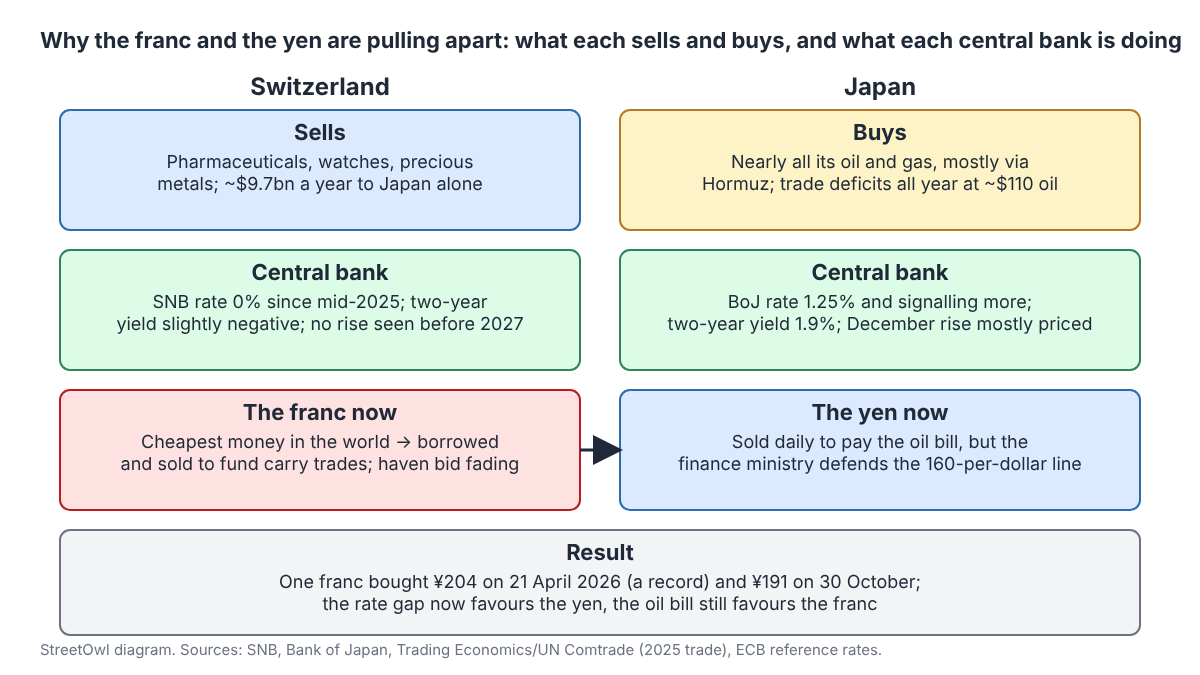
Switzerland and Japan are both rich, export-led economies with currencies that investors run to in a crisis, and that is why they are usually spoken of in the same breath. The trade between them is modest and one-sided: Switzerland sold Japan about $9.7bn of goods in 2025, led by pharmaceuticals ($3.8bn), watches ($2.2bn) and precious metals ($1.5bn), according to UN trade data. A Swiss drug or watch company is therefore a steady seller of yen for francs.
What moves the pair this year, though, is energy rather than watches. Japan imports nearly all of its oil and gas, most of it through the Strait of Hormuz, and has run trade deficits through 2026 as crude near $110 a barrel inflates the import bill. Yen are sold every day to pay for it. Switzerland, by contrast, runs on hydro and nuclear power and its import bill has risen far less.
What is holding each currency up or down
For twenty years the yen was the currency the world borrowed. Japanese interest rates sat at or below zero, so anyone wanting to fund an investment elsewhere borrowed yen, sold them and bought something that paid more. That machine has quietly reversed. The Bank of Japan has raised its policy rate to 1.25% and its governor used the October meeting to signal further moves towards a neutral level; Japan's two-year government bond yields about 1.9%, and markets price a further rise in December as more likely than not.
The Swiss National Bank has held its rate at 0% since mid-2025. Its two-year yield is slightly negative, its chairman said on 29 October that no change was currently needed because inflation is stable, and economists see no Swiss rise before 2027. So the franc, not the yen, is now the cheapest money in the world, and the borrowing has moved with it: the franc is being borrowed and sold to fund investments elsewhere, which is why it has been weakening for most of the year. The central bank, which spent the spring threatening to intervene against a too-strong franc, has scaled those threats back because strength is no longer the problem.
The yen has a floor the franc lacks. Japan's finance ministry has defended a line near 160 yen to the dollar, with suspected intervention above 161 in May and a promise of decisive action on 27 October. The franc's safe-haven bid, which took the pair to a record ¥204.03 per franc on 21 April as the Iran strikes began, has been fading since June: the Swiss National Bank sold CHF 3.9bn of francs in the first quarter of 2026 to hold the currency down and only CHF 1.4bn in the second.
The rate as a plain fact
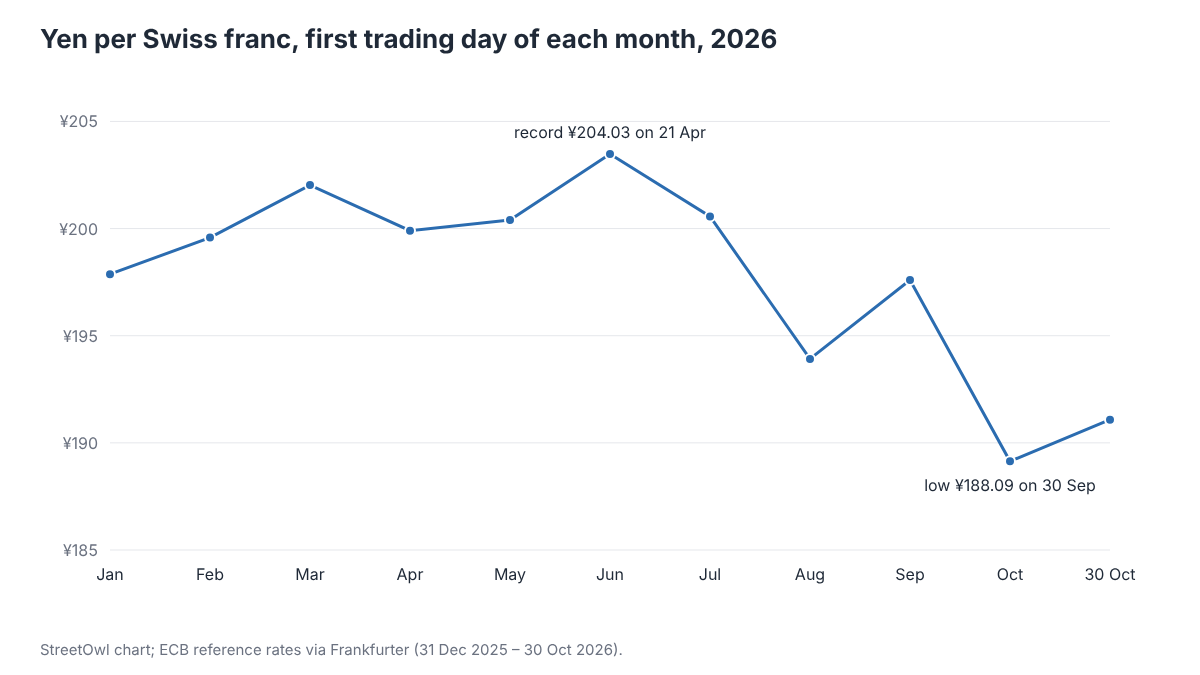
One franc bought ¥191.08 on 30 October 2026, according to ECB reference rates. The 2026 range runs from ¥188.09 on 30 September to the record ¥204.03 on 21 April; the year began at ¥197.65. The pair has therefore given back about 6% from its April peak while the rate gap has moved steadily in the yen's favour.
The dates that could change it
Swiss consumer prices for October are published on 3 November; a reading above about 1.3% for two months running would revive talk of a Swiss rise in 2027. The Bank of Japan's governor speaks on 6 November and the bank decides on 18–19 December; a hold with no guidance would remove the yen's new yield advantage. The Swiss National Bank meets on 10 December and publishes its quarterly intervention figures late in December, which show whether it is still selling francs. And the dollar-yen rate against the finance ministry's 160 line is the daily test of whether the yen's floor still holds.
What it means for a British household
For holiday money the pound buys about CHF 1.10 (30 October) against 1.05 in May, so a Swiss ski week is a little cheaper than it was in the spring, and about ¥211, which keeps Japan one of the cheaper long-haul destinations for British visitors; StreetOwl's Holiday money board on the Travel tab shows what £100 buys in each. On imports, a weaker franc takes a little pressure off the price of Swiss medicines and watches, while a yen that strengthens from here would do the opposite for Japanese cars and cameras.
Sources
- Frankfurter (ECB reference rates), CHF to JPY daily, Jan–Oct 2026
- Trading Economics, Swiss franc weakens on carry trade appeal, 29 Oct 2026
- Swissinfo, SNB restates increased resolve on franc as rate held at zero, 19 Mar 2026
- InvestingLive, BoJ to hold at 1.25% but Ueda signals further hikes toward neutral, Oct 2026
- Trading Economics / UN Comtrade, Switzerland exports to Japan, 2025
This piece was researched with AI from the public sources named and written up and checked by Michael Rossi before it went up. It explains why a currency moves; it is not advice to buy or sell any currency and is not financial advice.
← Back to StreetOwl