Why the Swiss franc has stopped falling, though its interest rate is still zero
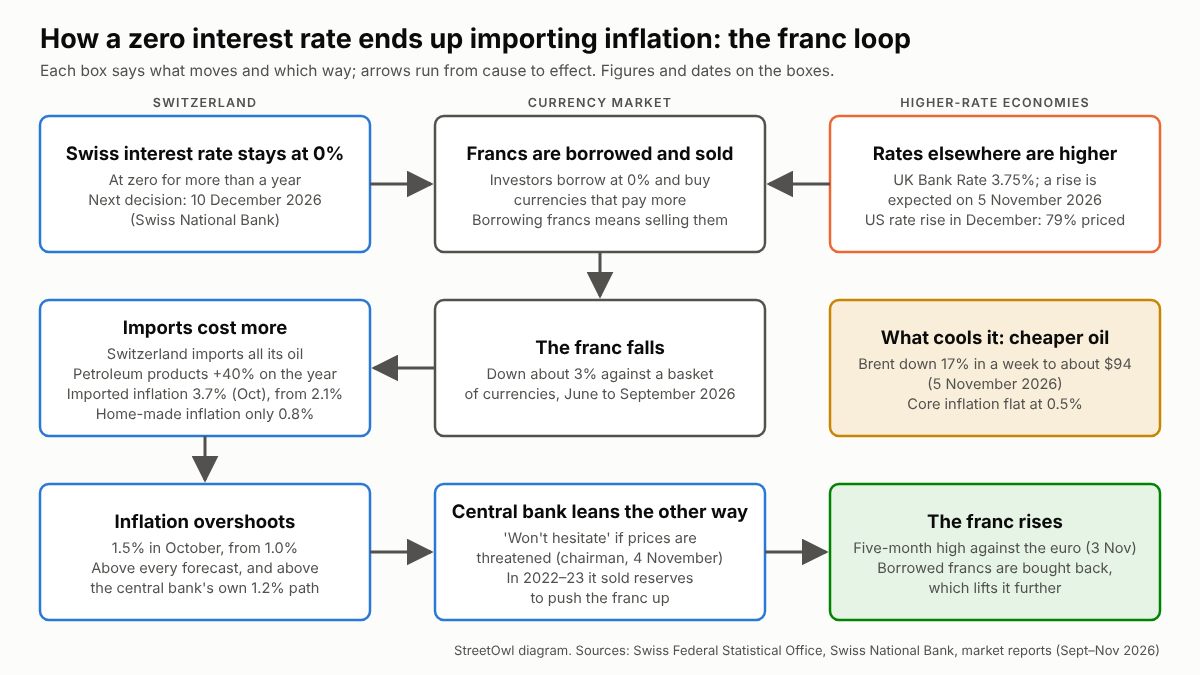
A zero interest rate made the franc the currency to borrow and sell, so it fell, so Switzerland's imported oil cost more, so inflation overshot, and the Swiss remedy for imported inflation is a stronger franc.
The world's cheapest loan
The Swiss National Bank has held its interest rate at zero for more than a year. Almost everywhere else pays more: the Bank of England's rate is 3.75 per cent, with a rise widely expected at noon on 5 November 2026, and markets put the chance of a US rate rise in December at 79 per cent. So investors borrow francs for nothing and hold currencies that pay interest instead.
Borrowing one currency to hold another means selling the first. Between June and September 2026 the franc fell by about 3 per cent against a basket of currencies. The central bank had itself acted to weaken the franc earlier in the year, and in September it softened its warning that it would step in again.
October's surprise
On 3 November Switzerland reported inflation of 1.5 per cent for October, up from 1.0 per cent in September. That was above every forecast in Bloomberg's survey of economists and above the central bank's own projection of 1.2 per cent for the final quarter; November and December would have to average about 1.05 per cent to meet it.
The split shows where it came from. Prices of things made in Switzerland rose 0.8 per cent. Prices of imports rose 3.7 per cent, up from 2.1 per cent a month earlier. Petroleum products cost 40 per cent more than a year ago and heating oil 81 per cent more, and fuel accounts for about 0.85 points of the 1.5. Switzerland imports all of its oil, and a weaker franc makes every barrel dearer. Core inflation, which leaves out energy, stayed at 0.5 per cent.
Why a stronger franc is the Swiss remedy
That is the loop. A zero rate makes the franc the thing to borrow; borrowing it means selling it; selling weakens it; a weaker franc raises the price of imports; and inflation overshoots. For a small economy that buys its energy abroad, the quickest cure is the exchange rate. In 2022 and 2023 the Swiss National Bank sold foreign reserves to push the franc up as part of its tightening.
On 4 November the bank's chairman, Martin Schlegel, said the October figure was above its forecast, that it saw no major second-round effects so far, and that it would not hesitate to change policy if price stability were endangered. Markets now expect the first rate rise in early 2027; Bloomberg's economists still expect none until late 2027; and one central-bank watcher calls a December rise a live risk if core inflation moves in November. The franc rose to a five-month high against the euro after the figures, and on 5 November a US dollar bought about 0.81 francs, the franc's strongest level since early September.
What could change it
Oil could undo the scare as quickly as it made it. Brent crude fell about 17 per cent in the week to 5 November, to roughly $94 a barrel, after the US midterm elections raised hopes of an end to the war with Iran. If that holds, the fuel line in Swiss inflation shrinks by the new year. If it does not, inflation heads towards the top of the central bank's 0 to 2 per cent range.
The dates to watch are Switzerland's November inflation figure, due in the first days of December, and the Swiss National Bank's decision on 10 December, its last of the year.
What it means for a British household
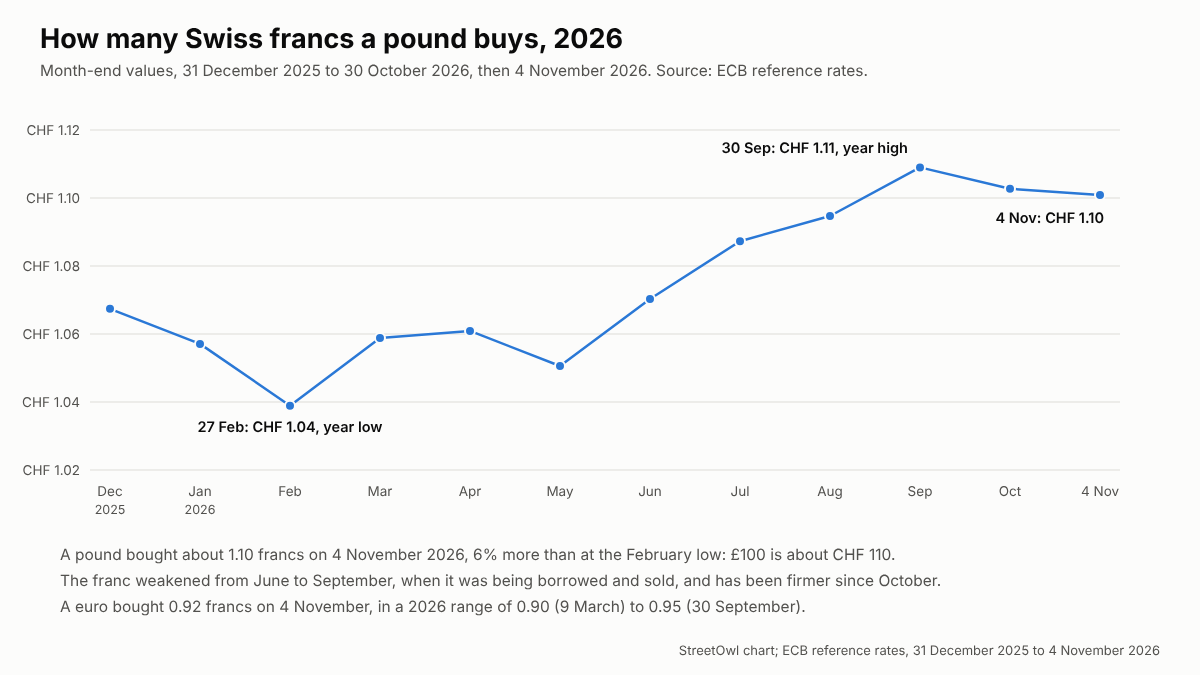
A pound bought about 1.10 Swiss francs on 4 November 2026, in a range this year of 1.04 on 27 February to 1.11 on 30 September, so £100 is about 110 francs: the Holiday money board on StreetOwl's Travel tab shows what £100 buys today. Anyone paying for a ski trip this winter is buying francs near the best rate of the year, but a firmer franc would take some of that back. The same goes for what Britain buys from Switzerland, such as medicines, watches and chocolate, which are billed in francs before they are billed in pounds.
Sources
- SWI swissinfo.ch (Bloomberg), Swiss inflation at highest in almost three years, 3 November 2026
- Gianluca Benigno, Swiss October 2026 CPI inflation report, November 2026
- Tradingpedia, Stronger inflation spurs hawkish SNB, firmer franc, 4 November 2026
- TMGM (FXStreet), Schlegel on Swiss price stability, 4 November 2026
- Trading Economics, Swiss franc, 5 November 2026
- Trading Economics, British pound and the Bank of England, 5 November 2026
- Trading Economics, gold and US rate expectations, 5 November 2026
- Trading Economics, Brent crude oil, 5 November 2026
- Business Standard (Bloomberg), oil prices and the US midterm results, 5 November 2026
- European Central Bank reference rates via Frankfurter, pound to franc, 31 December 2025 to 4 November 2026
This piece was researched with AI from the public sources named and written up and checked by Michael Rossi before it went up. It explains why a currency moves; it is not advice to buy or sell any currency and is not financial advice.
← Back to StreetOwl