Why the state is about to pay a fifth of the price of a starter home, and what that does to the price
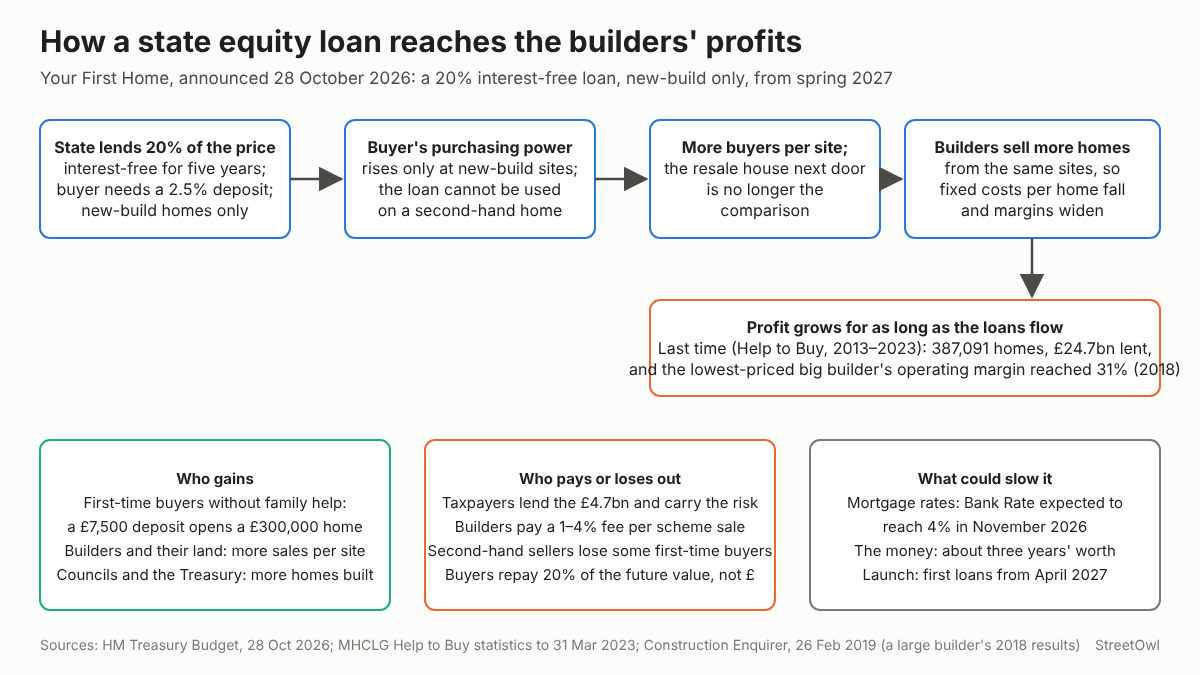
The government will lend first-time buyers a fifth of the price of a new-build home, so buyers with tiny deposits can only shop at new-build sites, so builders sell more homes from the same land and the cost of each one falls, so their margins widen for as long as the loans keep flowing.
What was announced
In the Budget on 28 October 2026 the Chancellor confirmed a scheme called Your First Home: £4.7bn of government-backed equity loans for first-time buyers in England, launching in the spring of 2027. The state lends 20% of the price of a home, interest-free for the first five years, on top of a deposit of as little as 2.5%. Buyers must earn less than £110,000 (£140,000 in London), the price of the home must sit under a cap set from local median prices, and the loan can only be used to buy a newly built home. The government expects about 70,000 households to use it and about 20,000 extra homes to be built as a result.
It is the successor to Help to Buy, which ran from April 2013 to March 2023. Over those ten years the state lent £24.7bn to help buy 387,091 homes worth £109bn, and 85% of the buyers were first-timers.
Why a loan on one product changes that product's price
An equity loan is a very particular kind of help. Because it can only be spent on a new-build, it does not raise demand for housing in general; it raises demand for one product, made by one industry. A buyer with £7,500 saved and a steady job can suddenly afford a £300,000 home at a new-build site, where the loan turns that £7,500 into a 22.5% deposit, and cannot afford the second-hand house next door, where it is still 2.5%.
Builders see three things at once. More buyers arrive at each site. Those buyers no longer compare the new home with the resale market, because the loan does not work there. And the price caps push the extra demand towards the cheaper end of the range, where the big builders sell most of their homes.
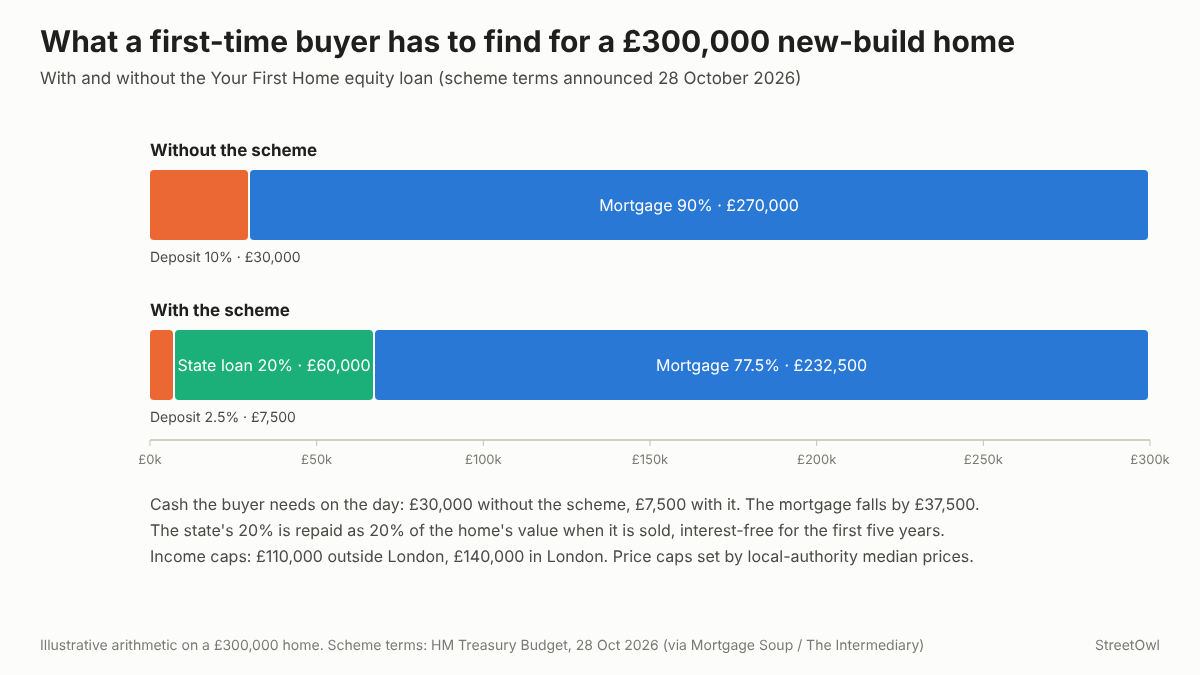
The arithmetic for a £300,000 home is in the chart below. The buyer's cash on the day falls from £30,000 to £7,500, and the mortgage falls by £37,500. The state's share is repaid as 20% of whatever the home is worth when it is sold, not as a fixed sum.
How it reaches the builders' profits
A housebuilder's costs are mostly fixed per site: the land, the roads and drains, the show home, the sales staff. The profit on each extra home sold from the same site is therefore much larger than the average profit. Fill the sites faster and the margin on every home rises. That is what happened last time: the operating margin of the largest low-priced builder rose from the low teens before Help to Buy to 28% in 2017 and 31% in 2018, when its pre-tax profit passed £1bn. Over the scheme's life new-build prices rose 64% against 67% for existing homes, so the loans did not push new-build prices up faster than the market; what they did was keep the sites full.
The same builders today run operating margins of 12% to 13%, against targets of 20%, and sell about 0.6 homes a week from each site. Roughly a third of their private sales already go to first-time buyers, and about half are priced under £300,000, so most of their range qualifies. Analysts' models of the new scheme assume volumes 10% higher and gross margins two percentage points wider by 2028, which would lift the sector's earnings per share by about 70%; that assumed a 1% fee from builders, and the real fee runs from 1% to 4%, so the gain is smaller.
What could slow it down
Three things. Interest rates: Help to Buy launched with Bank Rate at 0.5% and falling, while this scheme launches with the Bank of England expected to raise Bank Rate to 4% on 5 November and markets pricing further rises. A smaller mortgage offsets some of that, not all of it. Scale: £4.7bn at roughly £1.5bn a year is about three years' worth, and the first loans are not expected until April 2027, so the spring 2027 selling season is only half covered. And costs: build-cost inflation of 3% to 4%, a building safety levy, and higher material costs linked to the Middle East are all arriving at the same time.
Who gains and who pays is also worth stating plainly. First-time buyers without family help gain the most. Builders and the owners of land with planning permission gain next. Taxpayers lend the money and carry the risk of house prices falling. Sellers of second-hand homes lose some of their buyers. And a two-tier market, in which a new-build sells for more than the identical house next door because only one of them comes with a state loan, is the part to watch.
Sources
- ITV News, Budget at a glance, 28 October 2026
- Mortgage Soup, Budget confirms £4.7bn Your First Home equity loan scheme, October 2026
- Reuters via AOL, UK homebuilders slump as budget's first-time buyer scheme disappoints, 28 October 2026
- Trustnet, Housebuilders rally but Budget detail will decide who gains, 28 September 2026
- MHCLG, Help to Buy equity loan scheme data to 31 March 2023
- Construction Enquirer, 26 February 2019
- Investing.com, housebuilder H1 2026 results slides, 6 August 2026
- Finchiefs, Bank of England meeting preview, 5 November 2026
This piece was researched with AI from the public sources named and written up and checked by Michael Rossi before it went up. It describes how one thing moves another; it names no investment and is not financial advice.
← Back to StreetOwl