Why the powder, not the shell, decides how fast Europe can rearm
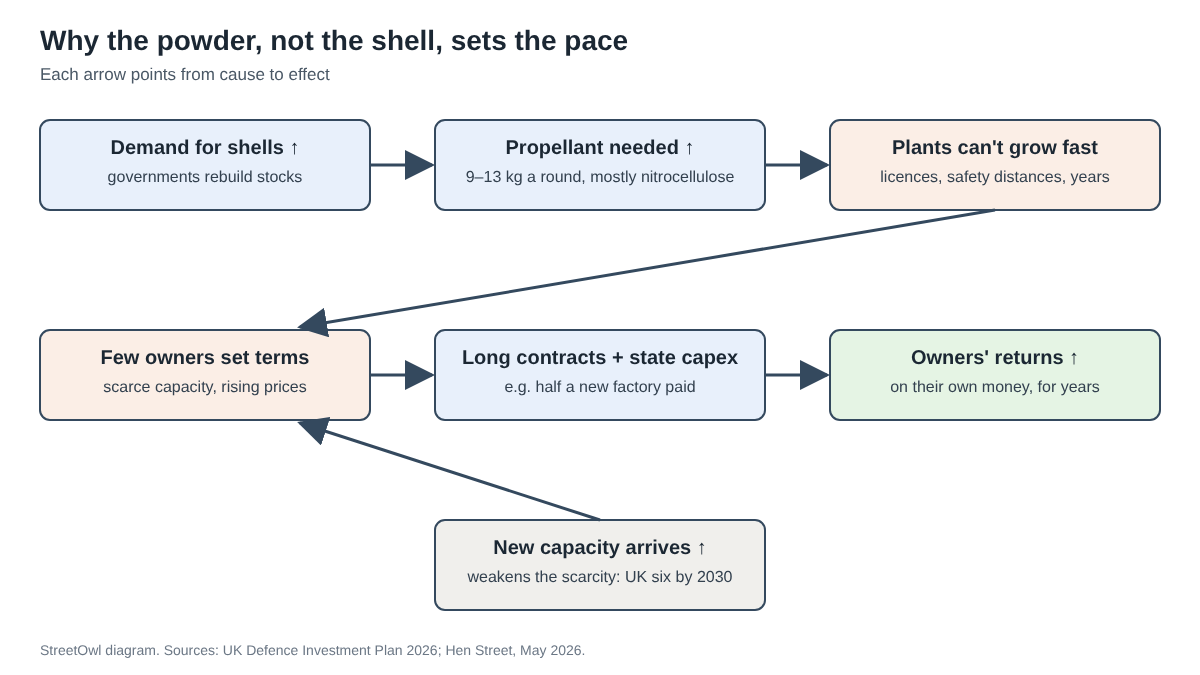
Governments want far more artillery shells, every shell needs propellant made in a handful of slow-to-build chemical plants, so the owners of those plants can set terms and get the state to help pay for new ones.
The part that is easy and the part that is not
In its 2026 Defence Investment Plan, Britain committed £1.5bn to building at least six energetics factories by 2030, making explosives, propellants and pyrotechnics, with construction of the first due to start before the end of this year. It sits inside £11.1bn of planned weapons and munitions spending over four financial years.
The steel body of an artillery shell is ordinary engineering. What fills and fires it is not. One 155mm round burns between 9 and 13 kilograms of propellant, and 75 to 95 per cent of that propellant is nitrocellulose, made by treating cellulose from the short fuzz left on cotton seed, known as cotton linters.
The arithmetic from round to cotton field
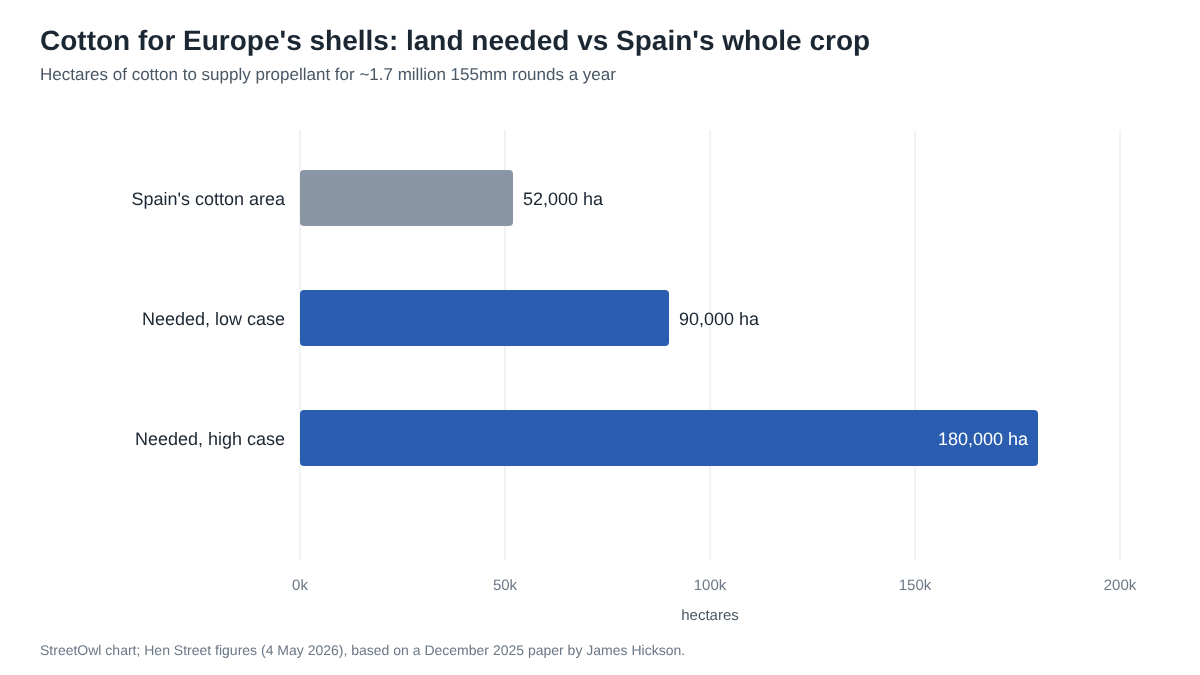
Europe is aiming for about 1.7 million rounds a year. On planning averages that needs roughly 17,000 tonnes of propellant, about 14,800 tonnes of nitrocellulose and about 14,700 tonnes of linters, which in turn means 410,000 to 620,000 tonnes of seed cotton. Growing that would take 90,000 to 180,000 hectares. Spain, Europe's main cotton grower, has 52,000.
So a very large number funnels down at each step to a few chemical plants and a crop Europe barely grows.
Why the squeeze lasts, and who gains from it
An energetics plant cannot be added in a quarter. It needs a hazardous-site licence, wide safety distances, specialist staff and years of commissioning. Until new plants are running, whoever already owns working capacity can set the price and the length of the contract.
Governments respond the only way they can: they sign long supply agreements and pay part of the cost of new plants. In the summer the Ministry of Defence funded 22 firms to study new energetics production in Britain. When the customer pays for part of a factory and commits to buying its output for years, the return the owner earns on its own money rises much faster than its sales.
The squeeze is temporary by design. Each new factory, in Britain and on the continent, eases it. That is why the order in which plants open, and who runs them, matters as much as the size of the defence budget.
Sources
This piece was drafted by AI from the public sources named, then read and approved by Michael Rossi before it went up. It describes how one thing moves another; it names no investment and is not financial advice.
← Back to StreetOwl