Why the pound keeps buying more Canadian dollars: tariffs tax goods, not services
America's tariffs land on the things Canada sells and not on the services Britain sells, so Canada earns fewer dollars and its central bank pauses while Britain's keeps rates higher, and a pound buys more loonies than it did in the spring.
Two countries, two kinds of export
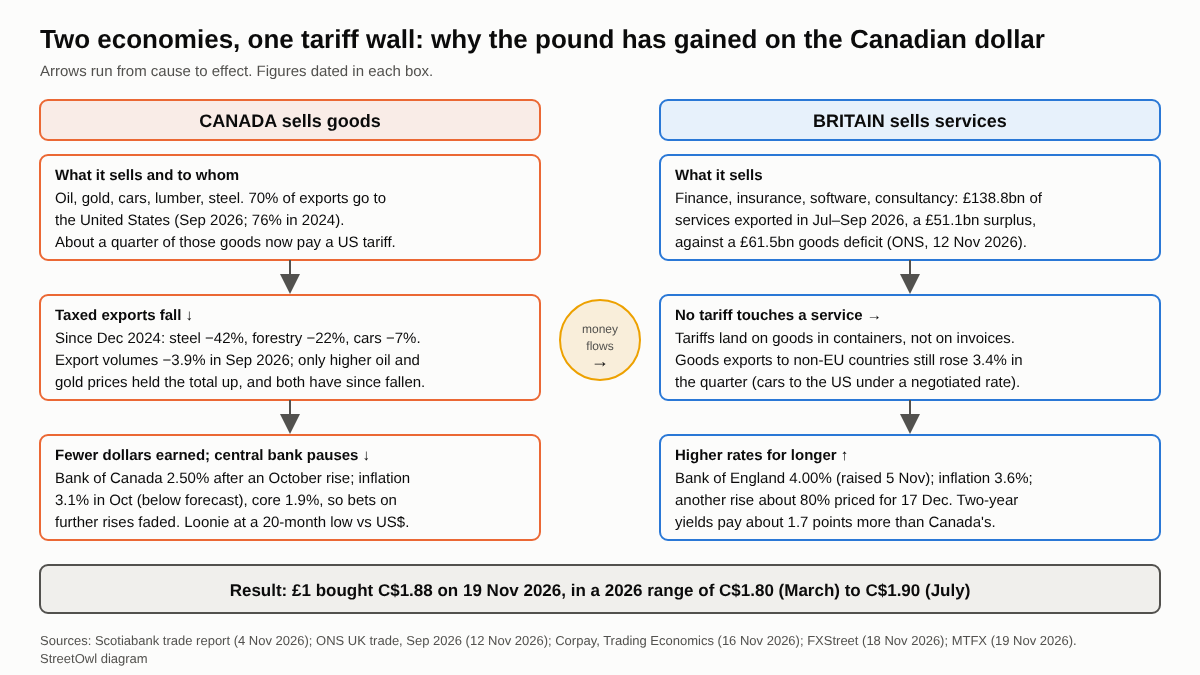
Every tariff the United States has imposed this cycle lands on a thing in a container. None lands on an invoice for insurance, software, consultancy or a fund manager's fee. That one fact separates the Canadian dollar from the pound.
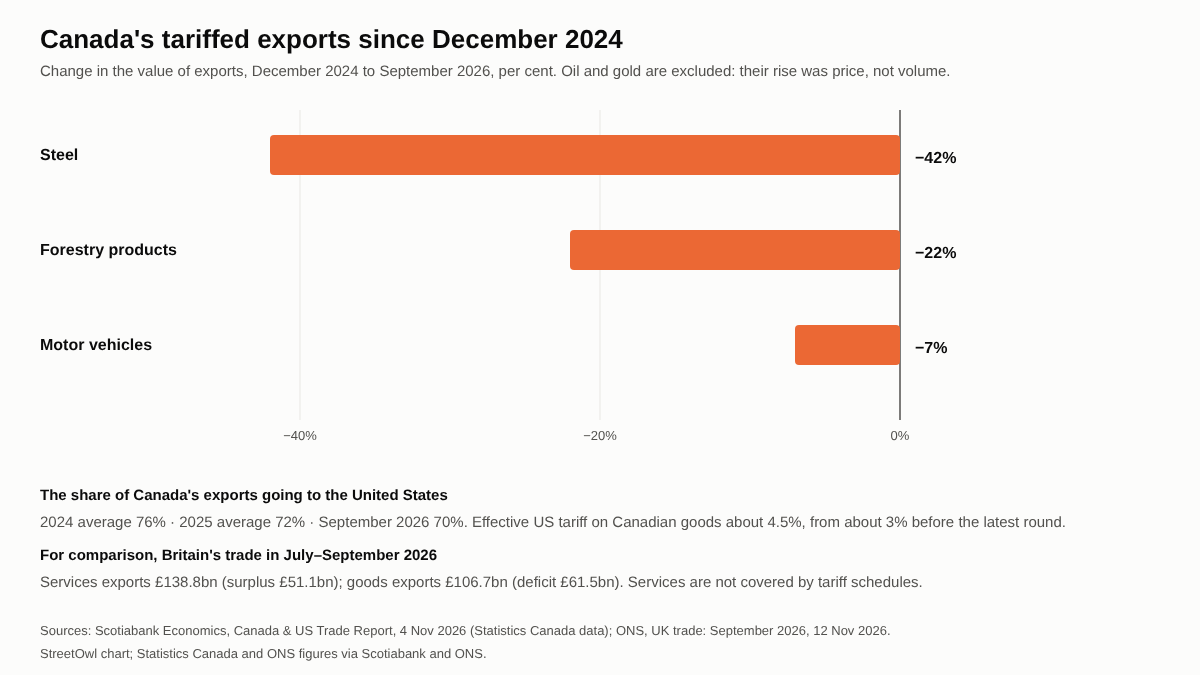
Canada sells things, and mostly to one customer. Seventy per cent of its exports went to the United States in September 2026, down from 76% in 2024 but still the bulk of its trade, and the things it sells are the things being taxed. Scotiabank's reading of the official figures has steel exports down 42% since December 2024, forestry products down 22% and cars down 7%, with about a quarter of Canadian goods entering the US now paying a tariff and the effective rate up to about 4.5% from roughly 3%. The headline export total still rose 0.2% in September, but only because crude oil and gold fetched higher prices; the volume of goods shipped fell 3.9%. Both of those prices have since fallen, oil from around $110 a barrel to the mid-90s and gold about 30% from its January peak.
Britain sells services. In July to September 2026 the UK exported £138.8bn of services and ran a £51.1bn services surplus, against a £61.5bn deficit on goods, according to the ONS. Services are not covered by any tariff schedule. The goods Britain does sell to America, cars above all, go under a negotiated rate, and goods exports to countries outside the EU rose 3.4% in the quarter.
What the central banks are reacting to
The Bank of Canada raised its policy rate to 2.50% in October because the Middle East conflict had pushed energy costs up. Then October's inflation came in at 3.1%, below the 3.2% expected, with the core measures at 1.9%, and the market pared its bets on further rises. The Canadian dollar fell to about 1.43 to the US dollar in mid-November, its weakest for 20 months.
The Bank of England moved the other way, raising Bank Rate to 4.00% on 5 November with UK inflation at 3.6%, and the market puts the chance of another rise on 17 December at about 80%. Two-year British government yields pay roughly 1.7 percentage points more than Canadian ones, so money held in sterling earns more while it waits. A pound bought C$1.88 on 19 November, in a 2026 range of C$1.80 in March to C$1.90 in July.
The dates that could change it
Several things could turn the pair round. Canadian and American negotiators are reported to be back at the table on the North American trade agreement, and a settlement that lifted the tariffs would lift the loonie with it. A jump in the oil price would do the same, because Canada's biggest export is still crude. The Bank of Canada meets on 9 December and the Bank of England on 17 December; Statistics Canada publishes October's trade figures on 8 December, and the share going to the United States is the number to watch.
There is also a wrinkle on the British side: the pound has been weak against the US dollar this month, back at its October low near $1.31. The pound's rise against the Canadian dollar is a story about which of two currencies the American dollar is beating less, not a story about sterling's strength.
What it means for a British household
For anyone booking a Canadian trip, £100 bought about C$188 on 19 November against about C$180 in March, a little over 4% more; StreetOwl's Holiday money board on the Travel tab shows what £100 buys day by day. Canada is a small supplier to British shops, mainly wheat, fish and timber, so a weaker loonie trims those import prices only at the margin. The bigger household effect runs the other way: the same energy prices that pushed Canada's central bank into a rate rise are the ones showing up in British gas and electricity bills.
Sources
- Scotiabank Economics, Canada & US Trade Report, 4 Nov 2026
- ONS, UK trade: September 2026, 12 Nov 2026
- ONS, Balance of payments, UK: April to June 2026, 30 Sep 2026
- Trading Economics, Canadian dollar hits 20-month low, 16 Nov 2026
- Corpay Market Wire, 16 Nov 2026
- FXStreet via TMGM, 18 Nov 2026
- MTFX FX Weekly, 19 Nov 2026
This piece was drafted by AI from the public sources named, then read and approved by Michael Rossi before it went up. It explains why a currency moves; it is not advice to buy or sell any currency and is not financial advice.
← Back to StreetOwl