Why the pound has held up against the Canadian dollar while the US dollar has not
Canada sells goods the United States now taxes, so its exports and investment are slowing and its central bank sits at 2.5%; Britain sells services no tariff touches and its central bank is at 4% and leaning higher, so money is paid more to sit in pounds than in loonies.
Two countries, two kinds of export
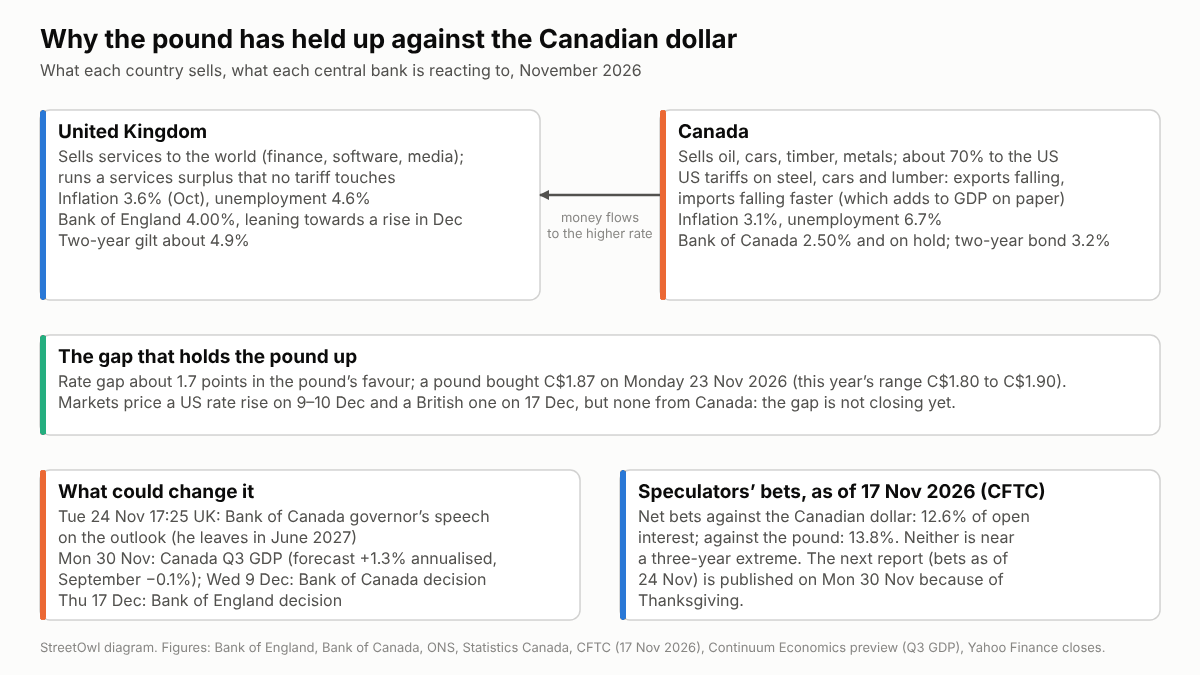
Canada earns its living selling things that cross a border: oil, cars, timber, metals, about 70% of it to the United States. Since 2025 the US has taxed Canadian steel, cars and lumber, and the taxed lines have been falling. Britain's biggest export is services, finance, software, media, consulting, and no tariff applies to a contract signed in London and delivered by email. The two economies therefore feel the same trade war very differently.
The central banks are reacting to different problems. The Bank of Canada has cut to 2.50% and is on hold, with inflation at 3.1% and unemployment at 6.7%. The Bank of England is at 4.00% with inflation at 3.6% and unemployment at 4.6%, and markets lean towards a rise on 17 December. Two-year government bonds pay about 4.9% in Britain and 3.2% in Canada, a gap of roughly 1.7 points in the pound's favour.
What the exchange rate has done
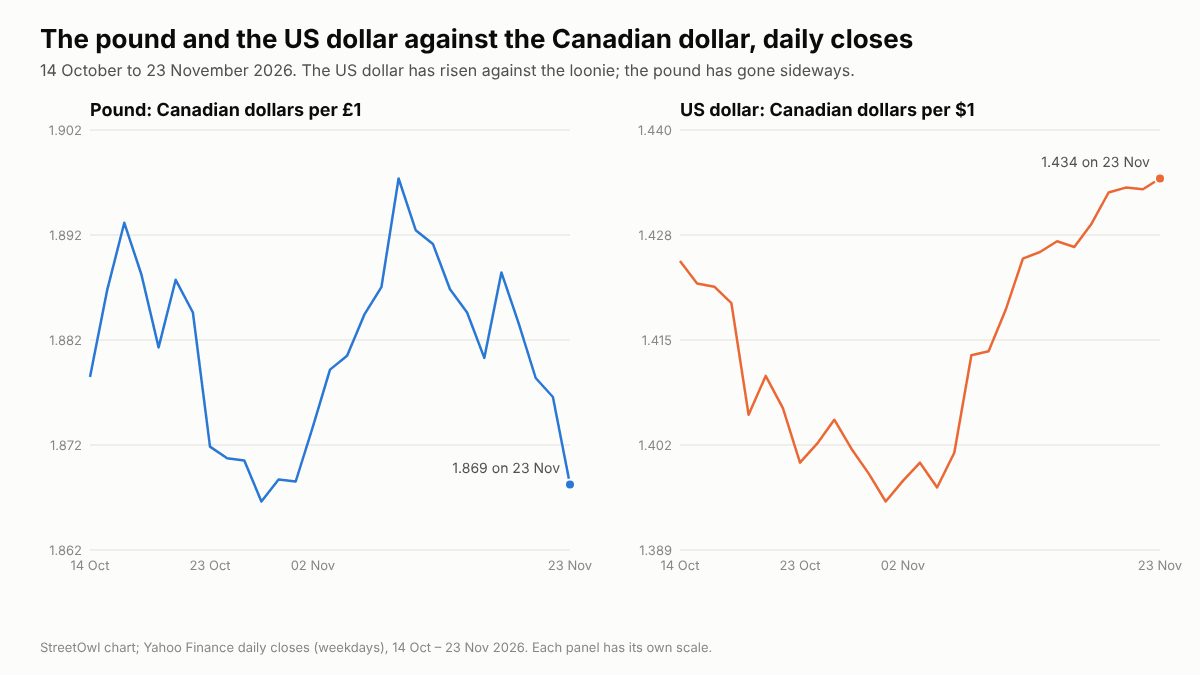
A pound bought C$1.87 on Monday 23 November 2026, inside a 2026 range of C$1.80 to C$1.90, and has gone sideways for six weeks. The US dollar, by contrast, has risen from about C$1.40 to C$1.43 since late October, because markets expect the Federal Reserve to raise rates on 9 and 10 December while the Bank of Canada stays put. The loonie is weak against both, but weaker against the dollar that is about to pay more.
How Canada's economy can grow while Canada shrinks
Canada publishes its third-quarter GDP on Monday 30 November. Continuum Economics expects growth of 1.3% at an annual rate, and what it is made of is the point. Imports are expected to have fallen 5.1% and exports 1.6%. In the national accounts a fall in imports counts as growth, so net trade adds to GDP for a second quarter even though less is being sold. Stock-building is expected to subtract 2.4 points, domestic demand to slow to 2.3% from 3.9%, and September alone to have shrunk 0.1%. The economy is only 1% larger than a year ago.
A headline near 1.3% can therefore read as resilient while the parts that pay for a currency, exports and investment, weaken. A number well above 2% would be the surprise that lifts the loonie; a soft one changes little, because the Bank of Canada is already expected to do nothing on 9 December.
The dated events that could change it
Tuesday 24 November, 17:25 UK time: the Bank of Canada's governor, Tiff Macklem, speaks to the Economic Club of Canada on the outlook and the challenges facing monetary policy, with a press conference about 19:00. He announced on 16 November that he will step down in June 2027, which tends to loosen a central banker's tongue. A hint that the Bank's next move is up would be the biggest single surprise for the loonie this month.
Wednesday 25 November brings US inflation and growth figures that feed the Fed's December decision; Thursday is Thanksgiving and Friday a thin half-day in New York. Then Canada's GDP on 30 November, the Bank of Canada on 9 December and the Bank of England on 17 December.
Speculators' bets
The US regulator's weekly report shows that, as of 17 November 2026, speculators held net bets against the Canadian dollar equal to 12.6% of open interest, and against the pound equal to 13.8%; neither is near a three-year extreme, unlike the euro and the Australian dollar, where bets against are the heaviest in three years. The next report, covering bets as of 24 November, is published on Monday 30 November because of the Thanksgiving holiday.
What it means for a British household
Holiday money: a pound buys about C$1.87, near the top of this year's range, so Canada is slightly cheaper for a British visitor than it was in the spring; StreetOwl's Holiday money board on the Travel tab shows what £100 buys. Imports: Britain buys little directly from Canada, but Canadian oil and lumber are sold in US dollars, and the US dollar has been rising against the pound, which is the exchange rate that matters for petrol and building timber.
Sources
- Bank of Canada, Speech by Tiff Macklem, Governor of the Bank of Canada (media advisory), 24 November 2026
- Continuum Economics, Preview: Canada Q3/September GDP, due November 30, November 2026
- CFTC, Commitments of Traders, CME currency futures, report for 17 November 2026
- investingLive, Market outlook, the week of 23rd–27th November, 23 November 2026
- Lirunex, Week ahead: Australia CPI and core PCE, 20 November 2026
- Yahoo Finance, GBP/CAD and USD/CAD daily closes, 14 October to 23 November 2026
This piece was drafted by AI from the public sources named, then read and approved by Michael Rossi before it went up. It explains why a currency moves; it is not advice to buy or sell any currency and is not financial advice.
← Back to StreetOwl