Why the pound earns 4.5 points more than the franc, and why Wednesday's Swiss inflation number matters
Britain pays 4% at the Bank of England and Switzerland pays nothing, so money is borrowed in francs and lent in pounds; Swiss inflation jumping from 0.5% to 1.5% put a Swiss rate rise into view and the franc has strengthened, so the November inflation figure on 2 December decides whether that gap starts to close.
Two economies, one interest-rate gap
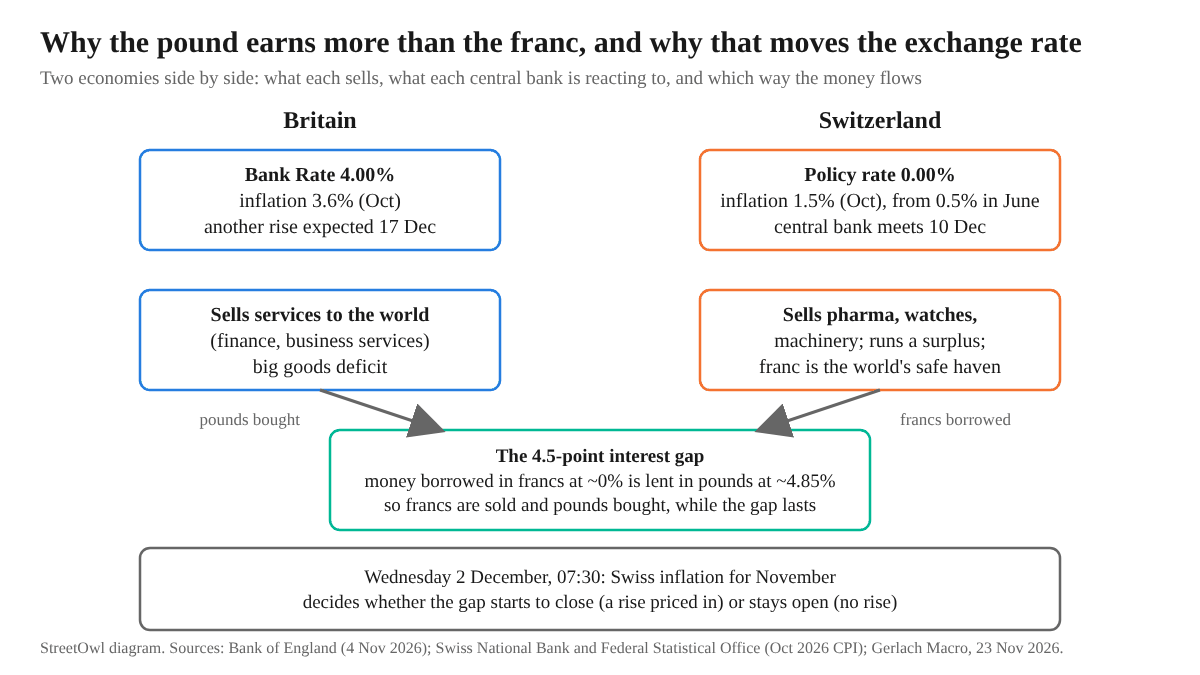
Britain and Switzerland sit at opposite ends of the interest-rate table. The Bank of England raised Bank Rate to 4.00% on 4 November 2026, with UK inflation at 3.6% in October and markets expecting another rise on 17 December. The Swiss National Bank's policy rate is 0.00%, and its own forecast for average inflation this year is 0.7%. A two-year British government bond yields about 4.85%; a Swiss one about 0.3%.
That 4.5-point gap is the mechanism. Money borrowed cheaply in francs and lent in pounds earns the difference for as long as the exchange rate does not move against it, so francs are sold and pounds bought. It is why the franc, one of the world's safest currencies, has had a weak 2026 against the dollar, which pays even more: a dollar bought 0.76 francs at the low of the year and 0.83 on 26 November, with the Federal Reserve's own rise on 9 December almost fully priced.
What changed in October
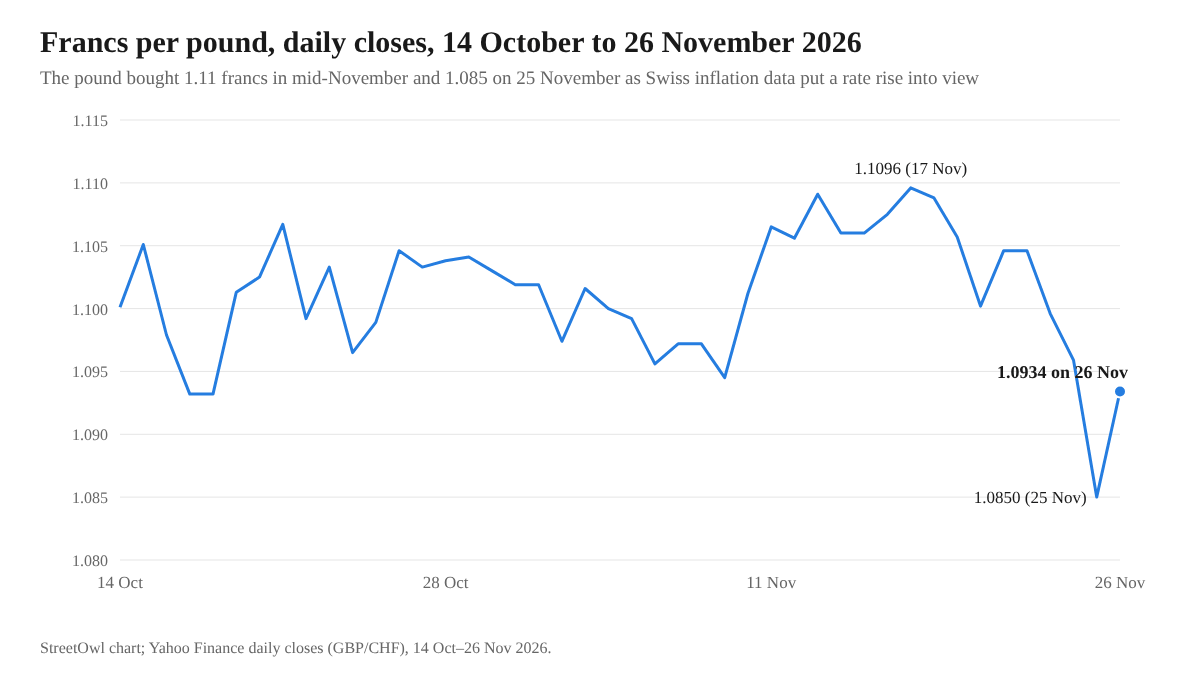
Swiss inflation rose from 0.5% in June to 1.0% in September and 1.5% in October, above forecasts, carried by oil: Brent averaged $114 in September and $124 in October. On 22 November the SNB's vice-chairman said the bank was watching for second-round effects and that December's decision depended on the data. Swiss two-year yields rose by about a third of a point over the month as traders began to price a rise from zero. The pound, which bought 1.11 francs on 17 November, bought 1.085 on 25 November and 1.0934 on 26 November.
Against that, oil has fallen back: Brent was near $94 by 19 November. Economist Stefan Gerlach's model, published on 23 November, projects Swiss inflation of about 1.37% for November and 1.34% for December, and he expects the SNB to leave rates unchanged unless oil rebounds. A survey of economists published by Investing.com put the first Swiss rise in June 2027. The SNB's own September forecast for the fourth quarter was 1.2%.
The dated events
The Swiss November inflation figure is published on Wednesday 2 December at 07:30 UK time. A reading at or below about 1.4% would take the rate-rise premium out of Swiss yields and leave the interest gap open; a reading of 1.6% or more would put the rise back on the table for the SNB's meeting on 10 December and strengthen the franc. On the British side, the Bank of England's Money and Credit figures on 30 November, the final purchasing managers' surveys on 1 and 3 December and the Decision Maker Panel on 4 December all feed the 17 December decision.
Speculators' bets, as reported by the US regulator for the week to 17 November, show the market had already moved: bets against sterling were being cut (speculators added about 9,000 long contracts and closed about 1,900 shorts that week) while bets against the franc, measured against its own three-year range, were the lightest they have been. The next report, delayed by the US Thanksgiving holiday, is due on Monday 30 November.
What it means for a British household
A pound bought about 1.09 francs on 26 November, a little below the 1.11 it reached in mid-November; StreetOwl's Holiday money board on the Travel tab shows what £100 buys in Swiss francs today. Switzerland is a dear country to visit at any exchange rate, and a franc strengthened by a Swiss rate rise would make a ski week dearer still. Britain imports pharmaceuticals, watches and machinery from Switzerland, so a stronger franc feeds, slowly, into those prices; a weaker one does the reverse.
Sources
- Gerlach Macro Notes, SNB: Is a December rate hike likely?, 23 November 2026
- Investing.com, Swiss inflation accelerates as SNB signals concern over broader price pressures, 22 November 2026
- IC Markets, Europe fundamental forecast, 27 November 2026
- MetaTrader economic calendar, Swiss CPI release, 2 December 2026
- CFTC, Commitments of Traders, CME currency futures, week to 17 November 2026
- Yahoo Finance, GBP/CHF daily closes, 14 October to 26 November 2026
This piece was drafted by AI from the public sources named, then read and approved by Michael Rossi before it went up. It explains why a currency moves; it is not advice to buy or sell any currency and is not financial advice.
← Back to StreetOwl