Why the New Zealand dollar is beating the Australian dollar into Christmas
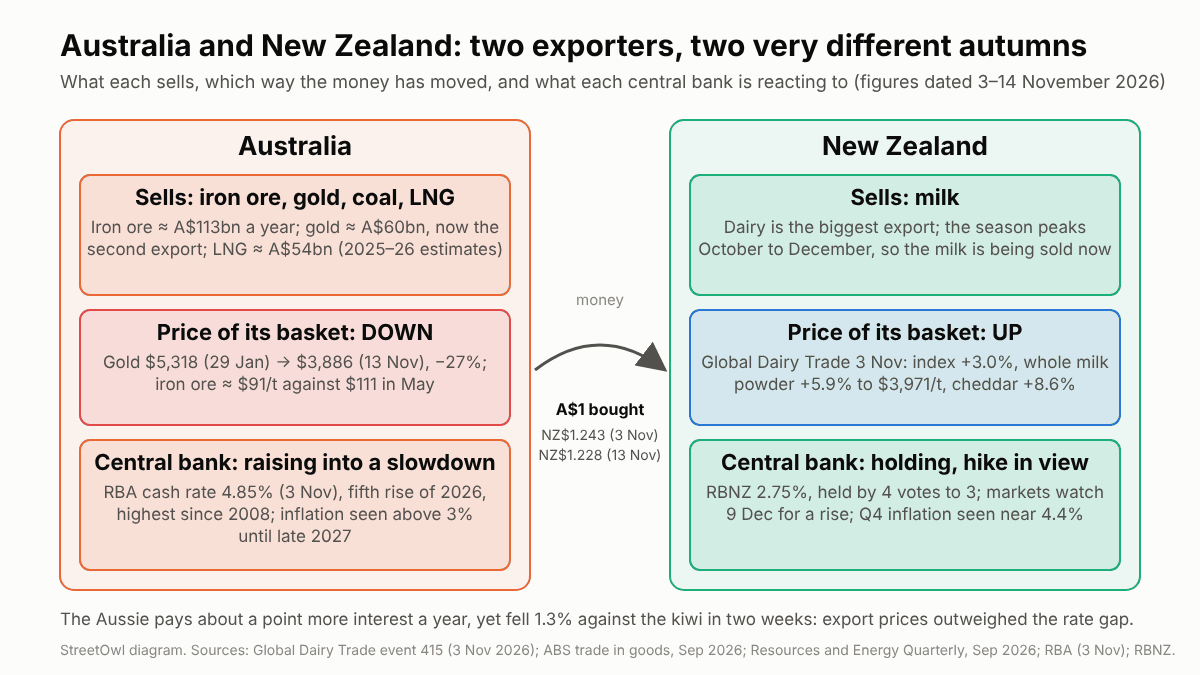
New Zealand sells milk and the milk price is rising, Australia sells gold and the gold price is falling, so money is flowing from one neighbour to the other even though Australia pays the higher interest rate.
Two neighbours, two export baskets
Australia and New Zealand are next-door economies with currencies that usually move together, and for most of this year the Australian dollar was the stronger of the two: at the end of October it bought almost NZ$1.25, its best run against the kiwi since 2017. Since then it has slipped. On 3 November it bought NZ$1.243; by Friday 13 November NZ$1.228, a fall of about 1.3 per cent in two weeks.
That is unusual, because holding the Australian dollar pays. Australia's cash rate is 4.85 per cent and New Zealand's is 2.75, so an investor who borrows kiwi dollars to hold Aussie dollars collects roughly a point a year for doing nothing. When a currency falls against that kind of reward, something in the trade accounts is pushing harder than the interest rate.
What New Zealand sells, and what it is fetching
New Zealand's biggest export is milk, mostly as powder, butter and cheese, and its dairy season peaks between October and December, so this is the time of year when the most milk is collected and sold. The buyers are paying more for it. At the Global Dairy Trade auction on 3 November the overall index rose 3 per cent, whole milk powder rose 5.9 per cent to $3,971 a tonne, skim milk powder 3.1 per cent and cheddar 8.6 per cent. The country's dairy co-operative has pencilled in a payment to farmers of about NZ$9.75 a kilo of milk solids for the season, one of the better years on record. The next auction is on the evening of Tuesday 17 November.
What Australia sells, and what has happened to its price
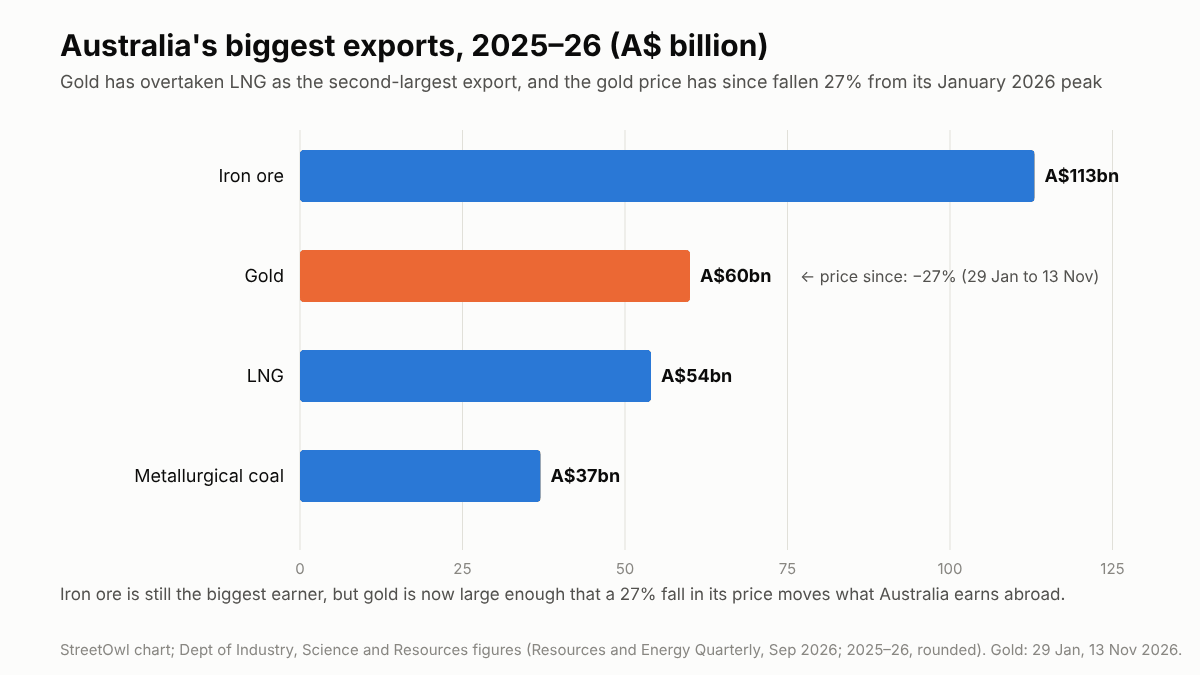
Australia sells iron ore (about A$113 billion a year), gold, coal and liquefied natural gas. Gold matters more than it used to: at around A$60 billion in 2025–26 it has overtaken LNG to become the country's second-largest export. Gold peaked at $5,318 an ounce on 29 January and closed at $3,886 on 13 November, a fall of 27 per cent, while iron ore sits near $91 a tonne against $111 in May. September's trade figures still showed a surplus of A$2.8 billion, but gold exports were already slipping (A$6.3 billion, down 1.6 per cent on the month) at a price that was then still above $4,000, with gas and farm goods doing the lifting.
Put the two baskets side by side and the gap is wide: the price of what New Zealand sells has risen about 6 per cent over the past month while the price of what Australia sells has fallen about 6 per cent. Exporters in New Zealand are converting more foreign currency into kiwi dollars; exporters in Australia are converting less into Aussie dollars.
What the two central banks are doing
The Reserve Bank of Australia raised its cash rate to 4.85 per cent on 3 November, the fifth increase of 2026 and the highest level since 2008, because inflation is being pushed up by fuel and import costs and is not expected back inside its target range until late 2027. It is raising into a slowing economy. The Reserve Bank of New Zealand held at 2.75 per cent by four votes to three, and markets now watch its meeting on 9 December for a rise, with inflation in the December quarter expected to be around 4.4 per cent. The interest-rate gap between the two, in other words, is about as wide as it will get, and the next move is more likely to narrow it than widen it.
The dates that could change the picture are the dairy auctions on 17 November and 1 December, Australia's jobs figures on 19 November, New Zealand's final election count on 27 November (the coalition has a one-seat majority on initial tallies), Australia's October trade figures on 3 December, and the two central bank meetings in December. A rebound in gold above about $4,200 an ounce would turn Australia's side of the account back up.
What it means for a British household
The pound buys about A$1.94 today against A$1.86 in mid-May, so £100 changed into Australian dollars is worth roughly A$194 at the counter, about A$8 more than in the spring; for a Christmas trip to see family in Australia that is the difference on every hundred pounds. Against the kiwi the pound is close to its high for the year at about NZ$2.39, so £100 is roughly NZ$239, which also makes New Zealand butter and lamb a little cheaper in sterling than they were a year ago. StreetOwl's Holiday money board on the Travel tab shows what £100 buys in each country today.
Sources
- Tradingpedia, AUD/NZD slips near multi-month floor as kiwi rallies, 9 November 2026
- Tradingpedia, AUD weakens versus NZD as RBA hike fails to lift currency, 3 November 2026
- Exchangerates.org.uk, Australian dollar falls to 1.2263 as BofA sees room for more NZD gains, 14 November 2026
- IndexBox / USDA, Global Dairy Trade event 415 results, 3 November 2026
- Australian Bureau of Statistics, International Trade in Goods, September 2026, 5 November 2026
- Department of Industry, Science and Resources, Resources and Energy Quarterly, September 2026
This piece was drafted by AI from the public sources named, then read and approved by Michael Rossi before it went up. It explains why a currency moves; it is not advice to buy or sell any currency and is not financial advice.
← Back to StreetOwl