Why the New Zealand dollar fell on a night of good milk news
Dairy prices rose and New Zealand's jobless rate hit an eleven-year high within four hours of each other; the trade flow lifts the kiwi over months, but rate expectations move it in hours, and last night the rate pipe was louder.
Two numbers in one night
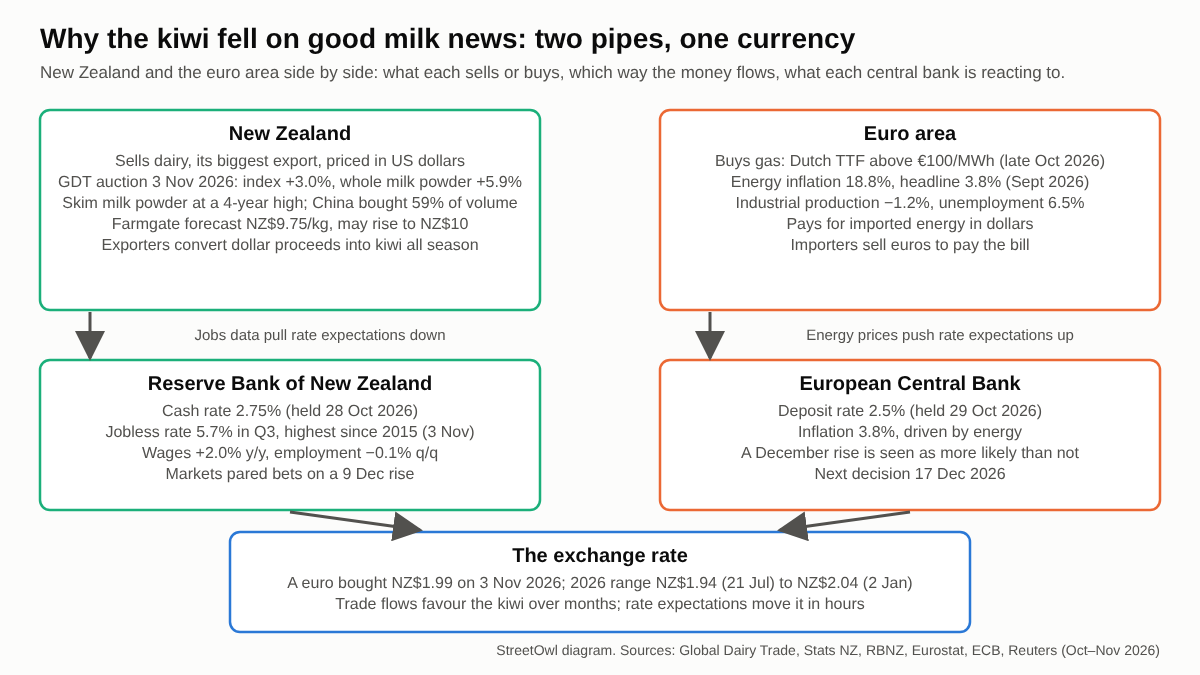
At the Global Dairy Trade auction on 3 November the price index rose 3.0 per cent, the biggest jump since February: whole milk powder up 5.9 per cent, its largest gain this year, skim milk powder up 3.1 per cent to its highest since June 2022, cheddar up 8.6 per cent, and Chinese buyers taking 59 per cent of everything sold. NZX's dairy analyst said the result "considerably exceeded" what the futures market expected, and processors may now lift the farmgate forecast to NZ$10 a kilogram of milk solids, from a midpoint of NZ$9.75. Then at 21:45 London time Statistics NZ reported unemployment at 5.7 per cent for the September quarter, the highest since 2015, against 5.5 per cent forecast; employment fell 0.1 per cent in the quarter when a 0.4 per cent rise was expected, and private-sector wage growth slowed to 2.0 per cent.
Two pipes into one currency
The milk price is a trade flow. Dairy is New Zealand's biggest export, it is sold in US dollars, and the proceeds are converted into kiwi to pay around 8,000 farmers monthly through a season that peaks in November and December. A higher payout is demand for the currency that arrives whatever the central bank does, and it arrives for a year. The jobs figure is a rate expectation: it changes what the Reserve Bank of New Zealand is likely to do on 9 December, and it changes it today. After the release the kiwi dipped to about 56 US cents, two-year swap rates fell six basis points to 3.78 per cent, and traders took back some of the chance of a rate rise. In the short run the rate pipe is louder, which is why the currency fell on a night of good milk news; over months the trade pipe is the steadier of the two.
The other side: a euro paying for gas
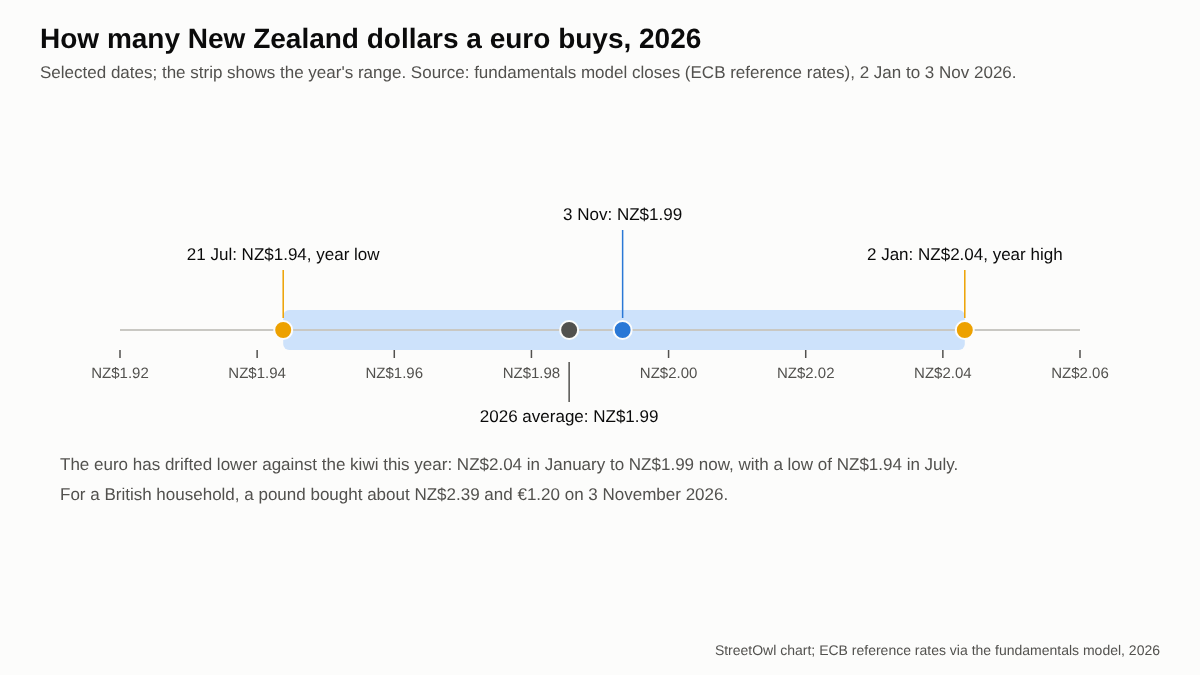
Against the euro the picture is a gas bill. The Dutch TTF benchmark closed above €100 a megawatt-hour in late October for the first time since 2022, euro-area energy inflation was 18.8 per cent in September with headline inflation at 3.8 per cent, industrial production is down 1.2 per cent and unemployment is 6.5 per cent. The European Central Bank held its deposit rate at 2.5 per cent on 29 October, and markets see a rise in December as more likely than not. A euro bought NZ$1.99 on 3 November, in a 2026 range of NZ$1.94 in July to NZ$2.04 on 2 January. The dated events that could change it are New Zealand's general election on Saturday 7 November, where the polls are tight, the next dairy auction on 18 November, the Reserve Bank's decision on 9 December and the ECB's on 17 December.
The dollar and the pound overnight
The same night, early results from the US midterm elections pointed to the Democrats taking both houses of Congress. The dollar index slipped to 101.4, the euro rose half a cent to $1.1249, sterling to $1.346 and the yen gained 0.7 per cent to 157.6 per dollar; analysts said a Democratic Congress would limit government spending for the rest of the presidential term, which means lower bond yields and a softer dollar. In Britain, the Bank of England decides at noon on Thursday 5 November, with a rise from 3.75 to 4 per cent widely expected.
What it means for a British household
For holiday money, a pound bought about NZ$2.39 and €1.20 on 3 November; the Holiday money board on StreetOwl's Travel tab shows what £100 buys in each. New Zealand's dairy matters to British shopping bills too: it is the world's largest exporter of milk powder and a big supplier of butter, so a rising auction price feeds into the cost of dairy ingredients that British food makers import, with a lag of a few months.
Sources
- eDairy News, Global Dairy Trade event 415, 3 November 2026
- investingLive, New Zealand labour market recap, 4 November 2026
- FXStreet, New Zealand unemployment, 3 November 2026
- Reuters via Freedom 96.9, dollar and the midterms, 4 November 2026
- Trading Economics, EU natural gas (TTF), November 2026
- Newstalk ZB, New Zealand election polling, 2026
This piece was researched with AI from the public sources named and written up and checked by Michael Rossi before it went up. It explains why a currency moves; it is not advice to buy or sell any currency and is not financial advice.
← Back to StreetOwl