Why the kiwi dollar is the commodity currency on the wrong side of the oil shock
New Zealand closed its only refinery in 2022, so it now buys every litre of petrol and diesel ready-made at crisis prices, so its import bill has outrun a good year for dairy, and its central bank has chosen to wait while Britain's is about to raise rates, which is why the pound buys more kiwi dollars than it did in February.
A surprise in Wellington
At one o'clock on the morning of 28 October, London time, the Reserve Bank of New Zealand held its official cash rate at 2.75 per cent. Twenty-two of the twenty-seven economists polled by Reuters had expected a rise to 3.00 per cent, and swap markets had priced it at 88 per cent. The committee split four to three. The New Zealand dollar fell as much as 1.7 per cent against the US dollar to 0.5583, and recorded its largest one-day fall against the Australian dollar since 2017. A pound, which bought NZ$2.34 at the close on 27 October, bought about NZ$2.38 afterwards; in February it bought NZ$2.24.
A one-day move on a surprise is one thing. Whether it holds depends on what is pushing on the currency underneath, and that story begins with a refinery that no longer exists.
The refinery that is not there
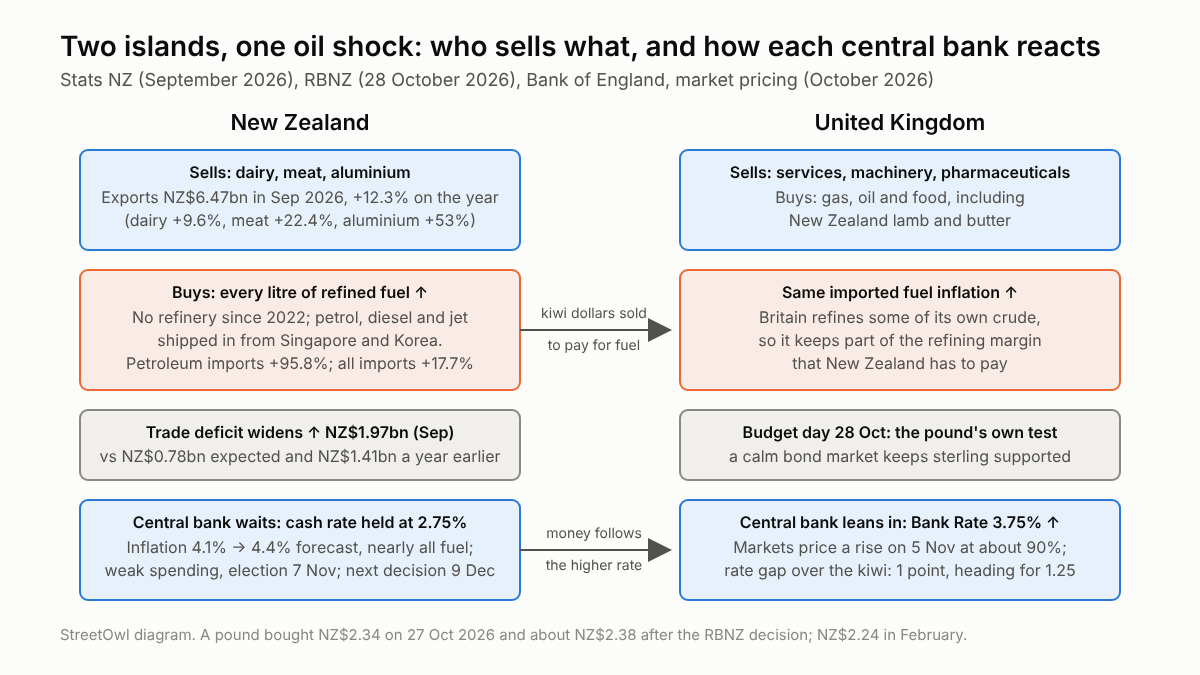
New Zealand shut Marsden Point, its only oil refinery, in 2022 and turned it into an import terminal. Before that it made about half the country's petrol, two-thirds of its diesel and most of its jet fuel. Now every litre arrives by ship from refineries in Singapore and South Korea, already refined. In this particular crisis that matters, because with Gulf refining and exports disrupted the price of finished fuels has run ahead of the price of crude oil. A country that imports crude and refines it at home keeps the refining margin; a country that imports finished fuel pays it.
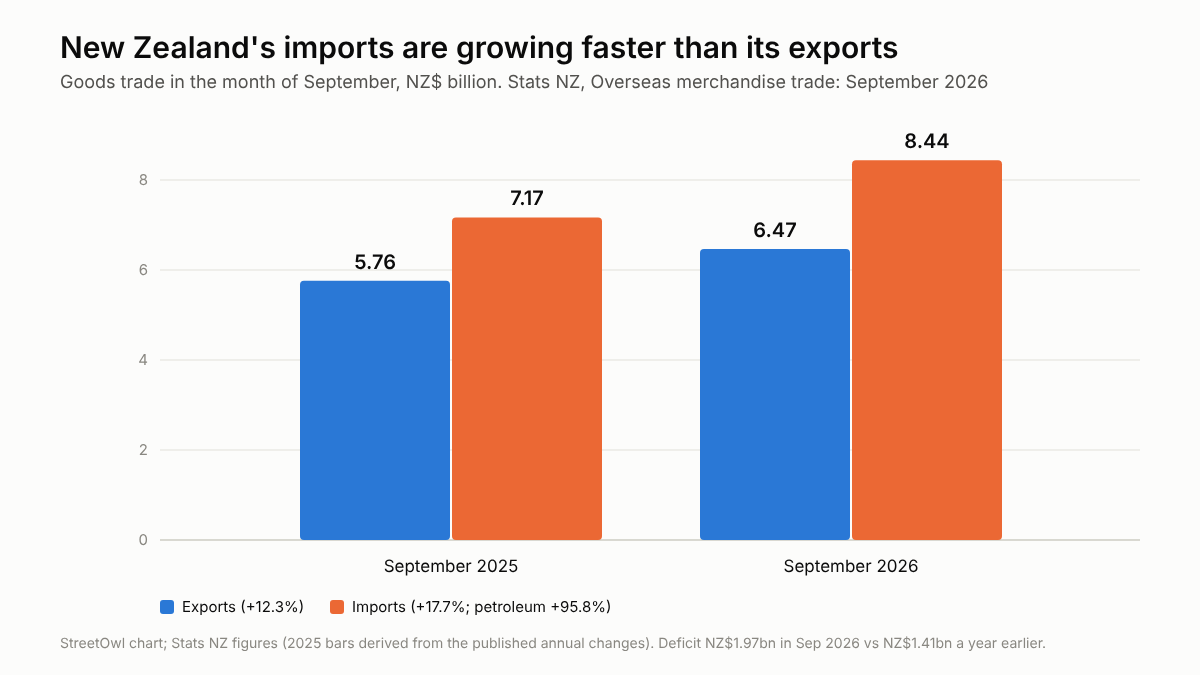
September's trade figures from Stats NZ show the consequence. Imports were NZ$8.44bn, up 17.7 per cent on a year earlier, with petroleum and petroleum products up 95.8 per cent. Exports were healthy at NZ$6.47bn, up 12.3 per cent, with dairy up 9.6 per cent, meat up 22.4 per cent and aluminium up 53 per cent, and dairy has had a good year: the Global Dairy Trade index was up 18 per cent by February. But a 10 per cent rise in milk receipts does not cover a doubling of the fuel bill. The monthly trade deficit widened to NZ$1.97bn, against NZ$0.78bn expected and NZ$1.41bn in September 2025. Every month that gap persists, New Zealand sells more of its own currency for foreign currency than it buys.
Why the central bank chose to wait
Inflation in New Zealand was 4.1 per cent in the June quarter and the Reserve Bank expects 4.4 per cent in the December quarter, almost all of it fuel. Faced with the same imported inflation as everyone else, it chose to look through it. Household spending is weak, the saving rate is an estimated 3.7 per cent against a ten-year average of 1 per cent, wage growth is subdued, and there is a general election on 7 November. Governor Anna Breman said further increases remain likely and may even be higher than the bank signalled in September, but that they depend on the data. The next decision is not until 9 December.
Britain faces the same fuel bill and is doing the opposite. Bank Rate is 3.75 per cent, and in mid-October markets put the chance of a rise on 5 November above 90 per cent, with the Bank's chief economist sceptical only of the four rises priced over the following year. So the gap between British and New Zealand interest rates, a full percentage point today, is likely to be a point and a quarter within a fortnight. Money tends to follow the higher rate, and that is what has been holding the pound up against the kiwi while the fuel deficit pulls the kiwi down.
What could change it
Delayed is not cancelled. Bank economists in Wellington still expect a rise to 3.00 per cent on 9 December, and if New Zealand's labour and pricing data run hot the kiwi could recover what it lost. The pound has its own test on 28 October, Budget day: a wobble in the gilt market would do more damage to sterling than anything in Wellington. The election on 7 November could loosen fiscal policy, or simply remove uncertainty. A settlement in the Gulf that brought oil down towards $80 would cut New Zealand's fuel bill at a stroke. And the fortnightly dairy auction matters: whole milk powder was $3,706 a tonne in February, and a sustained climb in dairy prices would rebuild the export side of the ledger.
What it means for a British household
For holiday money, £100 bought about NZ$238 after the decision, against NZ$224 in February and NZ$234 the day before; StreetOwl's Holiday money board on the Travel tab shows what £100 buys each day. For the shopping basket, New Zealand lamb and butter are staples of what Britain imports, and a weaker kiwi makes them a little cheaper in sterling at the wholesale stage, with the usual lag before it reaches a supermarket shelf.
Sources
- Westpac, First impressions: RBNZ Monetary Policy Review October 2026, 28 October 2026
- Reuters via Global Banking & Finance, Dollar steady before Fed decision, kiwi drops after RBNZ holds, 28 October 2026
- Pound Sterling Live, New Zealand dollar needs hawkish RBNZ guidance, 27 October 2026
- Pound Sterling Live, GBP/NZD exchange rate data, 27 October 2026
- Stats NZ via Trading Economics, New Zealand balance of trade, September 2026 (released 18 October 2026)
- Transporting New Zealand, Energy security: was closing Marsden Point a mistake?, March 2026
- Rural News, Global dairy prices surge with GDT index up 18% in 2026, 24 February 2026
- Crypto Briefing, Bank of England's Pill sceptical of markets' four rate hike expectations, 14 October 2026
- Macrosetup, RBNZ rate decision dates 2026 and 2027
- Bloomberg, New Zealand dollar slides most versus Aussie since 2017 on RBNZ, 28 October 2026
This piece was researched with AI from the public sources named and written up and checked by Michael Rossi before it went up. It explains why a currency moves; it is not advice to buy or sell any currency and is not financial advice.
← Back to StreetOwl