Why the kiwi dollar and the euro are pulling apart this winter
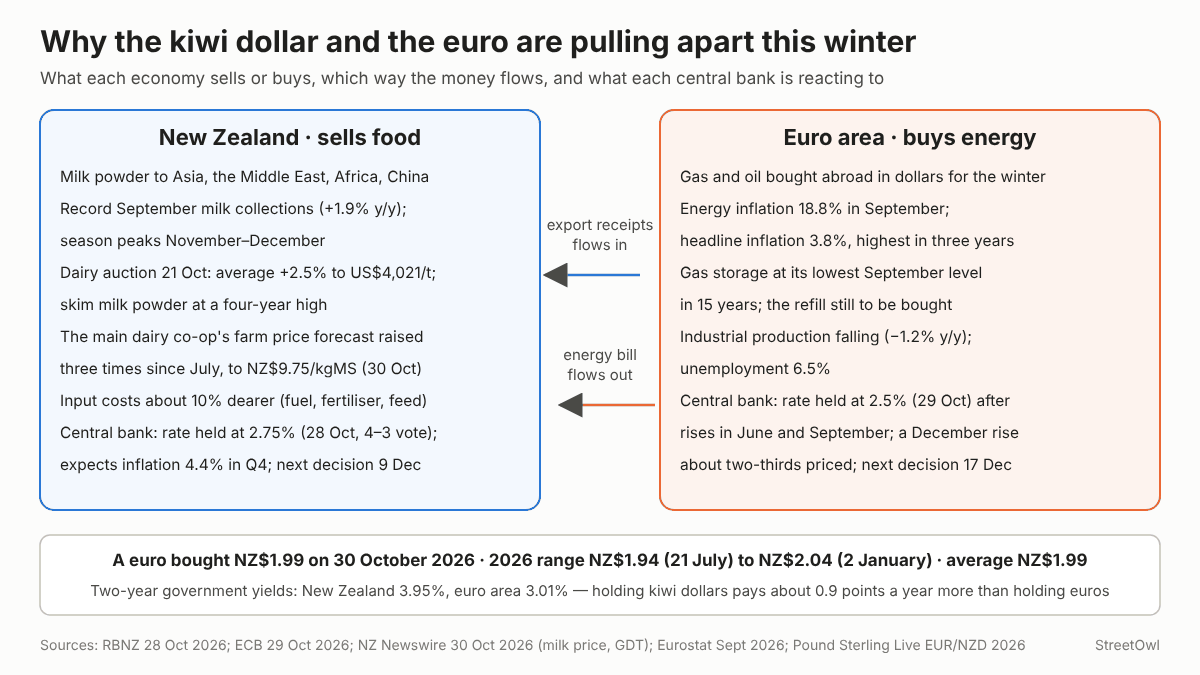
New Zealand's milk season peaks just as the price of milk powder rises, so export receipts flow in, while the euro area buys its winter gas and oil at crisis prices, so money flows out, and the two central banks are reacting to opposite problems.
Who sells what to whom
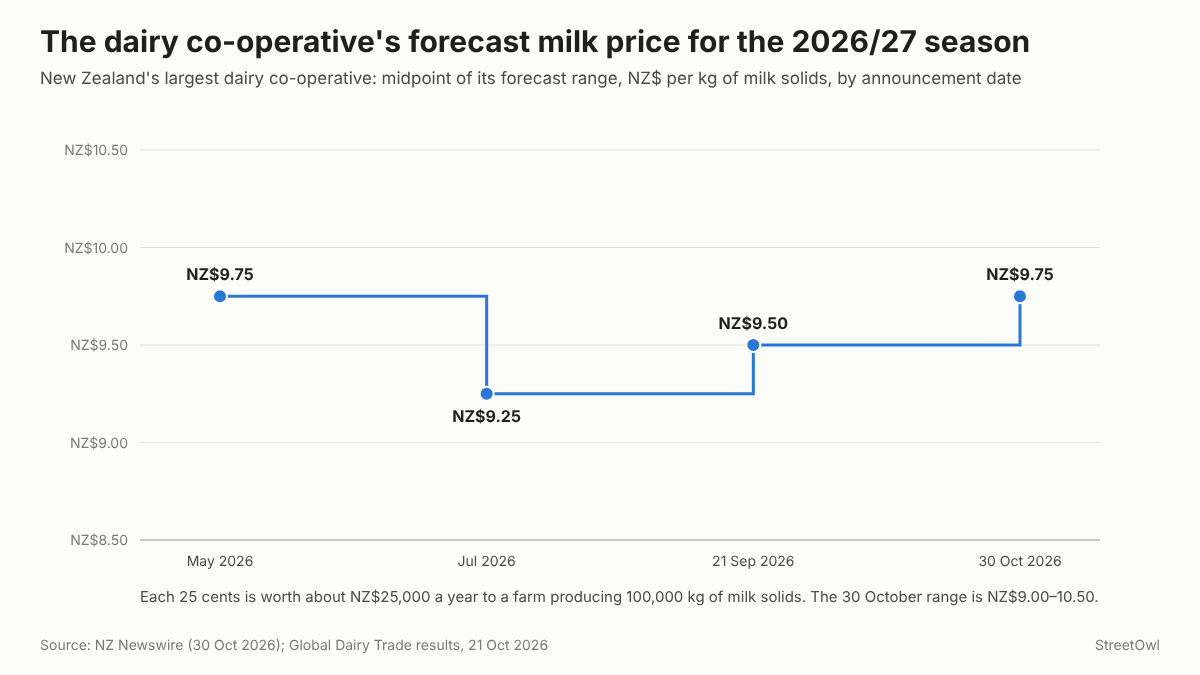
New Zealand's largest export is dairy, and its selling season is now. Milk collections hit a record for September, up 1.9% on a year earlier, and they run highest through November and December. The product is also getting dearer. At the Global Dairy Trade auction on 21 October the average price rose 2.5% to US$4,021 a tonne; whole milk powder rose 4.4% to US$3,760 and skim milk powder 3.4% to US$3,975, its highest on the platform in four years. The buyers are in Southeast Asia, the Middle East, Africa and China, restocking food after a year of disrupted shipping. New Zealand's largest dairy co-operative has raised its forecast farm milk price three times since July, to a midpoint of NZ$9.75 per kilogram of milk solids on 30 October, and has sold more of the season's milk in advance than usual. Farm costs are about 10% higher because fuel, fertiliser and feed all travel through the Strait of Hormuz, which is real but small next to the price of the milk.
The euro area's season is the one in which it buys. Energy inflation ran at 18.8% in September and headline inflation at 3.8%, the highest in more than three years. European gas storage was at its lowest September level in 15 years, and the refill still has to be bought. The European Central Bank said on 29 October that energy has become dearer across oil, petrol, fuel, gas and refining margins. That bill is paid in dollars by an economy whose industrial production is falling, down 1.2% on a year earlier, and whose unemployment rate is 6.5%.
What each central bank is reacting to
The Reserve Bank of New Zealand held its cash rate at 2.75% on 28 October by four votes to three, a decision that surprised all five of the country's big banks, which had expected a rise. That is why the kiwi has been weak: its trade-weighted value is down about 3% since early September. But the detail points the other way. Inflation in the September quarter came in at 3.7%, below the Bank's forecast, because fuel prices fed through less than expected; the Bank still expects 4.4% in the December quarter and says tighter policy is likely to be needed, with its next decision on 9 December.
The ECB also held, at 2.5%, after raising rates in June and September, and said a rise was debated. Markets price about a two-in-three chance of a further rise in December; one large bank expects that to be the last. So both currencies have one rise in prospect, but the kiwi pays more to hold: two-year government yields are 3.95% in New Zealand against 3.01% in the euro area.
The chart below shows how the dairy co-operative's forecast for the season has moved since May: cut in July as global supply ran ahead of demand, then raised in September and again in October as milk powder buyers returned.
The rate, and the dates that could change it
A euro bought NZ$1.99 on 30 October 2026. This year the rate has ranged from NZ$1.94 on 21 July to NZ$2.04 on 2 January, and its average for the year is NZ$1.99, so the pair sits in the middle of its range rather than at an extreme.
Four dates matter over the next six weeks. New Zealand votes in a general election on Saturday 7 November, and the polls are close, with the two main blocs swapping the lead from poll to poll; a change of government tends to unsettle a currency for a few days. The Global Dairy Trade auctions on 4 and 18 November will show whether the milk powder price holds. The Reserve Bank of New Zealand decides on 9 December and the ECB on 17 December. A settlement in the Gulf would help both economies, since each imports fuel, so it is not a factor that pushes the pair one way.
What it means for a British household
For holiday money, £100 bought about €120 and about NZ$237 on Friday, and the Holiday money board on StreetOwl's Travel tab shows what £100 buys in each currency day by day. A weaker euro makes a eurozone break cheaper for Britons; a stronger kiwi makes New Zealand dearer. For the shopping basket, Britain buys lamb, butter and wine from New Zealand, so a firmer kiwi feeds slowly into those prices, while the euro area's gas bill is also Britain's gas bill, since both buy in the same market: the energy price cap is forecast to rise 16% in January.
Sources
- investingLive, RBNZ holds OCR at 2.75% in surprise 4-3 vote, 28 October 2026
- Briefs, ECB holds rates at 2.5% as energy costs rise, 29 October 2026
- NZ Newswire, milk price forecast lifted to $9.75, 30 October 2026
- NZ Newswire, OCR tracker, October 2026
- Cornwall Insight, 16% price cap rise forecast in January, 30 September 2026
- Pound Sterling Live, EUR/NZD history 2026
- Wikipedia, opinion polling for the 2026 New Zealand general election
This piece was researched with AI from the public sources named and written up and checked by Michael Rossi before it went up. It explains why a currency moves; it is not advice to buy or sell any currency and is not financial advice.
← Back to StreetOwl