Why the gold price now moves the Australian dollar, and what that means for a pound
Gold has become Australia's second-biggest export, so when the gold price falls Australia earns fewer dollars, fewer dollars are swapped into Australian ones, and the Australian dollar slips against the pound even though both central banks are raising rates.
An iron-ore currency becomes a gold currency
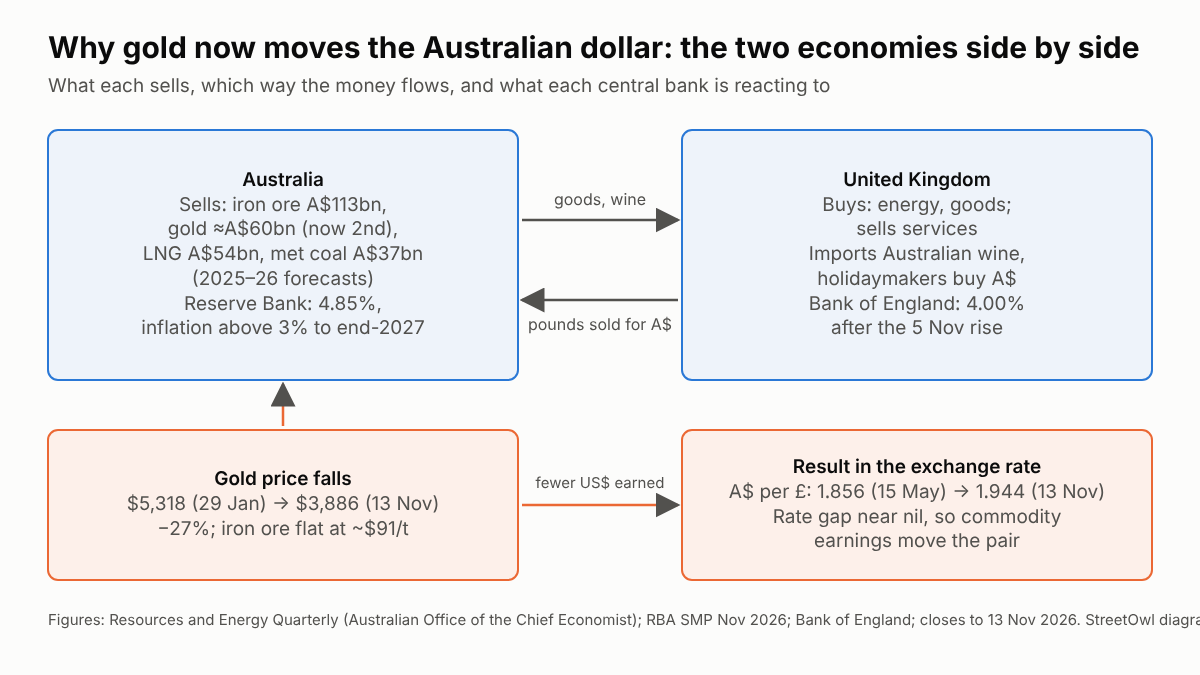
For thirty years the Australian dollar rose and fell with iron ore and coal. That is changing. The Australian government's Resources and Energy Quarterly puts gold exports at about A$60bn in 2025-26, up A$12bn in a year and roughly three times the level of seven years ago, which lifts gold past liquefied natural gas (A$54bn) and metallurgical coal (A$37bn) to second place behind iron ore (A$113bn). Mined output is forecast to rise from 293 tonnes to 369 tonnes by 2026-27.
Every ounce is sold for US dollars, and the wages, royalties and dividends come home in Australian dollars. So the gold price now feeds the currency the way the iron-ore price always has.
Two prices going opposite ways
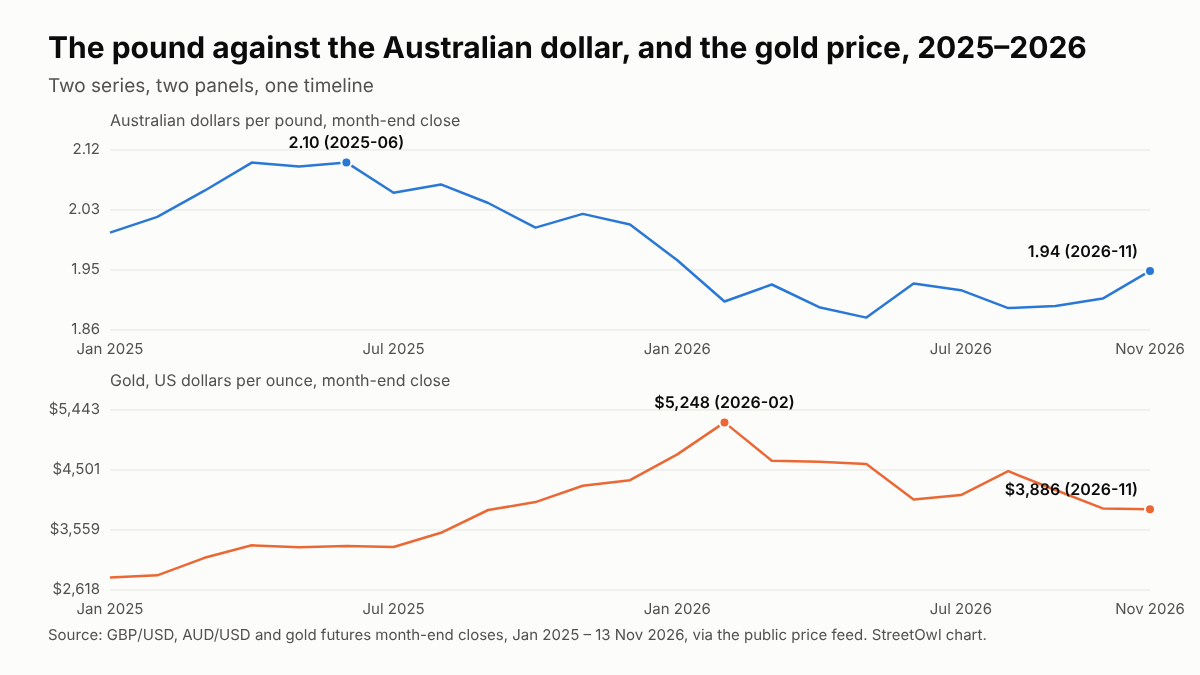
This year the two have parted. Iron ore sits at about $91 a tonne, flat on the month and down from $111 in May. Gold has fallen from $5,318 an ounce on 29 January to $3,886 on Friday 13 November, a 2026 low, 27% below the peak and 7% down in twenty trading days. Gas has gone the other way: Australia's LNG exports were A$8.1bn in September and the trade surplus A$2.8bn, a seven-month high, because the Gulf war has kept Asian buyers paying up.
Net it out and the commodity basket behind the Australian dollar is worth about 6% less than it was twenty trading days ago, with gold doing most of the damage.
Why interest rates cannot rescue it
The Reserve Bank of Australia raised its cash rate to 4.85% on 2 November, an 18-year high and its fifth rise this year. It expects inflation of 4.5% in December and above 3% until the end of 2027, growth of only 1.6% and unemployment rising to 4.7%, and it calls the currency roughly at its long-run level. The Bank of England is at 4.00% after its rise on 5 November.
That leaves the two-year interest-rate gap between the pound and the Australian dollar at almost nothing, so the interest a holder earns decides nothing. What moves the pair is the trade account: how many dollars each country earns from what it sells. The pound has gone from A$1.856 at its low on 15 May to A$1.944 on Friday, a rise of 4.7%, in a 2026 range of A$1.856 to A$2.018.
What could change it
Three dated things. Britain's October inflation figure on Wednesday 18 November: a soft number would make the Bank of England's rise look like the last one and weaken the pound before it weakened the Australian dollar. Australia's October trade figures on 3 December, which will show the gold and LNG lines side by side. And the gold price itself: back above about $4,200 the commodity basket turns positive again; below $3,800 it breaks the 2026 low.
A settlement in the Gulf cuts both the safe-haven bid for gold and the price Australia gets for its gas on the same day, so the direction of the pound against the Australian dollar on that day is not obvious.
What it means for a British household
Holiday money first: £100 bought about A$186 in mid-May and about A$194 on Friday, and A$202 at the start of the year. StreetOwl's Holiday money board on the Travel tab shows what £100 buys today. On the shelf, Australia sells Britain mainly wine, beef and lamb; a weaker Australian dollar makes those a little cheaper to import, though the duty and the retailer's margin usually swallow a 4% move.
Sources
- Reserve Bank of Australia, Statement on Monetary Policy, November 2026
- Stockhead, Gold outshines gas as precious metal props up Aussie exports (Resources and Energy Quarterly figures), October 2025
- Australian Bureau of Statistics, International Trade in Goods, September 2026
- Trading Economics, gold price news, 6 to 13 November 2026
This piece was drafted by AI from the public sources named, then read and approved by Michael Rossi before it went up. It explains why a currency moves; it is not advice to buy or sell any currency and is not financial advice.
← Back to StreetOwl