Why the gold price can fall by a quarter and the mines keep spending more than ever
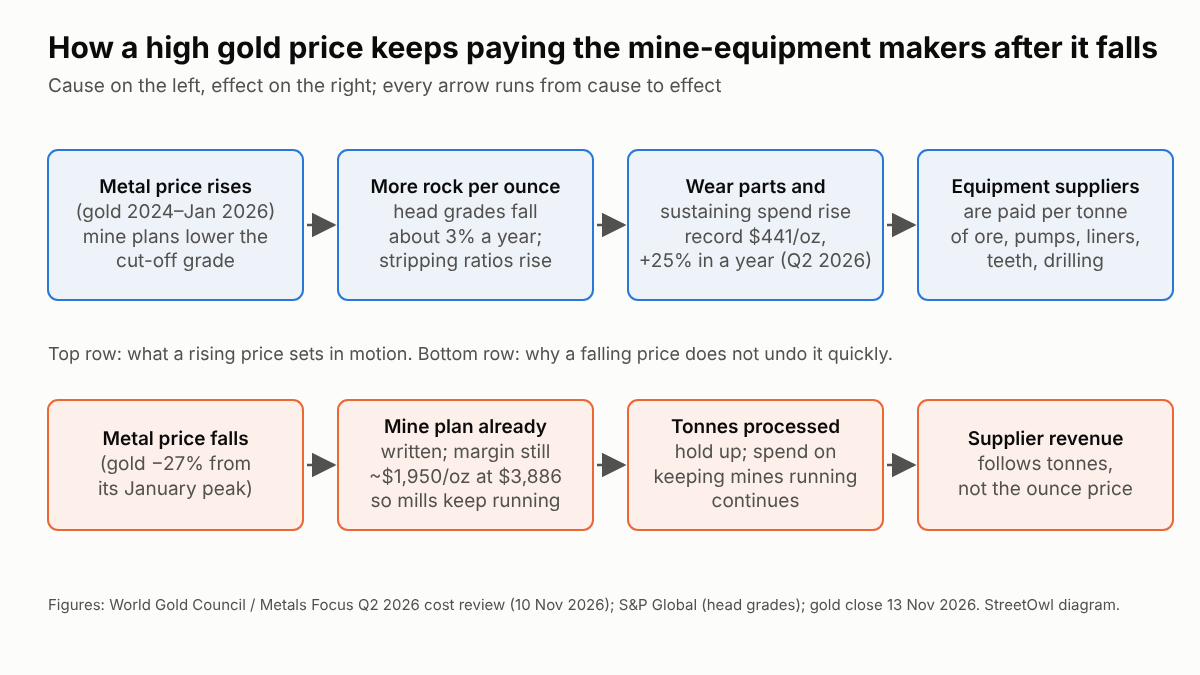
A high gold price makes mines dig leaner rock, leaner rock means more tonnes per ounce, and more tonnes means more worn-out pumps, liners and digging teeth to replace, a bill that keeps rising for the equipment makers long after the price turns down.
The price that fell
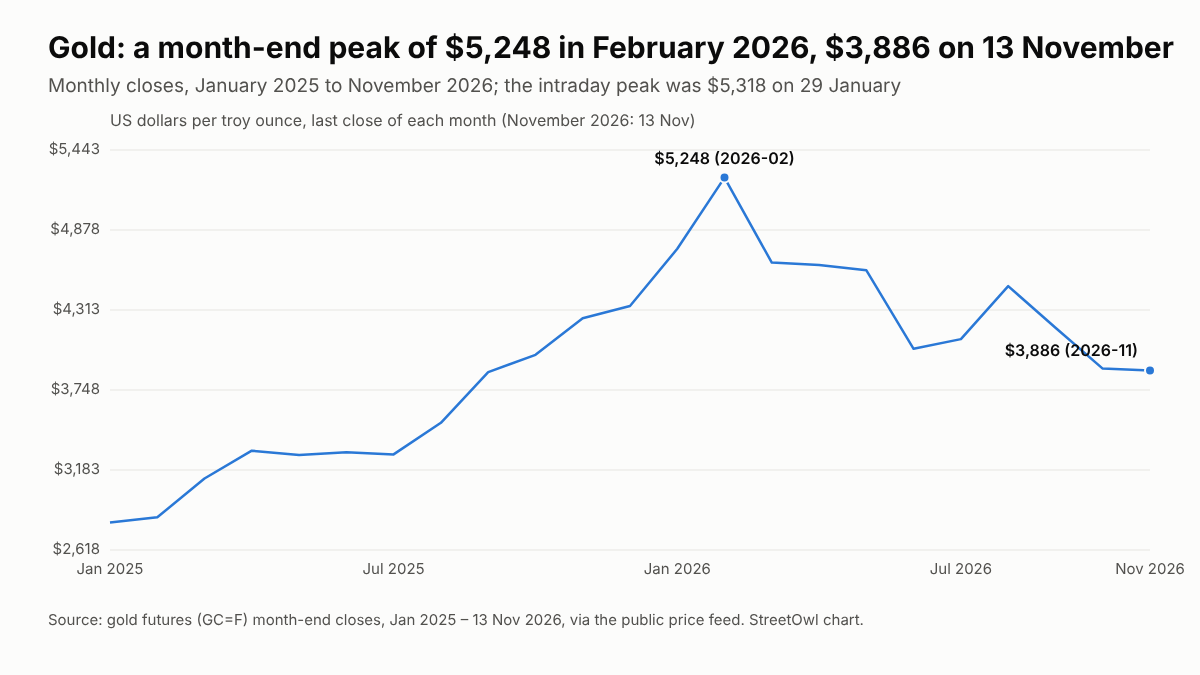
Gold closed at $3,886 an ounce on Friday 13 November, its lowest of 2026. It had peaked at $5,318 on 29 January, so it has lost 27% in ten months and 7% in the past twenty trading days. For most of the people who own gold, through a fund, a sovereign, a jeweller or a coin, that is the whole story.
For the companies that supply the mines it is not, because they are not paid in ounces. They are paid for every tonne of rock a mine moves, and that number has been going the other way.
How a mine decides what counts as ore
A gold mine is not a tap that opens wider when the price rises. Each mine has a plan built around a cut-off grade: the leanest rock that is worth putting through the mill at today's price. When the price goes up, rock that used to be waste becomes ore, so the mine moves and grinds more tonnes to produce each ounce. S&P Global's long series shows the average grade of gold ore falling 13.4% since 2010, and the amount of waste rock stripped per tonne of ore rising whenever the price is high.
The World Gold Council's review of miners' costs for the second quarter of 2026, published on 10 November with Metals Focus data, puts numbers on the latest leg. Average grades fell 3.1% year on year. The spending needed just to keep existing mines running, sustaining capital, reached a record $441 an ounce, up 25% in a year. All-in sustaining cost hit a record $1,930 an ounce, its 29th consecutive annual rise.
Why the fall does not undo it quickly
When the price falls back, the plan is already written, the trucks are already bought and the mill still has to be fed. More to the point, at $3,886 the typical mine still clears about $1,950 an ounce over its all-in cost, having received an average $4,512 an ounce in the second quarter. Nobody slows a mill at that margin. The industry's habit of deferring spending only returns when prices approach cost, which in 2013 to 2015 meant gold near $1,200 against costs near $1,000.
So the miners' sustaining spend keeps flowing, and that spend is somebody's revenue: the makers of slurry pumps, mill liners, screens and the teeth on the digger bucket, which grind themselves away processing ore and are replaced by the tonne; and the drilling and earth-moving contractors paid per metre and per tonne. The makers of that kit reported rising orders in the quarter to September, with gold and copper customers leading and lower ore grades named as a driver of demand, while the gold price was falling.
Who gains and who pays
The gainers are the suppliers of wear parts and mining services, whose revenue follows tonnes rather than the ounce price, and the workers at the mines, since a mine running flat out at a $1,950 margin is not cutting shifts. The payers are the miners' shareholders, whose margin is being squeezed from both sides at once: a lower price and a record cost of keeping the gates open. Gold's own buyers pay nothing extra; the metal is cheaper than it was.
The chain breaks only if the price falls far enough to reach cost, or if copper, which is a bigger business for the same equipment makers than gold, turns down with China. Neither has happened yet.
Sources
- World Gold Council / Metals Focus, Gold miners remain resilient despite tighter margins in Q2'26, 10 November 2026
- S&P Global Market Intelligence, Gold mine stripping ratios rise on high prices, grades continue declining, 12 December 2023
- Trading Economics, gold price news, 6 to 13 November 2026
- TradingView / Reuters, Q3 trading update of a London-listed mining-equipment maker, 4 November 2026
This piece was drafted by AI from the public sources named, then read and approved by Michael Rossi before it went up. It describes how one thing moves another; it names no investment and is not financial advice.
← Back to StreetOwl