Why the euro keeps losing to the pound
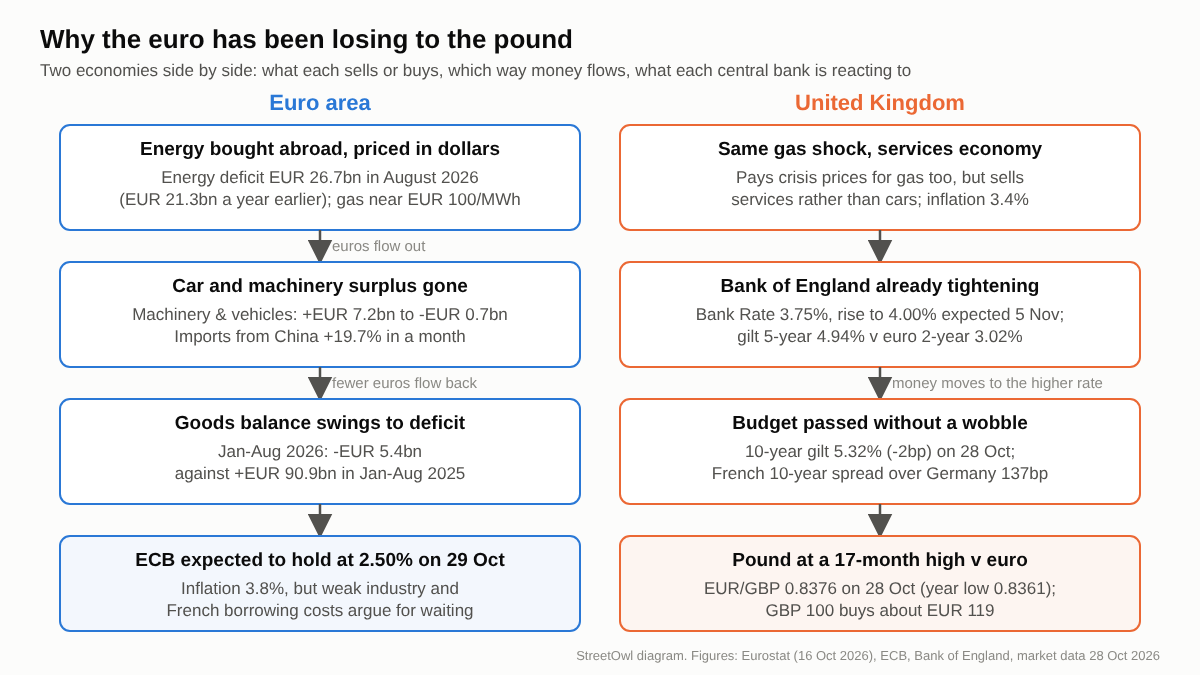
Europe pays dollars for its energy and no longer earns a surplus on its cars, so fewer euros flow back than flow out, and with the ECB waiting while the Bank of England raises rates, money moves towards sterling.
A surplus that has gone
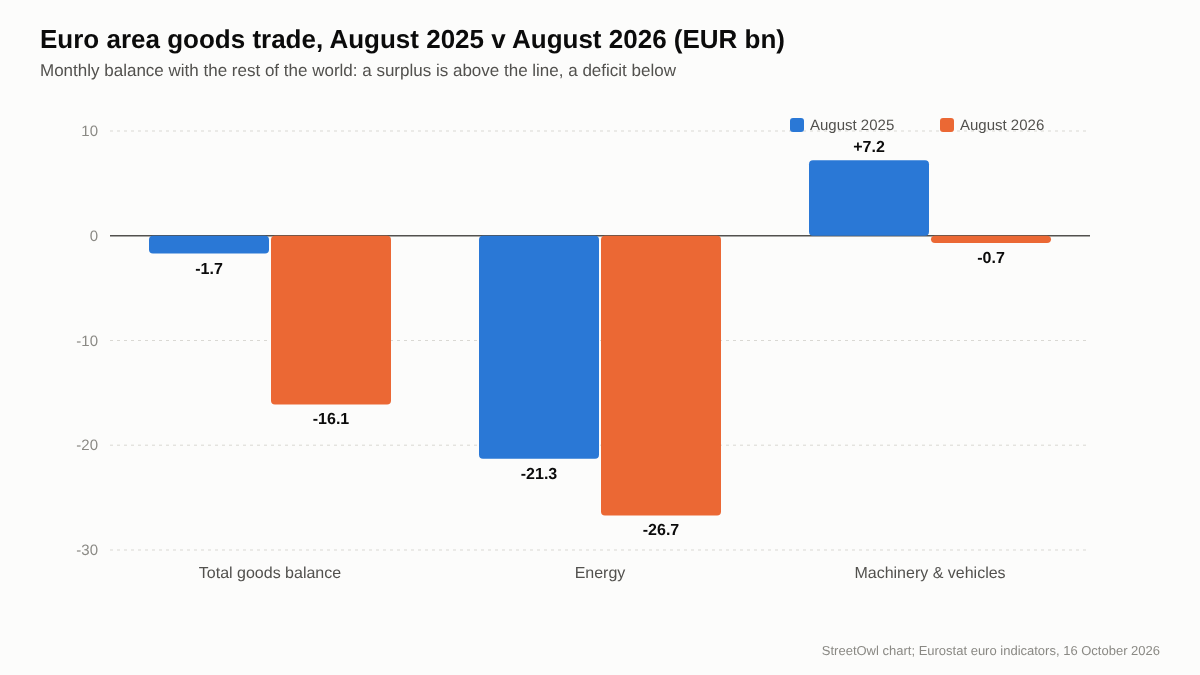
The quietest big number of the year is the euro area's trade in goods. Eurostat's release of 16 October shows an August deficit of €16.1bn, against €1.7bn a year earlier, and the balance for January to August is a €5.4bn deficit against a €90.9bn surplus in the same months of 2025. Imports rose 16.7% in the month; exports rose 9.9%.
Two lines did the damage. The energy deficit widened from €21.3bn to €26.7bn in a single month, with Dutch gas within a few euros of €100 a megawatt-hour, well above the €75 the European Central Bank had treated as its adverse case. And machinery and vehicles, the engine of the European model, went from a €7.2bn surplus to a €0.7bn deficit, as EU imports from China rose 19.7% to €53.1bn in the month.
Why a trade balance moves a currency
For twenty years Europe ran a simple machine: import energy cheaply, turn it into cars and machines, sell them abroad at a surplus. That surplus was a standing bid for the euro, because every exporter converted its dollars back into euros to pay wages and suppliers at home. Both legs have broken at once. Energy is priced in dollars at crisis levels, and China now sells Europe the cars Europe used to sell it. A deficit is a standing offer of euros instead of a bid.
Britain imports the same gas at the same price, so the energy leg hurts both. The difference is that Britain's exports are mostly services, which are not in these figures and are not competing with Chinese factories.
Two central banks, two answers
Inflation is similar on both sides of the Channel, 3.8% in the euro area in September (energy prices up 18.9% on the year) and 3.4% in Britain, but the reaction is opposite. The ECB raised its deposit rate to 2.50% in September and is expected to hold it on 29 October, with markets pricing only about 20 basis points of further tightening by the end of the year; weak industry and France's borrowing costs, where the 10-year spread over Germany reached 137 basis points, the widest since 2012, argue for waiting.
The Bank of England, at 3.75%, is widely expected to raise Bank Rate to 4.00% on 5 November: 54 of 63 economists polled by Reuters in mid-October said so. The gap is already in the bond market, with the five-year gilt yielding 4.94% against 3.02% on two-year euro-area AAA debt. Money moves towards the higher rate. The UK Budget of 28 October added nothing to worry about: the 10-year gilt yield closed two basis points lower at 5.32%, so the fiscal premium on sterling shrank on the day France's kept growing.
What could change it
Three things could turn the euro. A hawkish surprise from the ECB, since 3.8% inflation and €100 gas are not a hold-forever picture; a Gulf settlement that cuts energy prices, which helps the euro area more than Britain because its energy deficit is the larger; and a Bank of England that delivers its rise on 5 November with cautious words, since a move everyone expects can disappoint but cannot surprise.
What it means for a British household
A pound bought about €1.19 on 28 October, its best level in 17 months (EUR/GBP 0.8376, against a year low of 0.8361 the day before and 0.8725 a year ago), so £100 buys about €119 of holiday money, roughly €4 more than last autumn; StreetOwl's Holiday money board on the Travel tab shows the line. The same move trims the sterling price of what Britain buys from the euro area, which is its largest source of imports, from German cars to Italian pasta, though energy, priced in dollars, is untouched by it.
Sources
- Eurostat, euro area international trade in goods, August 2026, 16 October 2026
- Newsquawk, ECB policy announcement preview, 29 October 2026
- TradingPedia, EUR/GBP struggles near lows, 27 October 2026
- TradingPedia, euro nears lows v pound on French political risks, 12 October 2026
- Reuters poll via Global Banking & Finance, Bank of England expected to raise rates in November, 15 October 2026
- AskTraders, Budget market reaction, 28 October 2026
This piece was researched with AI from the public sources named and written up and checked by Michael Rossi before it went up. It explains why a currency moves; it is not advice to buy or sell any currency and is not financial advice.
← Back to StreetOwl