Why the euro keeps losing to the Australian dollar as winter arrives
Europe must buy gas it cannot produce and Australia sells gas it cannot use, so money leaves one and enters the other, and the two central banks are raising rates for opposite reasons.
One price, two economies
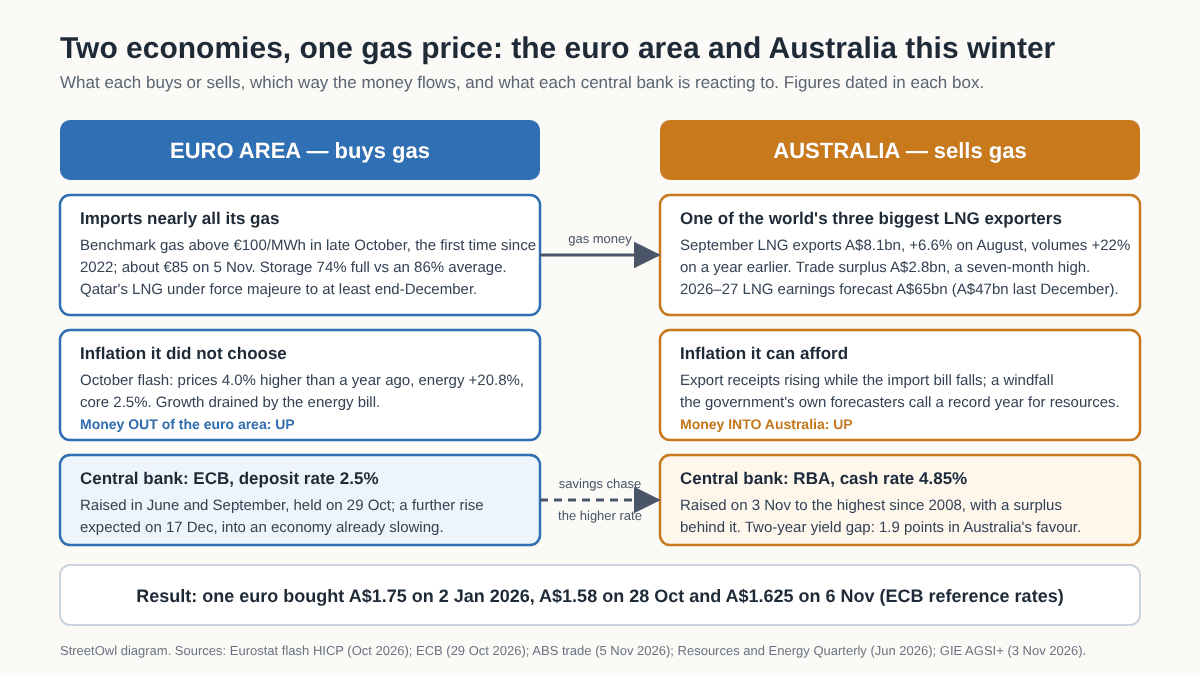
The euro area imports nearly all of its gas. Australia is one of the three biggest sellers of liquefied natural gas in the world. Since the Gulf war began in February, that single fact has been running the exchange rate between the two. The European benchmark gas price closed above €100 a megawatt-hour in late October for the first time since 2022, and European storage was 74% full on 3 November against a five-year average of about 86%. Qatar, which supplied a large slice of Europe's LNG before the war, has extended force majeure on deliveries to at least the end of December.
Gas fell about 16% to around €85 on 5 November on hopes of an American deal with Iran, but Gulf shipments have lagged the recovery in oil, and the International Energy Agency expects the shortage to last into 2027.
Australia's cheque
At the other end of the pipe, Australia's trade surplus jumped to A$2.8bn in September, a seven-month high. Its LNG exports were worth A$8.1bn in the month, up 6.6% on August, with volumes 22% higher than a year earlier. The Australian government's own forecasters now expect LNG earnings of A$65bn in the 2026–27 financial year, up from the A$47bn they predicted last December, inside a record A$416bn of resource exports.
Two central banks, two reasons
Money leaves the euro area to pay for gas and enters Australia for selling it. The transmission to the exchange rate runs through the central banks. In the euro area, energy prices are 20.8% higher than a year ago and overall inflation reached 4.0% in October, the highest in three years, with core inflation at 2.5%. The European Central Bank, whose deposit rate is 2.5% after rises in June and September and a pause on 29 October, is widely expected to raise again on 17 December, into an economy whose growth the energy bill is draining.
Australia's inflation is home-grown. The Reserve Bank of Australia raised its cash rate to 4.85% on 3 November, the highest since 2008, with a trade surplus and an export windfall behind it. One currency is defending itself against a bill; the other is tightening on a cheque. Two-year government bond yields are about 1.9 percentage points higher in Australia than in the euro area, which is why savings tend to flow from one to the other.
What the rate has done
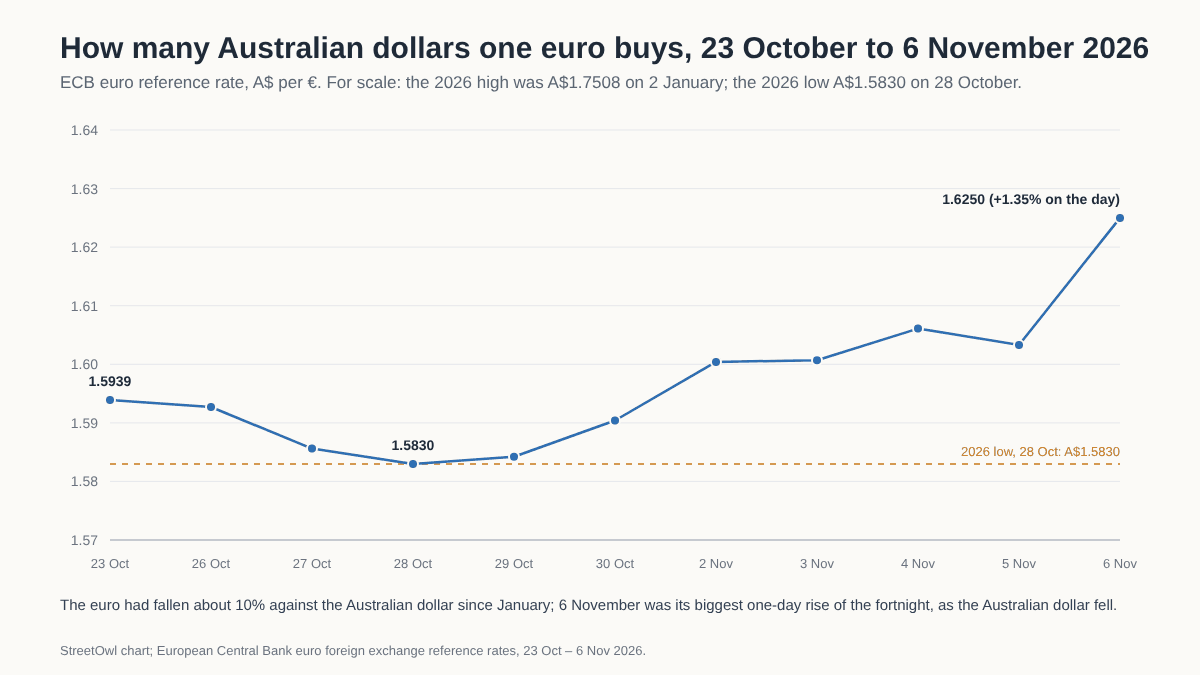
One euro bought A$1.75 on 2 January 2026 and A$1.58 on 28 October, the low of the year, a fall of about 10%. On Friday 6 November it bought A$1.625, up 1.35% on the day, as the Australian dollar fell alongside world shares and the Reserve Bank's tone softened. The Australian dollar tends to fall when investors are nervous, whatever gas is doing.
What could change it
Three dated things. A signed deal between Washington and Tehran that reopens the Strait of Hormuz would bring Qatar's gas back and cut Europe's bill faster than Australia's receipts fall, because Australian LNG contracts follow the oil price with a lag of about a quarter. The ECB's decision on 17 December matters for the euro: one rise described as the last is different from two more. And Australia's next trade figures, due on 3 December, will show whether the September cheque was a peak.
What it means for a British household
A pound bought about €1.20 and about A$1.94 on 6 November; the Holiday money board on StreetOwl's Travel tab shows what £100 buys in each. The same gas price sits behind British bills: Ofgem's January price cap, due by 25 November, is being set against the European gas market described above, because Britain imports gas on the same terms as its neighbours.
Sources
- Trading and Investment News, 5 November 2026
- GMK Center on the Eurostat flash estimate, 5 November 2026
- investingLive on the ECB decision, 29 October 2026
- Australian Bureau of Statistics, International Trade in Goods, September 2026, 5 November 2026
- Westpac IQ, 5 November 2026
- The Point, on the Resources and Energy Quarterly, 6 July 2026
- ECB euro reference rates via globalmacro.expert, 6 November 2026
This piece was researched with AI from the public sources named and written up and checked by Michael Rossi before it went up. It explains why a currency moves; it is not advice to buy or sell any currency and is not financial advice.
← Back to StreetOwl