Why the energy supplier's margin rises with your January bill
Wholesale gas has tripled since January, so the price cap for January to March 2027 is forecast to jump by 16 to 27 per cent, and because the supplier's allowed margin inside the cap is a fixed sum plus 1.41 per cent of everything else, the permitted profit per customer rises with the bill.
A formula, not a ceiling
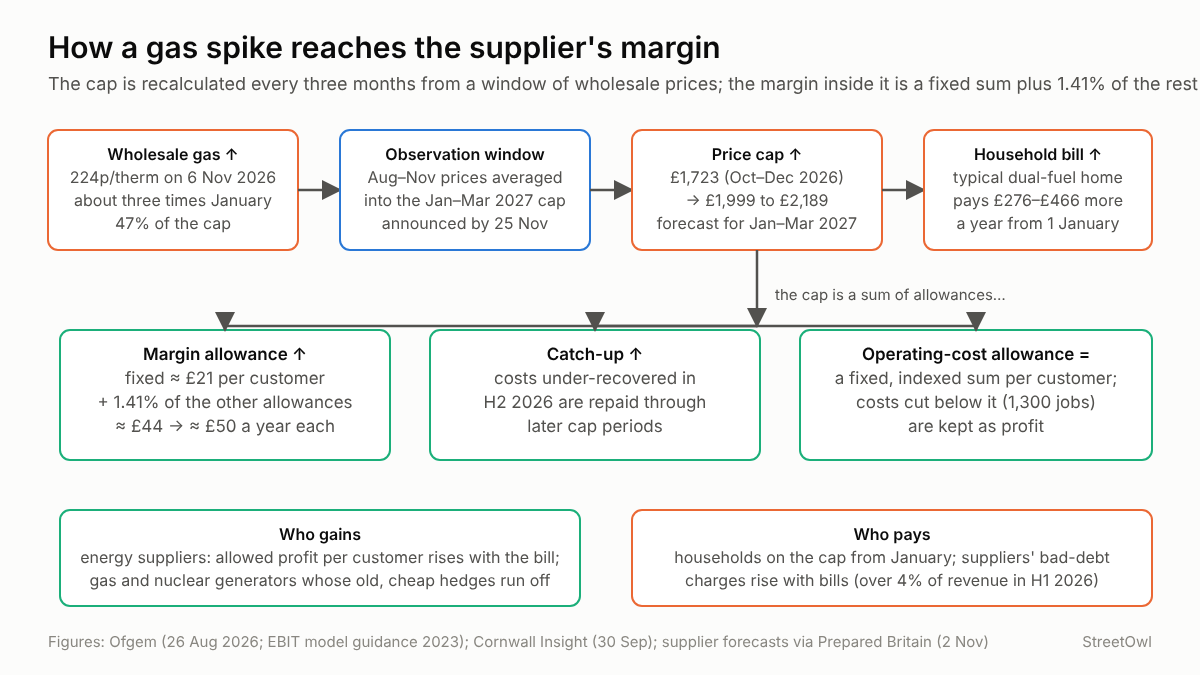
The energy price cap is usually described as a limit on what suppliers may charge. It is more exact to call it a recipe. Every three months Ofgem adds up what it costs to supply a typical home: the wholesale gas and electricity, bought over an observation window of about three months before the cap period; the network charges; policy costs; an allowance for the supplier's operating costs; and an allowance for its profit. The sum is the cap. For 1 October to 31 December 2026 it is £1,723 a year for a typical dual-fuel household paying by direct debit, and wholesale costs were 47 per cent of it.
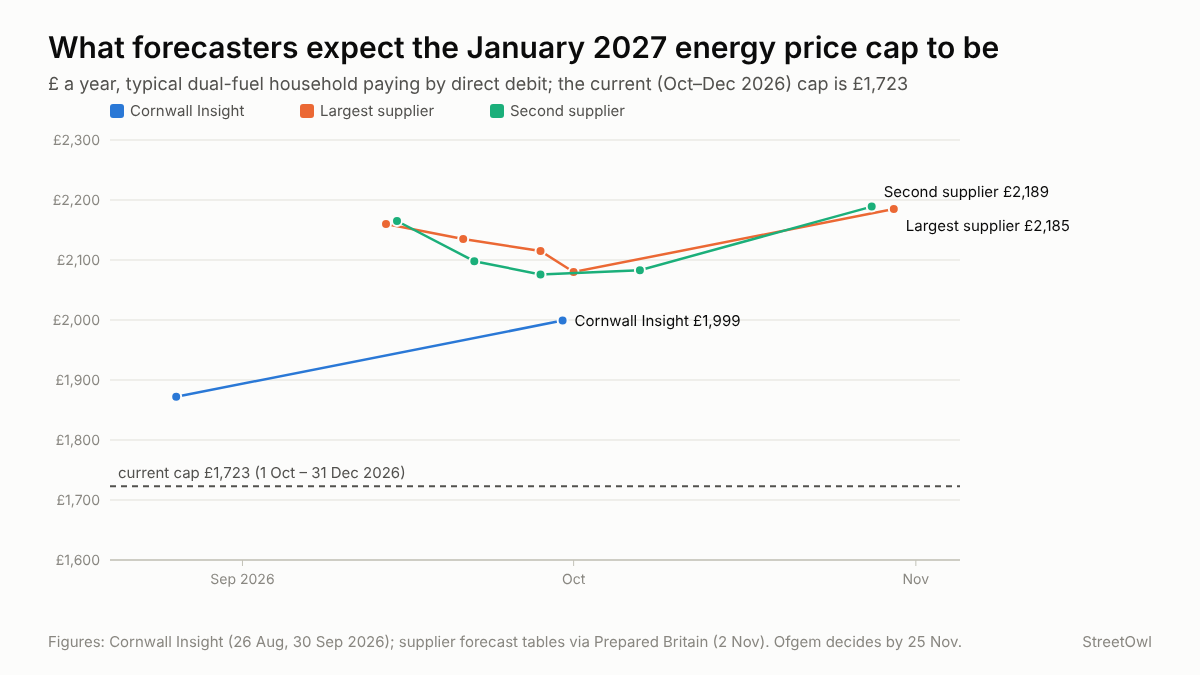
The next figure, for 1 January to 31 March 2027, must be published by 25 November, and the window that sets it has almost closed. Wholesale gas on the British market was 224p a therm on 6 November, roughly three times its level in January, after the conflict in the Gulf cut the flow of Qatari gas and left European storage at about 74 per cent against a five-year average near 90. Cornwall Insight forecast £1,999 on 30 September, a rise of 16 per cent and the largest since January 2023. The suppliers' own tables, which use later prices, said between £2,183 and £2,189 in their late-October updates, rises of around 27 per cent.
The margin is a slice, and the slice grows
Inside the recipe sits the profit allowance, called EBIT. Since October 2023 it has had two parts: a fixed sum per customer, £19.20 a year when it was set and uprated with inflation since, plus 1.41 per cent of all the other allowances in the cap. Ofgem designed it that way so that the allowance would rise when wholesale costs rise, because a supplier buying gas at three times the price has to post three times the collateral with its counterparties.
The consequence is mechanical. At a cap of £1,723 the allowance works out at roughly £44 a year per dual-fuel customer; at £2,185 it is about £50. Nobody decides to raise the supplier's permitted profit in January. The formula does it, on the same day it raises the bill. Across the 22 million households on the cap, that is a few pence in every pound of the increase set aside for the supplier before any gas is bought.
Two further parts of the recipe move the same way. Suppliers buy their gas ahead to match the window, so when the market rises after the window closes, as it did in September, they sell for a quarter at a loss and the rules let them recover that shortfall in later cap periods. The second half of 2026 is expected to be such a quarter, so part of what households pay from January is a repayment. And the operating-cost allowance is a fixed, indexed sum per customer: a supplier that cuts its costs below it, as the largest is doing with 1,300 job cuts, keeps the difference.
The bigger machine is in the power station
The quieter effect of a gas spike is on the generators that do not burn gas. Britain's electricity price is set, most hours, by the gas plant that is last to run, so when gas triples the price paid to a nuclear station triples with it, though the station's costs do not move. Generators sell much of their output a year or two ahead at the prices of the time: one owner of a share of the nuclear fleet has sold 4.1 terawatt-hours of 2027 output at £73 a megawatt-hour, while the forward price for the first quarter of 2027 was £180 on 6 November. The output not yet sold earns the new price. A levy takes 55 per cent of generators' receipts above a benchmark that began at £75 and rises with inflation, so the Treasury, not the generator, keeps most of the excess, but the remainder is still more than double the hedged price.
Gas storage works the same way. A site that buys gas in summer and sells it in winter is paid the gap between the two prices, and the gap widened this year: Britain's largest storage site swung from a loss of £26 million in the first half of 2025 to a profit of £57 million in the first half of 2026. Its operating consent ends in April 2027, and its owner has said it will not seek an extension without a long-term regulated framework, which the government has not yet offered.
Who gains, who pays
The gainers are energy suppliers, whose allowed profit per customer rises with the bill and who recover last autumn's shortfall through this winter's cap, and the owners of nuclear, hydro and storage whose old, cheap contracts are running off into a market priced by gas. The payers are the 22 million households on the cap, who face £276 to £466 a year more from January on the forecasts above, and, less visibly, the suppliers themselves on the other side of the ledger: the largest reported a bad-debt charge of £216 million for the first half of 2026, more than 4 per cent of its residential revenue, and a higher cap means more of it.
What would change the arithmetic is the gas price itself. European gas fell more than 15 per cent in the first week of November on talk of a settlement in the Gulf. The January cap is already largely set by the window that has closed, but the April cap, and the value of every unsold megawatt-hour, would follow the market down.
Sources
- Ofgem, Energy price cap will rise by 4% from October 2026, 26 August 2026
- Ofgem, Overview model guidance (EBIT allowance methodology), June 2023
- Ofgem, Energy price cap letter for 1 October 2023 (cost breakdown), August 2023
- Cornwall Insight, 16% price cap rise forecast in January, 30 September 2026
- Prepared Britain, January 2027 price cap: the predictions, checked, 2 November 2026
- Interim results of the largest UK energy supplier's parent company (RNS), 23 July 2026
- Prestige Business Solutions, Energy market report, 6 November 2026
- Johnston Carmichael, Electricity Generator Levy to increase to 55% from 1 July 2026
- ADVFN, European natural gas prices fall more than 15% in worst weekly decline since early 2025, 6 November 2026
This piece was researched with AI from the public sources named and written up and checked by Michael Rossi before it went up. It describes how one thing moves another; it names no investment and is not financial advice.
← Back to StreetOwl