Why the dollar stopped rising while the Fed is still raising rates
A rate rise that everyone expects is already in the price, so the dollar climbed while the December rise became certain and stalled once there was nothing left to add.
What happened to the pound against the dollar
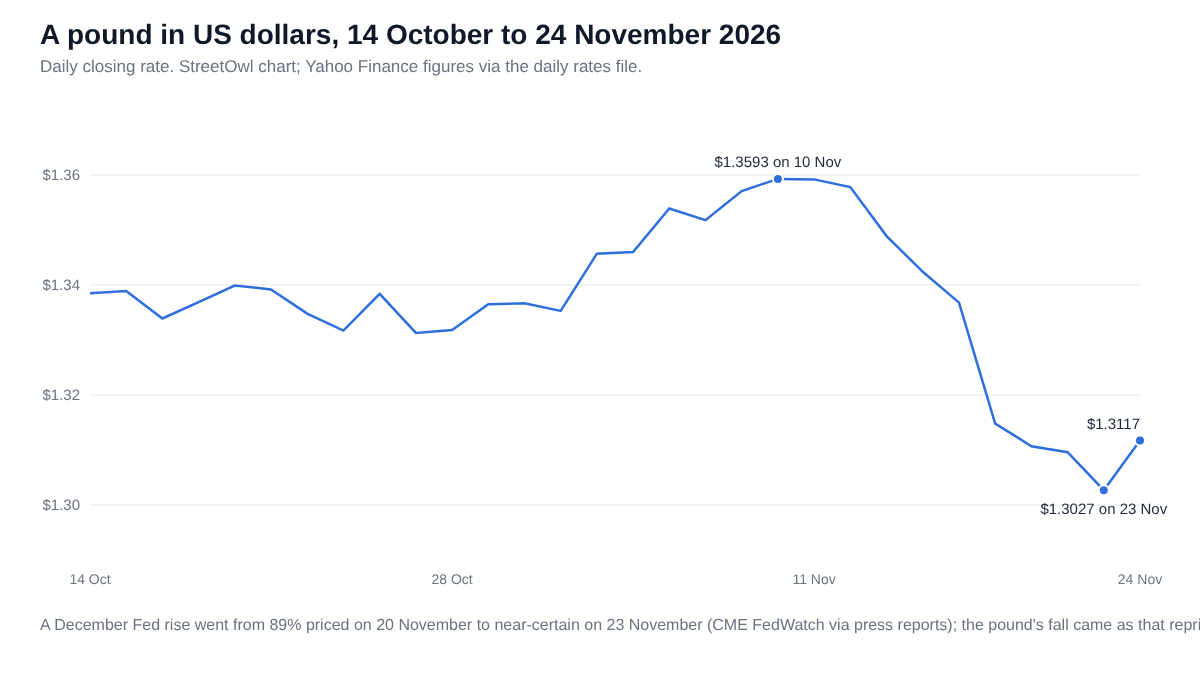
A pound bought $1.36 on 10 November 2026 and $1.30 on 23 November, a fall of over 4% in a fortnight, before edging back to $1.31 on 24 November (Yahoo Finance, via the daily rates file). Over the same fortnight the probability that the US Federal Reserve raises its rate in December, as traded in interest-rate futures, went from likely to near-certain: 89% on Friday 20 November and close to 100% after the New York Fed president said on Monday there was still work to do to bring inflation back to 2% (press reports, 24 November).
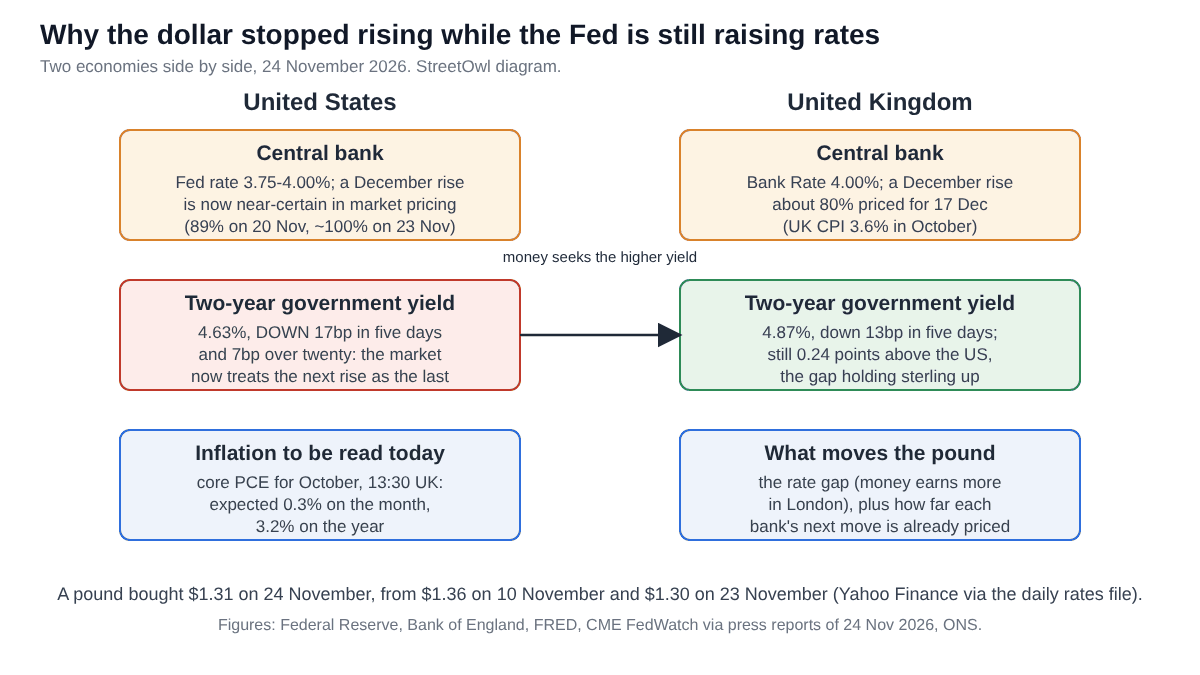
The Fed's rate is 3.75% to 4.00% and US inflation is running above 4%. The Bank of England's rate is 4.00% with UK inflation at 3.6% in October, and a rise on 17 December is about 80% priced. Both banks are tightening; the difference is how much of each move the market has already paid for.
Why a certain rate rise cannot lift a currency
A currency moves on changes in expectations, not on the rate itself. When traders think a rise is 80% likely, the exchange rate already reflects most of it. As the odds climb to 100% the currency collects the remainder, which is what the dollar did between 10 and 23 November. Once certainty is reached, the next piece of news can only be no rise, or the last rise, and both are bad for the dollar.
The bond market is already pricing the second of those. The US two-year Treasury yield, the market's best guess of where the Fed's rate will average over the next two years, fell about 17 basis points in five days to around 4.63-4.68% on 23 and 24 November even as the December rise became certain. A two-year yield falling while the central bank talks tough is the market saying this rise is the last, and on Tuesday the US Treasury Secretary warned publicly that the Fed risked a policy mistake if it over-tightened.
Britain's two-year gilt yield also fell, by 13 basis points to 4.87%, but it still sits about a quarter of a point above the American one. Money kept in sterling earns slightly more than money kept in dollars, and that gap is what holds the pound up while both banks tighten.
The dates that decide the next fortnight
Wednesday 25 November at 13:30 UK time brings the October US core PCE price index, the Fed's preferred inflation measure, expected at 0.3% on the month and 3.2% on the year, together with the second reading of third-quarter US growth. A reading of 0.4% or more would revive talk of a half-point rise in December, which only about 5% of the market expects; 0.3% or less leaves the Fed nothing new to say. Thursday is Thanksgiving and Friday a half-day in New York, so the move on the number can be exaggerated by thin trading.
Then come Bank of England lending figures on 30 November, US factory surveys on 1 December, US jobs on 4 December, the Fed's decision on 9 December and the Bank of England's on 17 December. The Fed meeting matters less than it looks, because the rise is already priced; its statement about January matters more.
Speculators, as counted in the US regulator's weekly report, held bets against the pound worth 13.8% of the open contracts as of 17 November, down from 19.7% a fortnight earlier, and bets in favour of the dollar worth 23.9%. A soft inflation reading would push those traders to unwind, which tends to lift the pound further than the news alone would justify.
What it means for a British household
At $1.31, £100 buys about $131, against $136 two weeks ago; the Holiday money board on StreetOwl's Travel tab shows what £100 buys today. Anyone booking a US trip for 2027 has lost about 4% of their spending money in a fortnight, and would get some of it back if the dollar's December rise turns out to be its last.
Fuel is the household import that follows this most closely: crude oil is priced in dollars, so a weaker pound raises the pump price even when oil itself does not move, and a stronger pound cushions it. The same arithmetic applies to anything bought from the United States or priced in dollars on the way to Britain, from microchips to grain.
Sources
- Trading and Investment News, December Fed hike near 100% as Williams says Fed must act, 24 November 2026
- Trading and Investment News, PCE rate hike test: core inflation seen at 3.2% this week, 24 November 2026
- 24/7 Wall St, Bessent warns the Fed could be making a policy mistake if it over-tightens, 24 November 2026
- CFTC, Commitments of Traders, futures only, report for 17 November 2026
- CFTC, Commitments of Traders, US Dollar Index, report for 17 November 2026
- Bank of England, yield curves (5-year gilt par yield), 24 November 2026
- FRED, 2-year Treasury constant maturity yield (DGS2), 24 November 2026
This piece was drafted by AI from the public sources named, then read and approved by Michael Rossi before it went up. It explains why a currency moves; it is not advice to buy or sell any currency and is not financial advice.
← Back to StreetOwl