Why the Australian dollar is falling against its neighbour: the morning the rate rises stopped
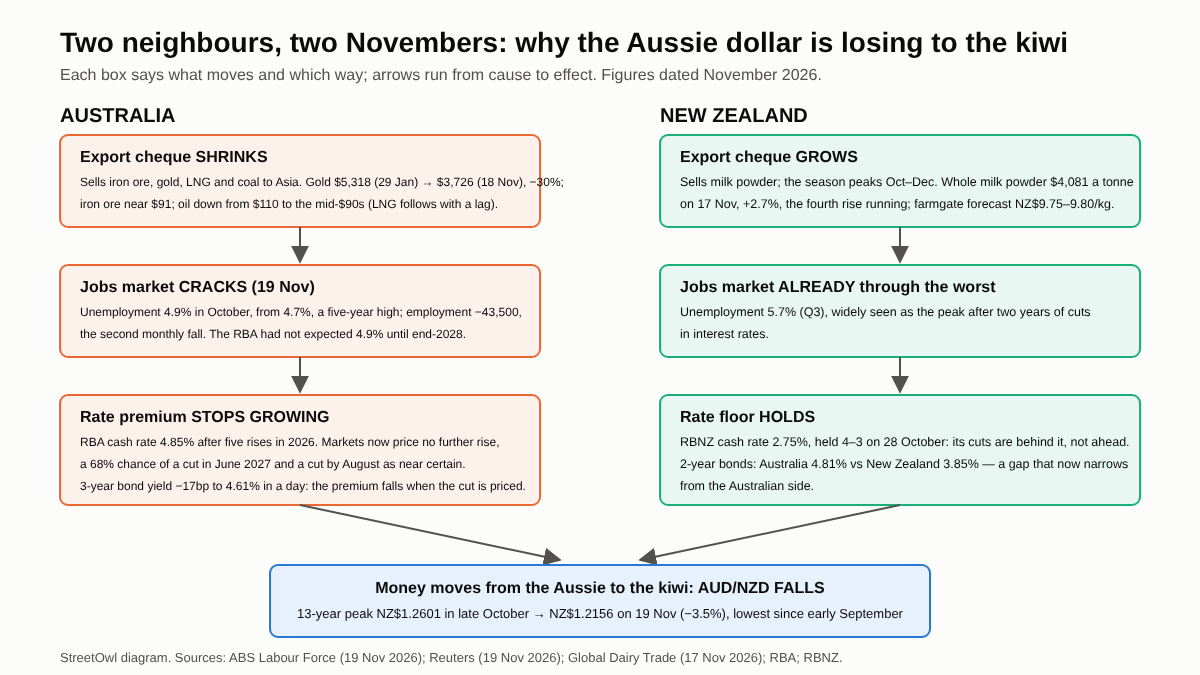
Australia's export prices have been falling for months and this morning its jobs market cracked, so the market stopped expecting higher Australian interest rates, so the money that had been parked in the Australian dollar for its rate premium is moving out, while New Zealand's milk prices and already-low rates leave the kiwi with nowhere further to fall.
What holds a commodity currency up
A currency like Australia's stands on two legs: the cheque the country earns for what it digs up and ships, and the interest premium its central bank pays anyone who holds the currency. Australia has had both all year. Its exports are iron ore (about A$113 billion a year), gold (now its second export at roughly A$60 billion), liquefied natural gas (A$54 billion) and coal (A$37 billion), most of them sold to China, Japan and Korea. Its cash rate is 4.85% after five rises in 2026, the highest since 2008, and its two-year government bond paid 4.81% on 18 November against New Zealand's 3.85%.
The first leg has been weakening for weeks. Gold peaked at $5,318 an ounce on 29 January and settled at $3,726 on 18 November, down 3.2% on the day and 30% from the peak, its lowest since September 2025, as the US dollar reached a 19-month high and traders priced a December rise in American interest rates. Iron ore sits near $91 a tonne. Oil has come down from $110 a barrel to the mid-90s, and Australia's gas contracts follow the oil price with a lag of a few months.
The morning the second leg went
On 19 November the Australian Bureau of Statistics reported that unemployment rose to 4.9% in October from 4.7%, the highest in five years and a level the Reserve Bank of Australia had not expected to see until the end of 2028. Employment fell by 43,500, the second monthly fall in a row, and the share of the population in work slipped to 63.6%.
Interest-rate markets reacted within minutes. The three-year government bond yield fell 17 basis points to 4.61%, its lowest since August. Swap contracts now price no chance of another rise, a 68% chance of a cut in June 2027 and a cut by August as near certain. A currency does not wait for the cut itself: the two-year yield that attracts money to it falls on the day the cut is priced. The Australian dollar fell to 66.79 US cents, its eighth daily fall in a row and a whisker above its 2026 low of 66.62.
Why New Zealand is the other side
New Zealand is the mirror image. Its central bank has already cut, to 2.75%, and held there by four votes to three on 28 October, so its rate cuts are behind it rather than ahead. Its unemployment rate, 5.7% in the third quarter, is widely treated as the peak. And its main export is milk powder, whose season peaks between October and December: the Global Dairy Trade auction on 17 November put whole milk powder at $4,081 a tonne, up 2.7% and the fourth rise in a row, and the farmgate milk-price forecasts sit at NZ$9.75 to NZ$9.80 a kilogram of milk solids.
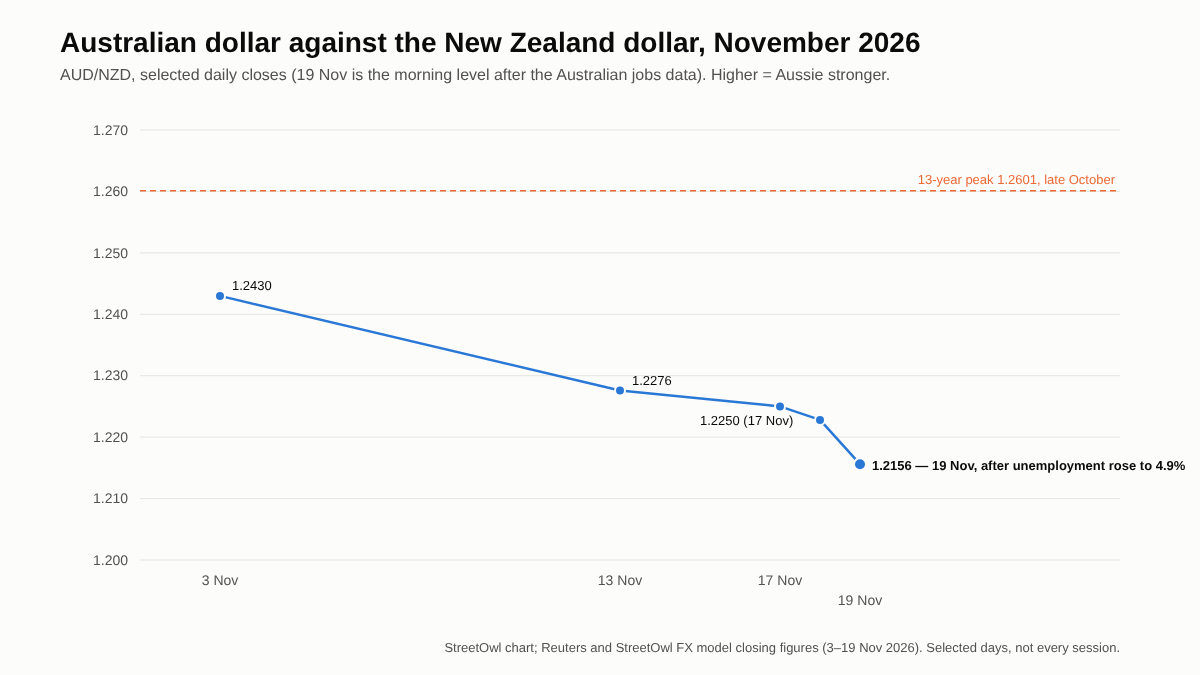
So one neighbour's export basket has been getting cheaper while the other's has been getting dearer, and one central bank has just run out of reasons to raise rates while the other finished cutting months ago. The exchange rate between them reflects that: the Australian dollar reached a 13-year peak of NZ$1.2601 in late October and bought NZ$1.2156 on the morning of 19 November, 3.5% less, its lowest since early September. The events that could change it are the next Australian jobs report on 17 December, the two dairy auctions on 1 and 15 December, the Reserve Bank of Australia's decision in early December and the Reserve Bank of New Zealand's on 9 December, and New Zealand's official election count on 27 November, where the governing coalition holds its majority by a single seat.
What it means for a British household
For holiday money the move helps anyone heading to Australia: a pound bought about A$1.97 on the morning of 19 November, near the top of this year's range of A$1.86 to A$2.02, so £100 buys roughly A$197. A pound bought about NZ$2.39, so £100 buys roughly NZ$239 in New Zealand, where the rate has moved less. StreetOwl's Holiday money board on the Travel tab shows what £100 buys in both.
On the shelf the effect is small and slow. A weaker Australian dollar makes Australian wine a little cheaper for British importers to buy over the coming months; New Zealand's lamb, butter and wine are sold in a currency that is holding up, and its dairy prices are rising at source, so no relief should be expected there.
Sources
- Australian Bureau of Statistics, 19 November 2026: Labour Force, Australia, October 2026
- ABC News, 19 November 2026: Unemployment rate surges to 4.9pc in October
- Reuters via Business Recorder, 19 November 2026: Australian dollar falls after weak jobs data, bonds rally on rate cut hopes
- Reuters via MarketScreener, 18 November 2026: Gold drops to 14-month low as dollar, yields rise
- Global Dairy Trade, 17 November 2026: event results, whole milk powder
- Reserve Bank of New Zealand, 28 October 2026: Monetary Policy decisions
- Reserve Bank of Australia: cash rate target
This piece was drafted by AI from the public sources named, then read and approved by Michael Rossi before it went up. It explains why a currency moves; it is not advice to buy or sell any currency and is not financial advice.
← Back to StreetOwl