Why New Zealand's dollar is at its lowest of the year against Canada's, with milk rising and oil falling
New Zealand sells milk and buys all its fuel, Canada sells oil, so the oil spike widened one country's deficit and the other's surplus and pulled their interest rates apart; this week both prices turned, but trade figures and an election stand between the turn and the exchange rate.
Two ends of one trade
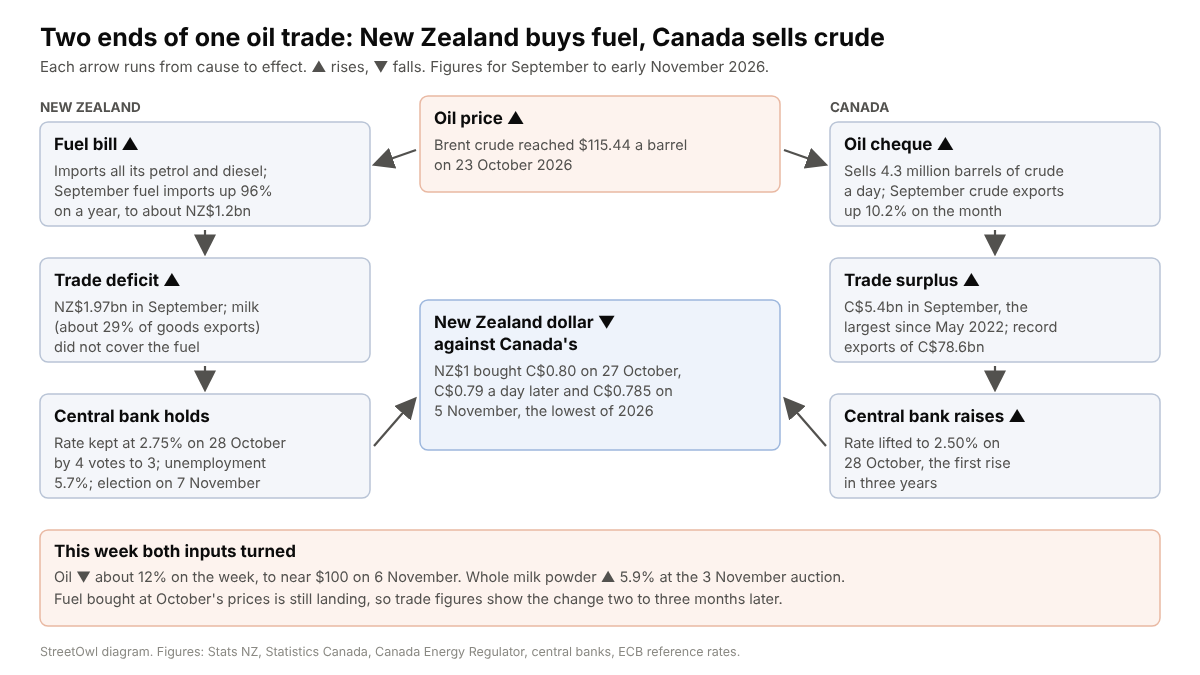
New Zealand and Canada are the same trade seen from opposite ends. New Zealand sells milk: milk powder, butter and cheese earned NZ$24.2 billion of its NZ$84.6 billion of goods exports in the year to July 2026, about 29 per cent. It buys every litre of its petrol and diesel from abroad, because its only oil refinery closed on 31 March 2022. Canada sells crude oil, 4.3 million barrels a day in 2025, nine-tenths of it to the United States.
So when oil spikes, one country writes the cheque and the other banks it.
What the oil spike did
Brent crude peaked at $115.44 a barrel on 23 October 2026, its highest since June 2022. New Zealand's fuel bill was NZ$12.1 billion in the year to July, up NZ$2.3 billion, and it was accelerating: in September the country paid about NZ$1.2 billion for petroleum, 96 per cent more than a year earlier. Its trade deficit that month was NZ$1.97 billion when NZ$775 million was expected, and the deficit for the year widened from NZ$2.4 billion to NZ$6.2 billion.
Canada's September was the mirror image: a surplus of C$5.4 billion, the largest since May 2022, on record exports of C$78.6 billion. Energy exports rose 8.2 per cent in the month and crude oil 10.2 per cent. Without energy and metals, which are mostly gold, exports fell 5.6 per cent.
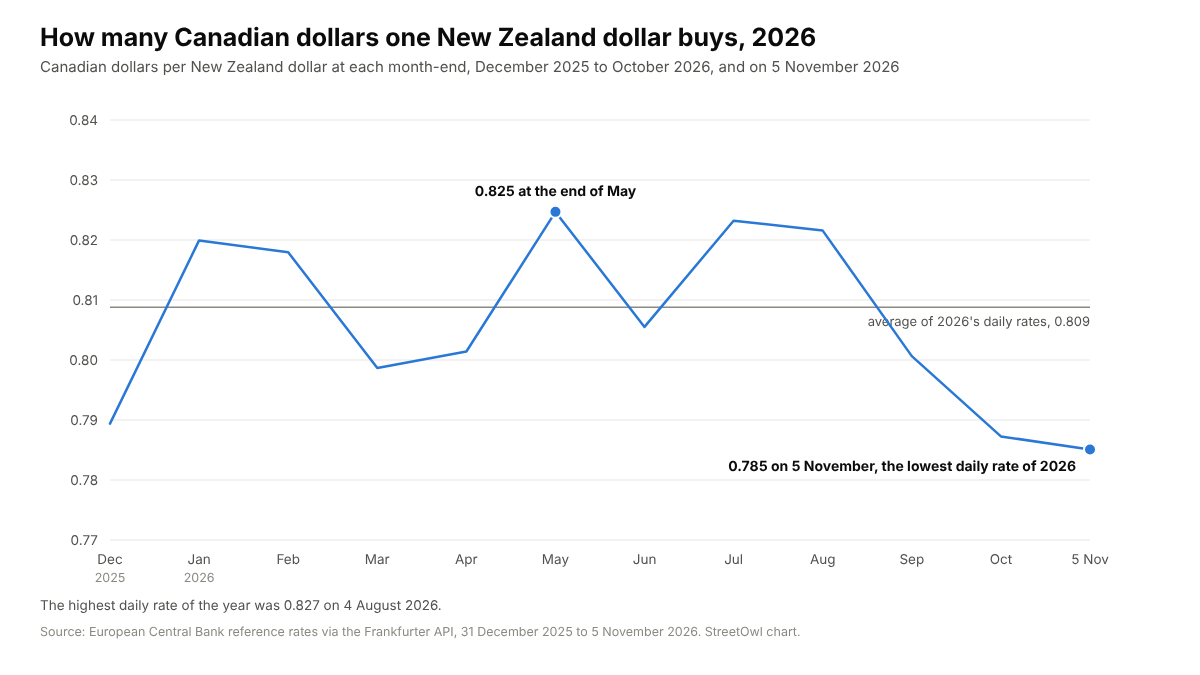
The central banks then moved apart. On 28 October the Bank of Canada raised its interest rate to 2.50 per cent, its first rise in three years. On the same day the Reserve Bank of New Zealand held at 2.75 per cent by four votes to three, when a rise had been expected; unemployment there is 5.7 per cent, an eleven-year high. A New Zealand dollar bought C$0.800 on 27 October and C$0.788 a day later. On 5 November it bought C$0.785, the lowest of 2026, in a range this year that reached C$0.827 on 4 August.
What turned this week
Both prices turned. Brent fell to about $94 on 5 November and was near $100 on the morning of 6 November, about 12 per cent lower on the week, after the Democrats won both houses of the US Congress and Iran said it was reviewing mediators' proposals. Canada does not receive the whole of that price in any case: its heavy crude sold at $27.50 a barrel below the US benchmark on 5 November, a gap that this week was the widest since 2018.
Milk went the other way. The Global Dairy Trade auction of 3 November rose 3.0 per cent, the biggest gain since February. Whole milk powder rose 5.9 per cent to $3,971 a tonne and skim milk powder reached its highest since June 2022. New Zealand's largest dairy co-operative raised its forecast payment to farmers on 30 October, for the second time in six weeks, to NZ$9.75 a kilogram of milk solids.
The exchange rate has not followed, and part of the reason is a lag. The fuel landing in New Zealand in November was bought at October's prices, so the trade figures for October and November, due around 20 November and in mid-December, will still show the spike. If oil stays lower, the relief appears in figures published from late January, at the time of year when dairy export receipts are at their peak.
The dated events that could change it
The first is New Zealand's general election on Saturday 7 November. The last Verian poll put National on 30 per cent and Labour on 29, with the governing parties on 58 seats when 61 are needed; a Freshwater poll published on 6 November put Labour ahead by 30.7 to 26.4. Polls close at 7pm in New Zealand, 6am in Britain, with currency markets shut for the weekend, and the official count is due on 27 November. The New Zealand dollar has already fallen about 6 per cent against the US dollar since late August, to its lowest since April 2025.
Canada has momentum of its own. Its Budget of 5 November added roughly C$142 billion of new spending and tax measures; its central bank has said it may need to raise rates again; and the Prime Minister said of trade talks with the United States on 5 November that the two sides were not quite there. October's jobs figures are due on 6 November, after 68,300 jobs were lost in September.
Oil can also go back up. One political-risk consultancy cut its estimate of the chance of a deal with Iran to 10 per cent this week, shipping through the Strait of Hormuz is running at under 60 per cent of capacity, and three more tankers were attacked on 5 November. The next dairy auction is on 18 November, and both central banks announce their next decisions on the same day, 9 December.
What it means for a British household
A pound bought NZ$2.39 on 5 November 2026, the top of this year's range, whose low was NZ$2.25 on 17 February, so £100 is about NZ$239, some NZ$15 more than at that low. A pound bought C$1.88 the same day, in a range of C$1.81 on 9 March to C$1.90 on 7 July. The Holiday money board on StreetOwl's Travel tab shows what £100 buys today.
It also touches the shopping basket. Britain's imports from New Zealand were £2.0 billion in the year to March 2026; the largest goods were meat at £417 million and drinks at £226 million. A cheaper New Zealand dollar lowers the sterling cost of that meat and drink for the importers who buy it. From Canada, Britain bought £716 million of crude oil and £284 million of cereals over the same year.
Sources
- News Wire New Zealand (Stats NZ figures), fuel imports and exports, year to July 2026, 24 August 2026
- RNZ, New Zealand's fuel supply, 10 March 2026
- ActionForex (Stats NZ figures), New Zealand trade in September 2026, 19 October 2026
- Canada Energy Regulator, Canada-US energy trade in 2025, 27 May 2026
- Statistics Canada, Canadian international merchandise trade, September 2026, 4 November 2026
- Trading Economics, Bank of Canada interest rate, 28 October 2026
- Trading Economics, Reserve Bank of New Zealand interest rate, 28 October 2026
- Trading Economics, New Zealand unemployment rate, 4 November 2026
- Trading Economics, New Zealand dollar, 6 November 2026
- Trading Economics, Brent crude oil, 6 November 2026
- BOE Report (Reuters), Canadian heavy crude discount, 5 November 2026
- Farmers Weekly New Zealand, Global Dairy Trade auction and farmgate milk price, 4 November 2026
- IndexBox, Global Dairy Trade prices, early November 2026
- 1News, final Verian poll, 3 November 2026
- Reuters via Yahoo News, New Zealand poll and election timetable, 6 November 2026
- B2B News New Zealand, the New Zealand dollar before the election, 5 November 2026
- Policy Magazine, Canada's Budget 2026, 5 November 2026
- The Hub, Canada-US trade talks, 5 November 2026
- Trading Economics, Canada employment change, November 2026
- Cornerstone Futures, oil market morning highlights, 5 November 2026
- Rallies, oil's weekly fall and Gulf shipping, 6 November 2026
- European Central Bank reference rates via Frankfurter, New Zealand dollar to Canadian dollar, 2026
- European Central Bank reference rates via Frankfurter, pound to New Zealand and Canadian dollars, 2026
- Department for Business and Trade, New Zealand trade and investment factsheet, 14 May 2026
- Department for Business and Trade, Canada trade and investment factsheet, 31 July 2026
This piece was researched with AI from the public sources named and written up and checked by Michael Rossi before it went up. It explains why a currency moves; it is not advice to buy or sell any currency and is not financial advice.
← Back to StreetOwl