Why Japan's winter gas bill is paid to Canada, and what it does to the yen
Japan must buy its oil and gas from outside the Gulf this winter, Canada has just become a seller eight days' sailing away, and every cargo is paid for by selling yen and buying Canadian dollars.
The buyer with the least room
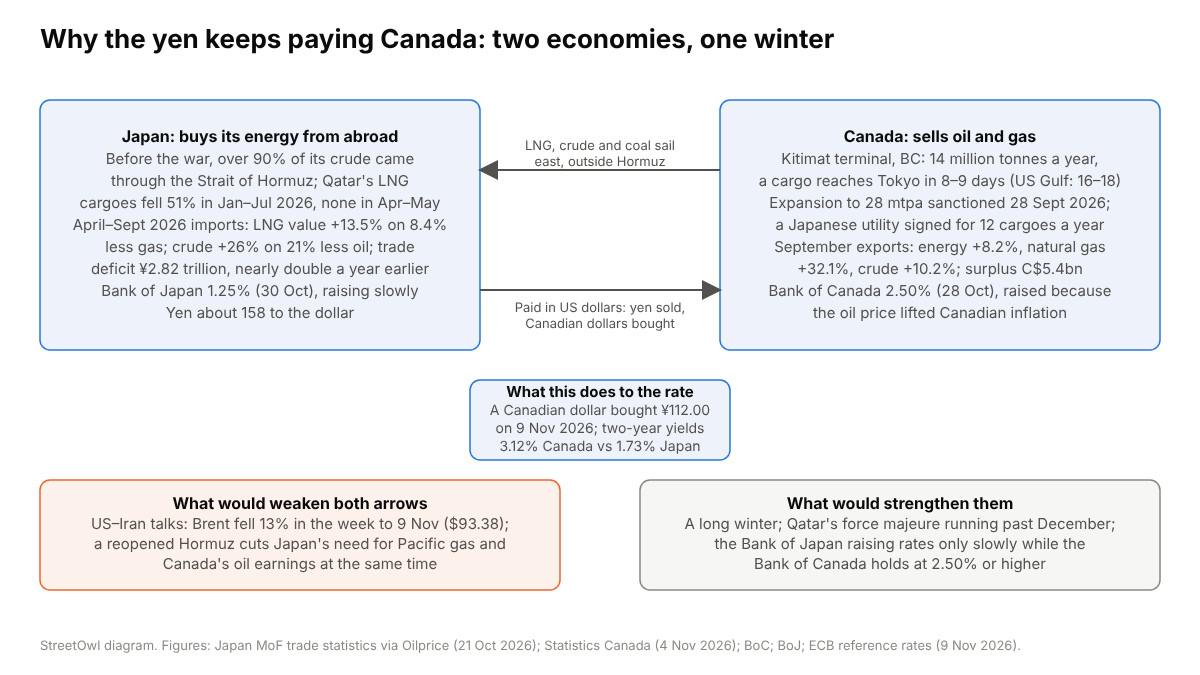
Before the war more than 90 per cent of Japan's crude oil and about 4 per cent of its liquefied natural gas came through the Strait of Hormuz. Qatar's gas cargoes to Japan fell 51 per cent in January to July 2026 and stopped altogether in April and May. Japan is the importer with the least slack: a government source told the Asahi newspaper that the country risked power cuts when only a tenth of its gas supply was disrupted after the Sakhalin-2 changes, and on 11 September its state energy agency signed its first emergency gas purchase agreement with a foreign supplier.
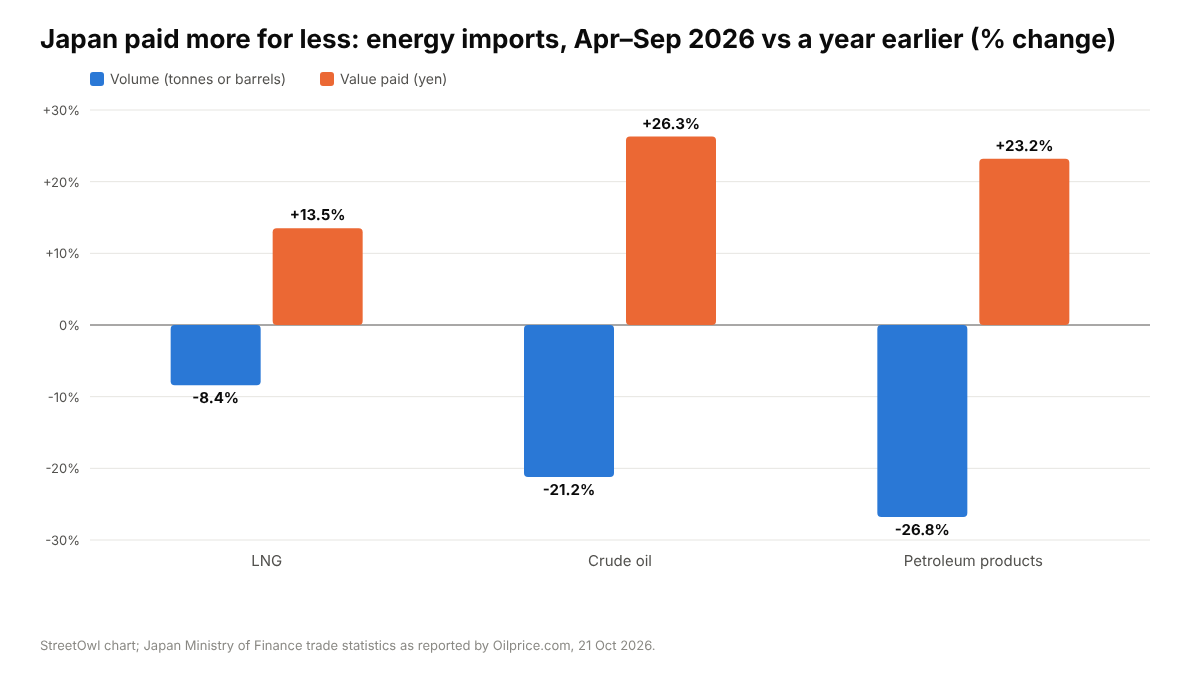
The bill shows in the trade figures. Between April and September Japan's imports cost 20.4 per cent more than a year earlier. It paid 13.5 per cent more for 8.4 per cent less gas, 26 per cent more for 21 per cent less crude, and its trade deficit for the half-year nearly doubled to ¥2.82 trillion. Every one of those invoices is paid in US dollars, which means selling yen.
The seller that just appeared
Canada's Kitimat terminal in British Columbia ships 14 million tonnes of gas a year, and a cargo reaches Tokyo in eight to nine days against 16 to 18 from the US Gulf, with no Hormuz, Panama or Suez on the route. A Japanese trading house owns 15 per cent of the plant and markets 2.1 million tonnes a year to Japanese buyers; a Japanese utility signed on 2 November for 12 cargoes a year from the expansion that was approved on 28 September at C$33bn.
Statistics Canada's September release shows what the flow looks like: energy exports up 8.2 per cent on the month, crude up 10.2 per cent and natural gas up 32.1 per cent, and a C$5.4bn trade surplus. The rest of Canada's exports fell 5.6 per cent after US tariffs returned when trade talks broke down in August, so energy is doing the work.
What the central banks are reacting to
The Bank of Canada raised its rate to 2.50 per cent on 28 October because the oil price was lifting Canadian inflation. The Bank of Japan held at 1.25 per cent on 30 October by eight votes to one, the dissenter wanting 1.5, and said it would keep raising, but it moves a quarter-point about every six months while the yen sits near 158 to the dollar. Two-year government bonds pay 3.12 per cent in Canada and 1.73 per cent in Japan, so money held in Canadian dollars earns about 1.4 points a year more than money held in yen.
A Canadian dollar bought ¥112.00 on 9 November, about 1.7 per cent more than a year earlier. What would pull the two apart is the thing that brought them together: the oil price. Brent fell 13 per cent in the week to 9 November, to $93.38, on hopes that Qatari-brokered talks end the war; a reopened Hormuz would cut Japan's need for Pacific gas and Canada's oil earnings at the same time, though the long-term Kitimat contracts run for decades. The other dated events are Japan's October trade figures around 19 November, the Bank of Canada on 9 December and the Bank of Japan on 18 and 19 December.
What it means for a British household
For holiday money the yen remains the cheap one: a pound bought ¥212 on 9 November, so £100 is about ¥21,200, and StreetOwl's Holiday money board on the Travel tab shows what that buys. A pound bought C$1.89 the same day, in a range this year of about C$1.80 to C$1.90, so Canada is the dearer trip and getting no cheaper while its oil and gas sell. Britain imports its own gas from Norway and by ship, so the same Pacific scramble for cargoes that Japan is paying for is one of the things keeping the UK's winter gas price high.
Sources
- Oilprice.com, Japan's trade deficit doubles as Hormuz crisis hikes energy import costs, 21 October 2026
- Discovery Alert, Global LNG supply security: Hormuz choke hits Japan hard, 14 September 2026
- Resource Works, Why Japan is watching Western Canadian LNG, 24 December 2025
- Discovery Alert, Canadian LNG exports: why Asia's window is narrowing, 23 October 2026
- Gas to Power Journal, Japanese utility to buy 12 LNG cargoes per year from LNG Canada, 2 November 2026
- Statistics Canada, Canadian international merchandise trade, September 2026, 4 November 2026
- Advisor.ca, Solid headline trade surplus number masks underlying softness, 4 November 2026
- Fattail, Bank of Japan rate decision October 2026, 30 October 2026
- The Globe and Mail, Bank of Canada raises key interest rate to 2.5%, 28 October 2026
- Trading Economics, Brent crude, 9 November 2026
- European Central Bank, Euro foreign exchange reference rates, 9 November 2026
This piece was drafted by AI from the public sources named, then read and approved by Michael Rossi before it went up. It explains why a currency moves; it is not advice to buy or sell any currency and is not financial advice.
← Back to StreetOwl