Why hotter inflation did not lift the Australian dollar
Australia's prices rose faster than expected in October, but the rise came from electricity and fuel bills in an economy that is already cooling, so markets saw no further rate rise coming and the currency fell.
A hot number and a falling currency
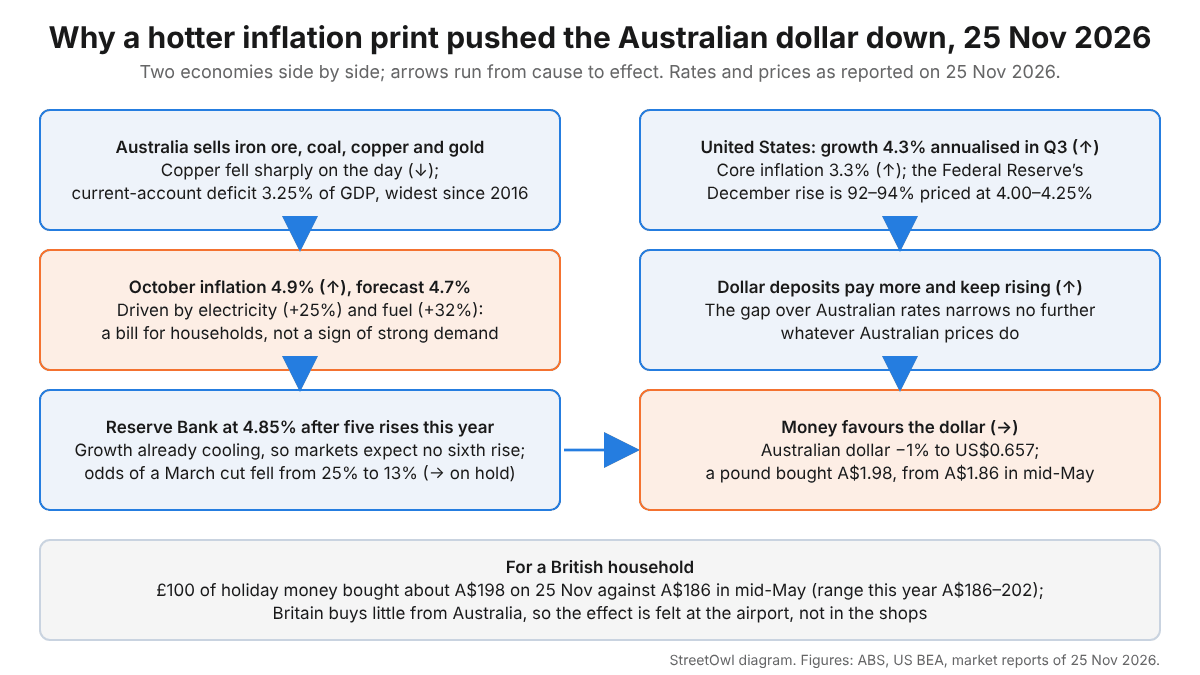
On 25 November 2026 Australia's statisticians reported that consumer prices rose 4.9% in the year to October, up from 4.3% in September and above the 4.7% forecasters expected; the Reserve Bank's own forecast had been 4.5%. The trimmed-mean measure, which strips out the wildest moves, was 3.8% against 3.6%. The textbook says a surprise like that lifts a currency, because it brings higher interest rates closer. The Australian dollar fell about 1% on the day, to US$0.657.
The reason is what the inflation was made of. Electricity prices were up 25% on a year earlier and fuel 32%: a bill landing on households rather than a sign of strong demand. The Reserve Bank has already raised its cash rate five times this year, to 4.85%, and the economy has cooled under those rises. Traders read the print as higher prices without the growth to bear them, the kind of inflation a central bank waits out rather than chases. The odds of a rate cut by March fell from 25% to 13%, but the big banks expect no sixth rise on 8 December either, which leaves the currency with nothing new to earn.
What Australia sells, and what it needs
A currency is also a bill of sale. Australia sells iron ore, coal, copper and gold to the world, and copper fell sharply on the same day, which took the commodity prop away just as the rate prop failed. Underneath both, the country's current account, the balance of everything it sells and earns abroad against everything it buys and pays, was in deficit by 3.25% of national output in the second quarter, the widest since 2016. A country in that situation needs foreign money every quarter and is more exposed when that money prefers to be elsewhere.
Elsewhere, on 25 November, was the United States. Its economy grew at a 4.3% annual rate in the third quarter, core inflation was 3.3%, and markets put the chance of a Federal Reserve rate rise in December at 92–94%. Dollar deposits already pay more than Australian ones and are about to pay more still, so the gap between the two narrows no further whatever Australian prices do. Money favoured the dollar.
What could change it
The dates that matter are close together. Australia's third-quarter growth figures come on 2 December (the second quarter was 0.4% on the quarter, 2.1% on the year), and a weak number would confirm the market's reading; a strong one would reopen the question of a sixth rate rise. The Reserve Bank meets on 8 December and the Federal Reserve on 9 December. On the other side of the Pacific, Canada's third-quarter growth on 30 November matters for the Australian dollar's commodity cousin, the Canadian dollar, which also sells oil and gold into a market that has turned.
Speculators' bets are the fuel for any reversal. The US regulator's weekly report showed speculators net short the Australian dollar by 48.6% of open contracts as of 17 November, near the heaviest in three years. When a crowd that size has already sold, a piece of good news for Australia can move the currency a long way as those bets are closed; the next report, delayed by the Thanksgiving holiday, is due on 30 November.
For a British household
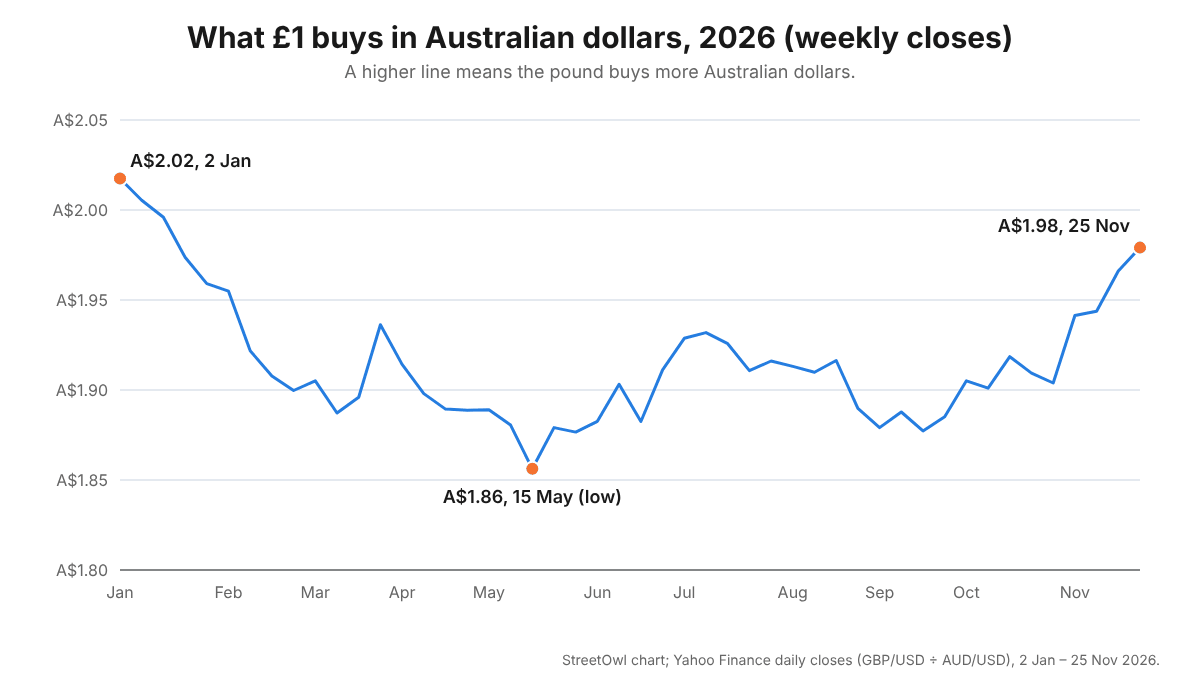
A pound bought A$1.98 on 25 November, up from a low of A$1.86 in mid-May and not far from the A$2.02 it bought at the start of the year, so £100 of holiday money buys about A$198 now against A$186 six months ago; StreetOwl's Holiday money board on the Travel tab shows what £100 buys day by day. Britain buys little from Australia by value, so the effect is felt at the airport rather than in the shops.
Sources
- TMGM, Australian inflation jumps to 4.9%, 25 November 2026
- FinScans, AUD slips as copper plunge outweighs 4.9% CPI print, 25 November 2026
- FinScans, US core PCE 3.3% and Fed rate-rise odds, 25 November 2026
- FXBrokerTrust, US Q3 GDP revised up to 4.3%, 25 November 2026
- Aussie, expert predictions for the RBA's December 2026 decision, 25 November 2026
- TD Economics, Weekly Bottom Line (Canada Q3 tracking), 20 November 2026
- CFTC, Commitments of Traders, currencies, report as of 17 November 2026
- Yahoo Finance, GBP/USD and AUD/USD daily closes, 2 January to 25 November 2026
This piece was drafted by AI from the public sources named, then read and approved by Michael Rossi before it went up. It explains why a currency moves; it is not advice to buy or sell any currency and is not financial advice.
← Back to StreetOwl