Why dear beef is making Britain eat more pork and chicken, and who is paid for it
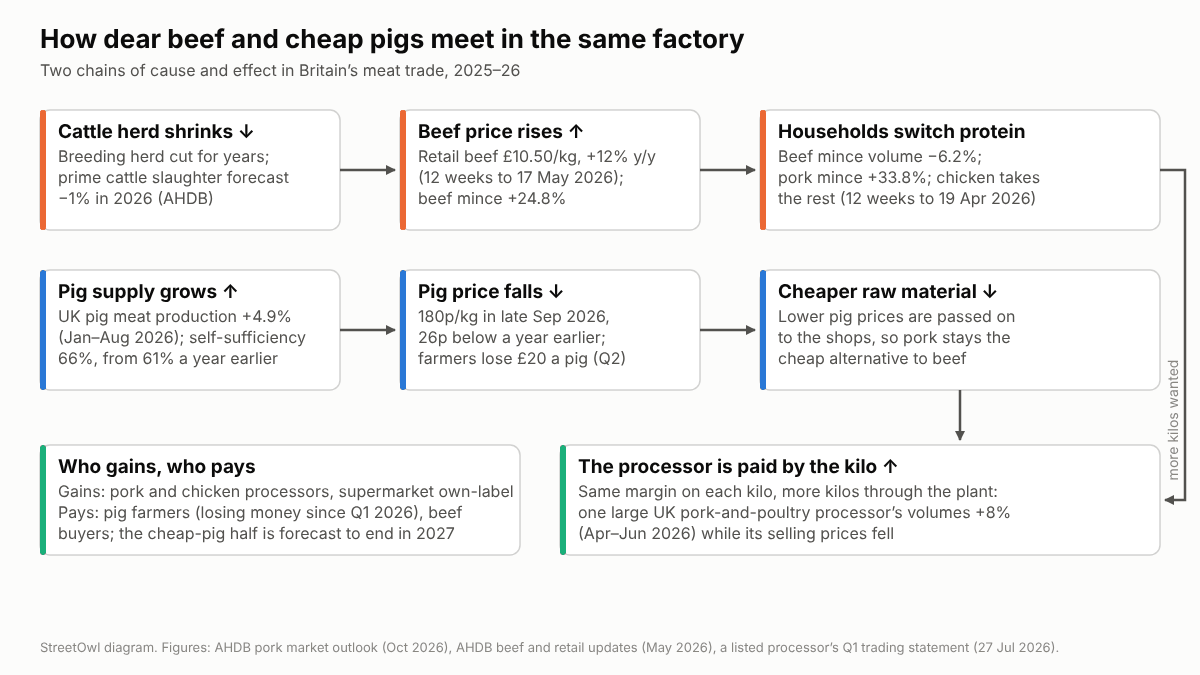
The cattle herd shrank, so beef became dear, so shoppers switched to pork mince and chicken; at the same time pig numbers rose and the pig price fell, so the processors in the middle are putting more kilos through their plants at a cheaper input.
Beef became dear because there are fewer cattle
Britain's breeding cattle herd has been cut back for years, and the bill arrived in 2025 and 2026. AHDB expects prime cattle slaughter to fall about 1% in 2026, with heavier carcases the only thing holding beef output up. In May 2026 the benchmark deadweight steer price was 603p a kilo, 87p below a year earlier but still far above the levels of 2023, and the shortfall was being filled by imports from outside the EU, which rose from 10–12% of tonnage to 28% in the first quarter.
At the till, beef cost £10.50 a kilo in the 12 weeks to 17 May 2026, up 12% in a year. Beef mince, the everyday cut, was 24.8% dearer over the spring quarter and households bought 6.2% less of it.
A household that stops buying beef does not stop eating
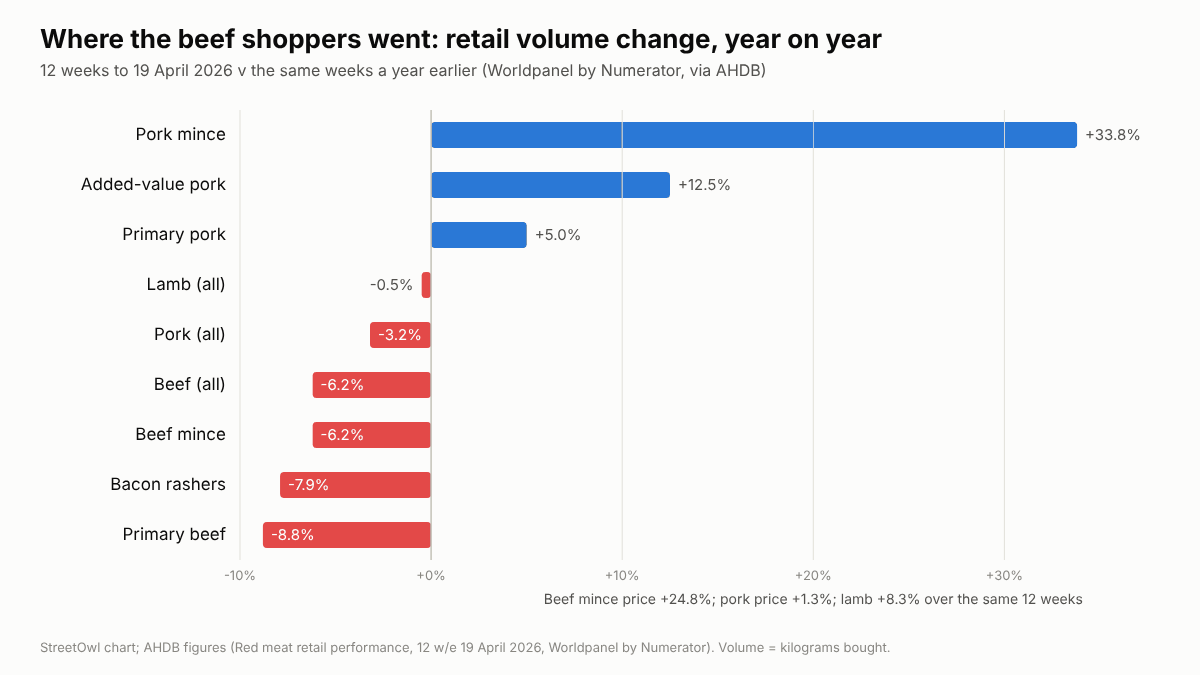
AHDB's retail data show where the money went. In the 12 weeks to 19 April 2026 pork mince volumes rose 33.8%, primary pork 5% and added-value pork 12.5%, while beef volumes fell 6.2% and primary beef 8.8%. AHDB's own words: consumers switched from beef mince into pork for everyday meals. Chicken, the cheapest protein, took the rest.
A price gap between proteins moves volume, not just price. That is the first chain: fewer cattle, dearer beef, more pork and chicken sold.
At the same time the pig became cheap
While beef got dear, pigs got plentiful. UK pig meat production was up 4.9% in January to August 2026 and the country's self-sufficiency in pork rose from 61% to 66%. The standard pig price was 180.25p a kilo in the week to 26 September 2026, 25.93p below a year earlier. Pig farmers lost £20.44 on every pig in the second quarter and have been losing money since the first.
So the raw material for pork fell in price in the same months that demand for pork rose. That is the second chain, and it runs into the first.
The processor in the middle is paid by the kilo
Between the farm and the shelf sits the processor, which buys pigs and chickens, cuts and packs them and sells to the supermarkets at roughly a fixed percentage margin. It earns the same pence on each kilo, so more kilos through the same plant means more profit. One large UK pork-and-poultry processor reported volumes up 8.2% in April to June 2026 while its revenue rose only 5.5%, because it passed the lower pig price on to the shops and kept the extra tonnage. It is spending about £160m a year adding capacity, a quarter more at one poultry plant alone.
Who gains: the processors and the supermarkets' own-label pork and chicken ranges. Who pays: pig farmers, who are selling below cost, and beef shoppers, who are paying 12% more for less.
How long it lasts
Cattle are slow in both directions: a beef animal takes two to three years, so the gap between beef and the cheaper meats survives into 2027 even as finished cattle prices ease. The cheap-pig half is forecast to end sooner. AHDB expects UK pig production to fall 3.7% in 2027 as the sow herd shrinks, and pig prices to firm gradually, capped by British pork's 40–50p a kilo premium over EU pork.
Exports are the loose end. UK pig meat exports rose 11% by volume in the first half of 2026, China took 61% of 2025's shipments, and China's five-year anti-dumping duties of 4.9% to 19.8% on EU pork, in force since 17 December 2025, do not apply to British pork. Chinese buyers have been quiet in 2026 because China's own imports are down, so the advantage has not yet been paid for.
What it means at the checkout
For a household the switch is already made: a kilo of pork mince or chicken thighs costs a fraction of beef mince, and that gap is set by herd arithmetic that does not change quickly. The thing to watch is the weekly pig price. While it sits under about 200p a kilo pork stays the cheap meat; if it climbs past 210p for a couple of months, as AHDB's 2027 outlook allows, the bargain narrows and the processors' easy half of the story is over.
Sources
- AHDB, Pork market outlook, October 2026
- AHDB, Why are finished cattle prices falling and will this continue? Beef market update, 29 May 2026
- AHDB, Red meat retail performance, 12 weeks ending 19 April 2026, published 1 May 2026
- Pig World, UK pigmeat exports up, imports down in first half of 2026, 4 September 2026
- Reuters (via Yahoo Finance UK), China lowers EU pork tariffs in final ruling after 18-month probe, 16 December 2025
- Cranswick plc, First quarter trading statement (company announcement), 27 July 2026
This piece was drafted by AI from the public sources named, then read and approved by Michael Rossi before it went up. It describes how one thing moves another; it names no investment and is not financial advice.
← Back to StreetOwl