Why cigarette makers earn more as fewer people smoke, and where that stops working
Most of the price of a packet is a fixed duty, so a small rise at the till is a large rise for the maker; volumes fall by less than the price rises, until the black-market packet sets the price and the whole arrangement breaks, as it has in Britain.
What a packet is made of
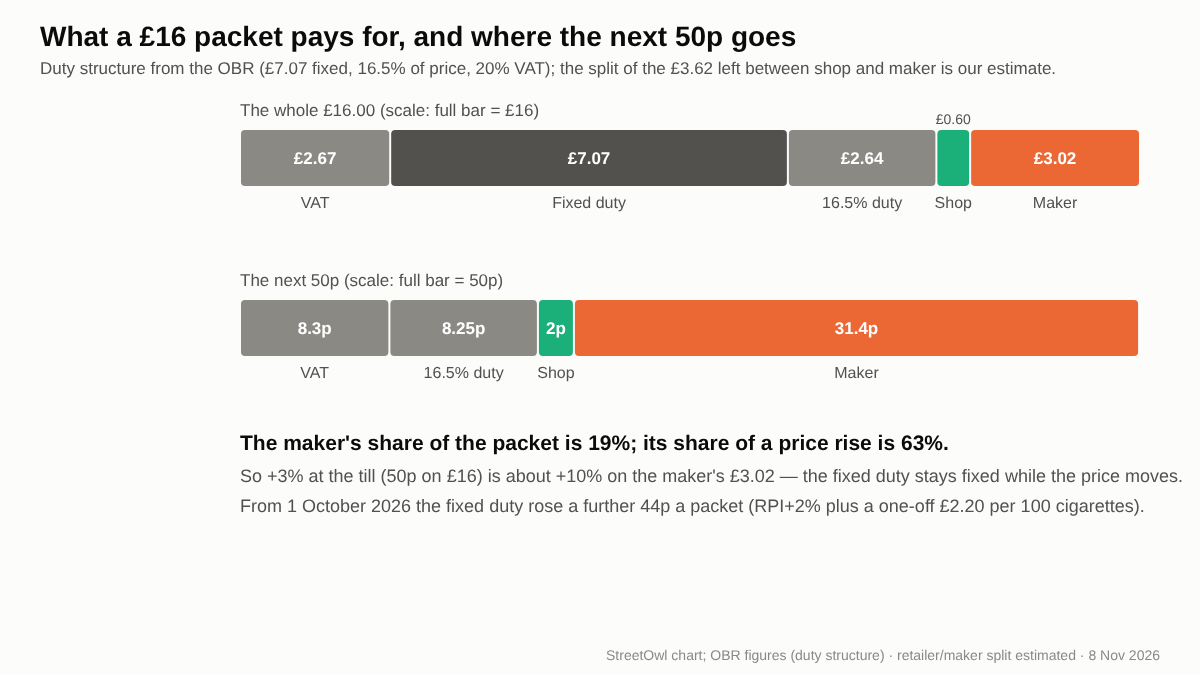
The price of a packet of 20 cigarettes in Britain is mostly tax, and most of that tax is a fixed sum rather than a percentage. The Office for Budget Responsibility sets out the structure: £7.07 of duty per packet, plus 16.5% of the retail price, plus 20% VAT on the lot. The fixed part rises every year by RPI inflation plus two percentage points until 2029, and on 1 October 2026 it went up by a further 44p a packet on top.
On a £16 packet that comes to roughly £2.67 of VAT, £7.07 of fixed duty and £2.64 of percentage duty, which leaves about £3.60 to be shared between the shop and the manufacturer. The exact split between those two is not published; a shop margin of around 60p is a reasonable estimate, leaving the maker about £3.
The lever
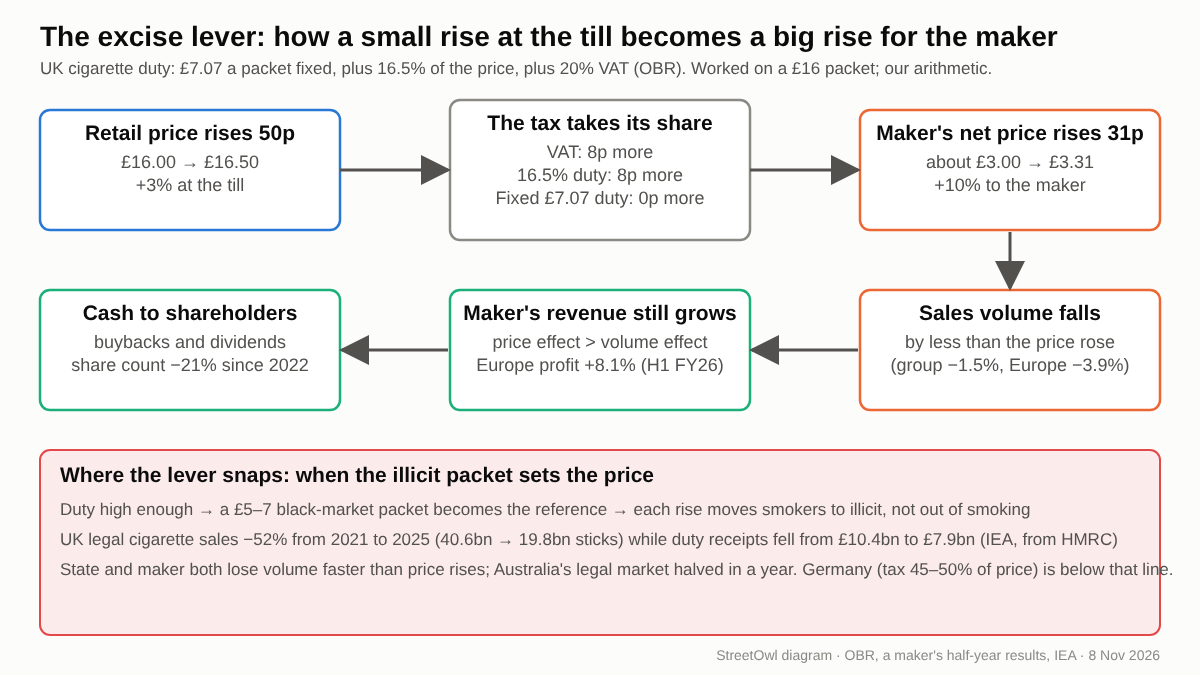
Now raise the retail price by 50p. VAT takes about 8p of it, the percentage duty about 8p, the shop a couple of pence, and the maker keeps the remaining 31p or so. The fixed £7.07 does not move at all. So a rise of 3% at the till is a rise of about 10% in what the manufacturer receives for each packet. The fixed duty acts like the pivot of a long lever: the maker's slice sits at the far end, and a small movement at the till becomes a large one there.
Fewer people buy as the price rises, but by less than the price went up. One large maker's results for the six months to March 2026 show the pattern: prices up about 3% and volumes down 1.5% across the group, so revenue still grew; in Europe, prices up 6%, volumes down 3.9%, and profit up 8%. That is how an industry with a shrinking customer base has reported rising revenue year after year.
Where the lever snaps
The lever has a limit, and Britain has found it. Legal cigarette sales in the UK fell 52% between 2021 and 2025, from 40.6bn sticks to 19.8bn, while surveys show the number of smokers fell far less; cigarette excise is up 73% since 2020, and the Treasury's tobacco duty receipts have fallen from £10.4bn to £7.9bn, the lowest on record after inflation. Once an illicit packet at £5 to £7 becomes the reference price on the street, each duty rise moves smokers to the black market rather than out of smoking, and both the state and the legal makers lose volume faster than the price rises. Australia's legal market halved in a year on the same mechanism.
So the arrangement works between two lines: duty high enough that the fixed sum dominates the packet, but not so high that the counterfeit sets the price. Britain and Australia are past the second line; the Office for Budget Responsibility now expects tobacco receipts to fall in cash terms for the rest of the decade. Most of Europe and the United States are not past it.
Why Germany matters now
On 16 October the Bundestag approved staged tobacco tax rises that take an average packet from €8.77 to €9.56 next year and up to €11.36 by 2030. Tax is 45% to 50% of a German packet's price, well under Britain's 80% or more, and the government expects €756m of extra revenue next year and €3.58bn a year by 2030. For the makers, a tax-led price rise works the same way as one of their own as long as the legal market holds: more per packet, fewer packets. The question for Germany over the next four years is whether it stays on the working side of the line or follows Britain across it.
Who gains and who pays: the Treasury and the makers gain from each rise while the legal market holds; smokers pay; corner shops lose legal sales to the black market as the line is crossed; and the state loses receipts it had counted on, which is where Britain now stands.
Sources
- Office for Budget Responsibility, tobacco duties (forecasts in depth), 2026
- HM Treasury and HMRC, changes to tobacco duty rates from 26 November 2025 and 1 October 2026
- Institute of Economic Affairs, legal cigarette sales down by 52% as black market booms, 2 March 2026
- Vinetur, Germany approves a tobacco tax increase that will lift cigarette packs to €9.56 next year, 16 October 2026
This piece was researched with AI from the public sources named and written up and checked by Michael Rossi before it went up. It describes how one thing moves another; it names no investment and is not financial advice.
← Back to StreetOwl