Why Canada's oil windfall has not lifted its dollar, yet
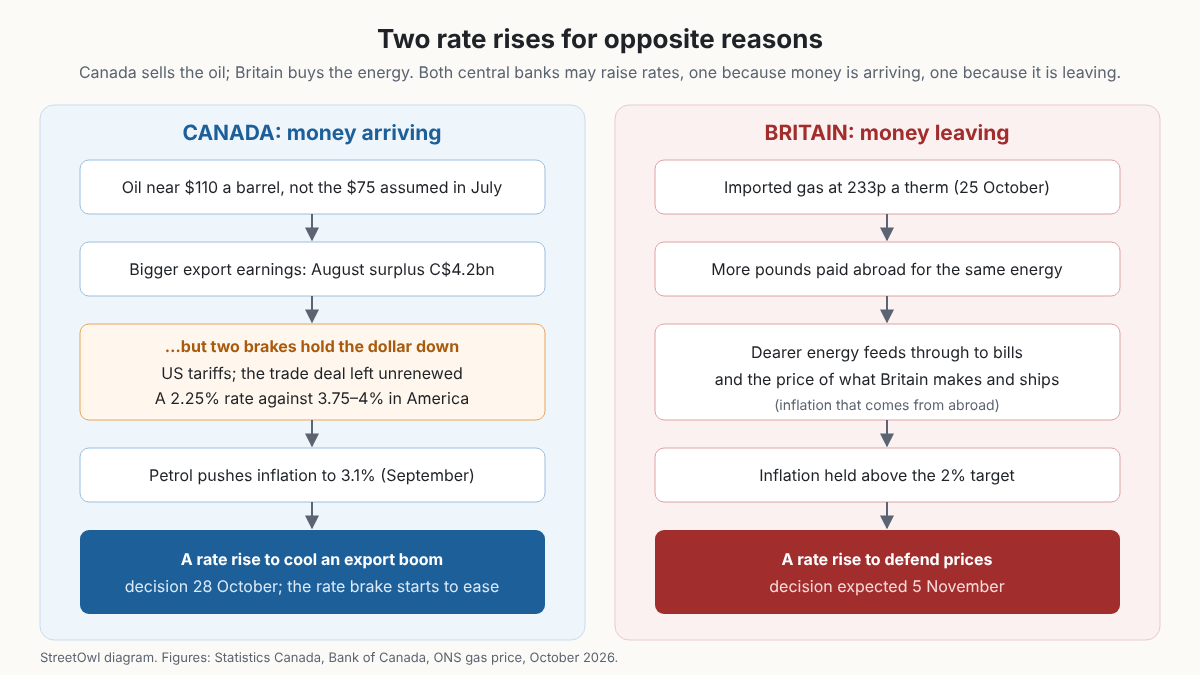
Dear oil means more money flowing into Canada, but tariffs and a lower interest rate than America's have held its dollar down; if petrol-led inflation forces the Bank of Canada to raise rates, one of those brakes comes off.
Who sells what to whom
Canada is one of the world's great oil sellers. It ships about 4.7 million barrels of crude a day, worth C$146bn in 2025, plus C$13bn of gas, and energy is about a fifth of everything the country exports. Most of it, 87 per cent, still goes to the United States, but the expanded Trans Mountain pipeline now sends roughly an eighth to Asia through Vancouver.
When oil is dear, every barrel brings more money into the country. Brent crude has been near $110 a barrel this month, against the $75 the Bank of Canada assumed in its July forecast, and on those volumes every $10 on a barrel is worth something like US$17bn a year. The trade figures show it: Statistics Canada reported a trade surplus of C$4.2bn for August, a four-year high, against the C$1.55bn economists had expected.
Why the currency has not followed
In a simple world, money flowing in would push the Canadian dollar up: buyers abroad need Canadian dollars to pay Canadian producers, and the producers' earnings sit in Canada. Instead, on 5 October the Canadian dollar fell to an 18-month low of 1.4293 to the US dollar. Two brakes explain it.
The first is trade policy. Washington declined to renew the US–Mexico–Canada trade agreement on 1 July, leaving steel, aluminium, lumber and copper under American tariffs and the whole relationship under an annual review with no timetable. Uncertainty about a country's biggest customer weighs on its currency whatever its oil earns.
The second is the interest rate. Money held in a currency earns that country's interest rate, and the Bank of Canada has held its rate at 2.25 per cent for seven decisions in a row while the US Federal Reserve raised its own to 3.75 to 4 per cent. Holding US dollars has simply paid more, so the pull of the interest rate has worked against the pull of the oil money.
What could take a brake off
Dear oil does not only fill the trade account; it also raises prices at home. Canadian inflation reached 3.1 per cent in September, with petrol prices up 27.8 per cent on a year earlier. On 19 October the Bank of Canada's governor, Tiff Macklem, said its new forecast for inflation would be significantly higher, and the odds markets attach to a rate rise at the Bank's 28 October decision jumped above 75 per cent the next day.
A rate rise in Canada would narrow the gap with American rates, which is the brake that has held the Canadian dollar down. It would be a rise to cool an economy that is earning more from the world, which is a different thing from a rise to defend prices.
Britain on the other side of the same trade
Britain sits on the other side. It buys much of its gas abroad, and wholesale gas was 233p a therm on 25 October, so more pounds leave the country for the same energy, and dearer energy feeds into bills and into the price of what British firms make. The Bank of England is widely expected to raise rates on 5 November, but in response to inflation that has arrived from abroad, not to an export boom. One central bank's rate rise reflects money arriving; the other's reflects money leaving.
For a household the plainest way to feel all this is holiday money. On Friday a pound bought C$1.87, near the top of its range this year of C$1.80 (9 March) to C$1.90 (7 July). StreetOwl's Holiday money board on the Travel tab shows what £100 buys in Canada today against a year ago, and how that compares with other destinations.
Sources
- BNN Bloomberg, Canada's trade surplus widens to four-year high in August, 6 October 2026
- Advisor.ca, Merchandise trade surplus rises to $4.2B in August, October 2026
- BOE Report, Higher gas prices drove inflation up to 3.1% in September (Statistics Canada), 19 October 2026
- The Star (Reuters), BoC raises inflation outlook as oil prices surge, 19 October 2026
- CTV News, Odds of an interest rate hike from the Bank of Canada have jumped, October 2026
- Canadian Association of Petroleum Producers, crude and gas export figures for 2025
This piece was researched with AI from the public sources named and written up and checked by Michael Rossi before it went up. It explains why a currency moves; it is not advice to buy or sell any currency and is not financial advice.
← Back to StreetOwl