Why Canada's oil cheque is smaller than it looks, and why its dollar has not risen with crude
War freight and Venezuelan barrels have pushed Canadian heavy crude to its biggest discount since 2018, so the oil money goes to US refiners rather than Canada, so the Canadian dollar sits at its weakest of the year against the US dollar even with crude dear.
Two economies, one pipeline
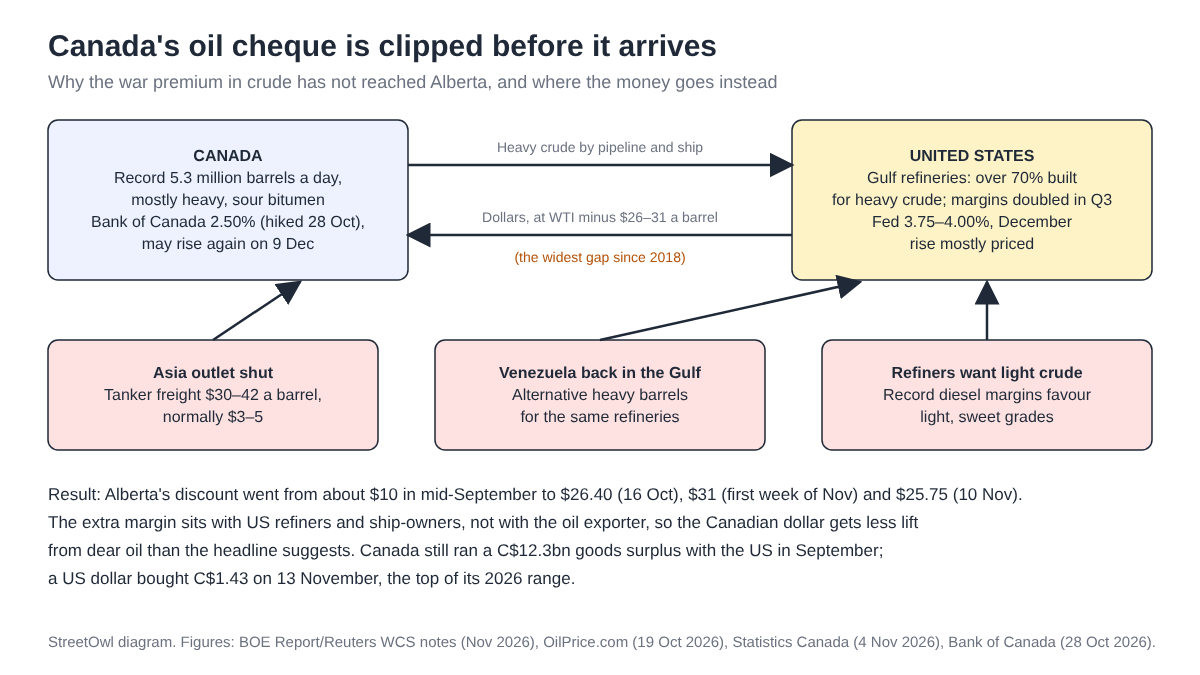
Canada pumps a record 5.3 million barrels of oil a day, most of it heavy, sour bitumen from Alberta that only certain refineries can process. Its natural customers are the refineries on the US Gulf Coast, more than 70% of which are built for heavy crude. Since the expanded Trans Mountain pipeline to the Pacific (890,000 barrels a day) filled up in June 2026, the other outlet has been Asia, by tanker.
In September Canada sold the world $5.4 billion more goods than it bought, and ran a C$12.3 billion surplus with the United States alone, with crude exports up 10.2% on the month on higher prices. On that reading the war in the Gulf, which has kept Brent crude far above its January level, ought to be a windfall for Canada and its currency.
Where the money actually goes
The war has broken the Asian outlet and bent the American one. Shipping a barrel of crude to Asia has cost $30 to $42 this autumn against a normal $3 to $5, with the largest tankers hired at a record $805,000 a day in October. A Canadian barrel that has to sail to China is worth that much less at the wellhead. At the same time Venezuelan heavy crude is flowing back into the Gulf, giving the same refineries an alternative, and refiners chasing record diesel profits prefer light, sweet grades.
The result is in the price of Western Canadian Select, Alberta's benchmark. Its discount to the US benchmark WTI went from about $10 a barrel in mid-September to $26.40 on 16 October, $31 in the first week of November and $25.75 on 10 November: the widest since 2018, and at Houston wider than the October 2022 record. An energy analyst quoted by Reuters says it has nothing to do with pipeline capacity; it is how Gulf buyers now value heavy barrels.
So the war premium in crude has not reached Alberta. US refining margins more than doubled in the third quarter, and the refiners expect record Canadian heavy runs this quarter and wide discounts through 2027. The money sits with the refiners and the ship-owners, between the wellhead and the pump.
What each central bank is reacting to
The Bank of Canada raised its rate to 2.50% on 28 October to stop fuel-driven inflation of about 3% (3.5% by year-end, it expects) spreading into other prices, and said there could be a need to raise it further; it meets next on 9 December. Canada's economy is growing at about 2% and is expected to slow in the fourth quarter under US tariffs.
The US Federal Reserve sits at 3.75–4.00%, and markets price a rise in December at around four chances in five. Two-year US yields pay about 1.4 percentage points more than Canadian ones, which is a reason to hold US dollars rather than Canadian ones whatever oil does. The US dollar had its best week in two months in the week to 13 November and touched a 19-month high.
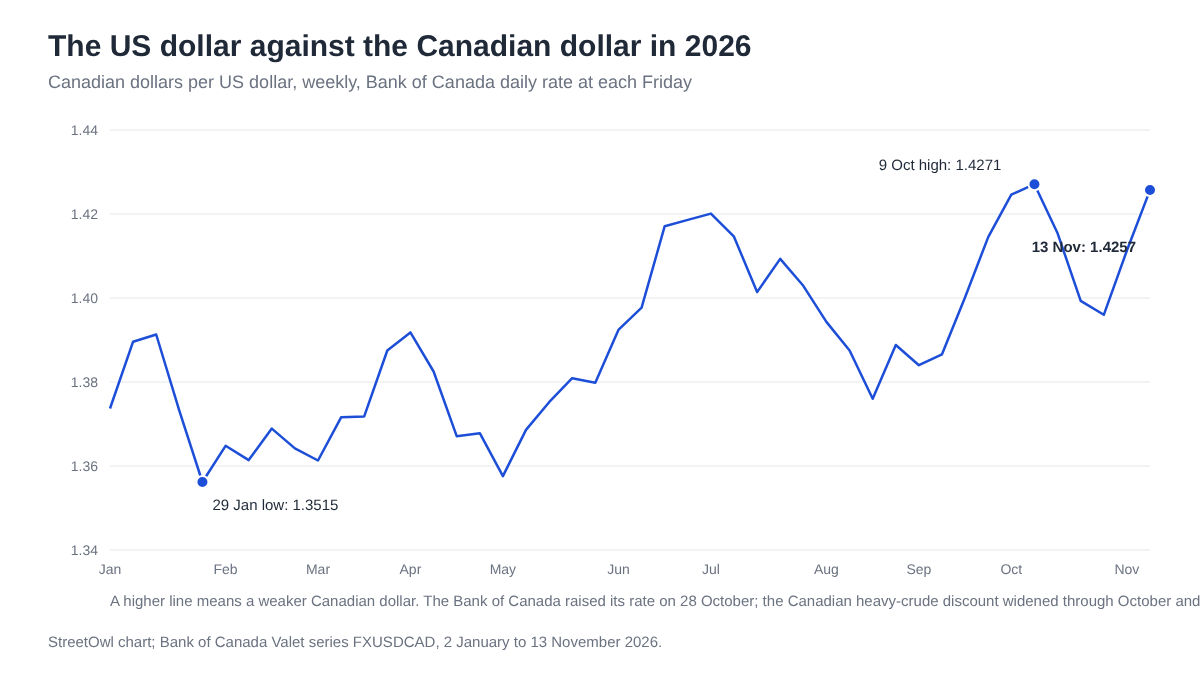
A US dollar bought C$1.4257 on 13 November by the Bank of Canada's rate, the top of a 2026 range that ran from C$1.3515 on 29 January to C$1.4271 on 9 October. Statistics Canada publishes October's trade figures on 8 December, the day before the Bank of Canada decides.
What it means for a British household
A pound bought C$1.89 on 12 November by the European Central Bank's reference rates, near the top of its range this year, so Canada is a slightly cheaper holiday than it was in the spring; StreetOwl's Holiday money board on the Travel tab shows what £100 buys. Britain buys little Canadian crude, so the discount on Alberta's barrels does not reach the forecourt here; what reaches it is Brent, which has eased from October's highs on hopes of a settlement.
Sources
- BOE Report/Reuters, 2 November 2026
- BOE Report, 10 November 2026
- BOE Report/Reuters, 6 November 2026
- OilPrice.com, 19 October 2026
- Statistics Canada, The Daily, 4 November 2026
- Bank of Canada, rate announcement, 28 October 2026
- Bank of Canada, Valet exchange-rate series, 2026
- CNBC, 13 November 2026
- European Central Bank, reference rates, 12 November 2026
This piece was drafted by AI from the public sources named, then read and approved by Michael Rossi before it went up. It explains why a currency moves; it is not advice to buy or sell any currency and is not financial advice.
← Back to StreetOwl