Why Canada's export boom has not lifted its dollar against the pound
Canada is selling more than ever abroad, but the rise is oil and gold prices that have since fallen, its factories are losing their one customer, and Britain pays more to hold pounds, so a pound buys more Canadian dollars than it did in the spring.
A surplus that should mean a strong currency
Canada sold the world C$670 billion of goods in the first nine months of 2026, up 15.5% on a year earlier, and it has run a trade surplus for seven months in a row, C$5.0 billion in September. A country with those numbers would normally have a rising currency. Instead a pound bought C$1.88 on 16 November, in a 2026 range of C$1.80 on 9 March to C$1.90 on 7 July.
Look inside the boom and it is two prices
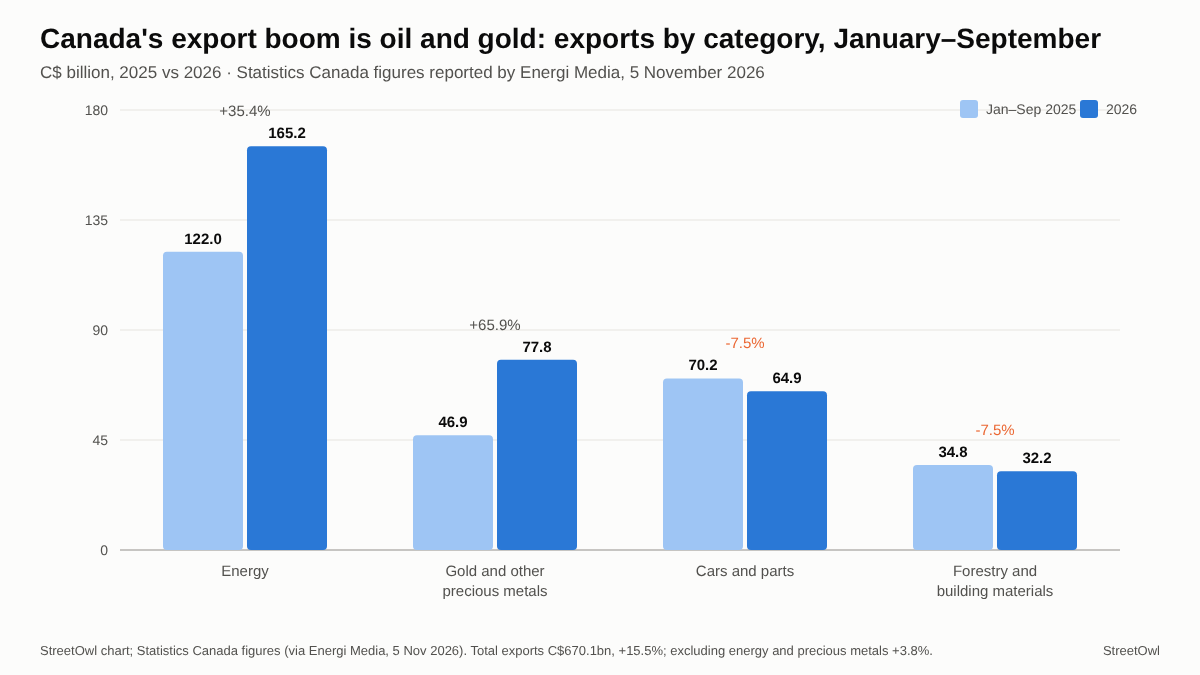
Of the C$89.9 billion increase in exports, 82% came from two things: energy, up 35% to C$165 billion, and gold and other precious metals, up 66% to C$78 billion. Those are prices, not volumes. In September the volume of goods Canada shipped fell 4.0% even as the value edged up. And both prices have turned. Brent crude was about $110 a barrel in late October and settled at $95.84 on 13 November; gold is 27% below its January peak.
Strip out oil and gold and Canada's exports grew 3.8%. Cars and parts fell 7.6% and forestry products 7.5%, because those are the goods the United States now taxes, with 50% tariffs on steel and aluminium. The US still takes 68.5% of everything Canada exports, down from 72.9% a year ago. The headline surplus is an oil-and-gold windfall that is already shrinking, sitting on top of a manufacturing base that is losing its one customer.
What the two central banks are reacting to
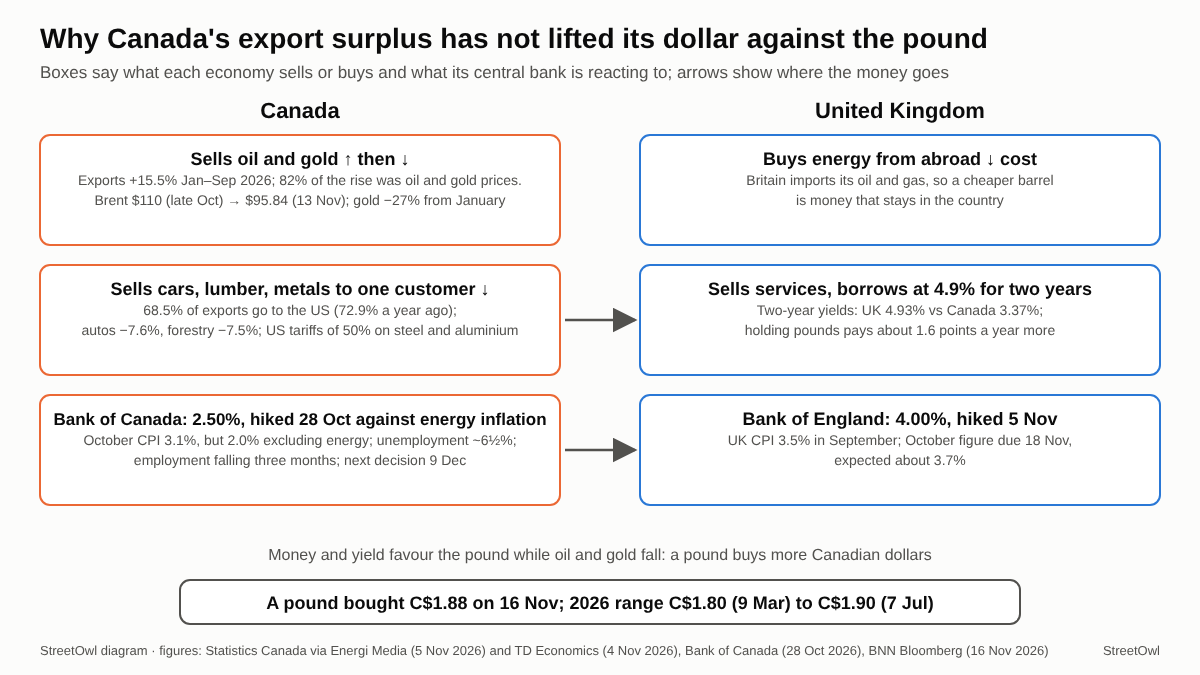
The Bank of Canada raised its policy rate to 2.50% on 28 October, explicitly to stop high energy prices spreading into everything else. October's inflation figures, published on 16 November, suggest they have not spread: the headline rate stayed at 3.1%, but excluding energy it was 2.0%, down from 2.1%. Unemployment has sat around 6.5% for months and employment has fallen for three. The next decision is on 9 December.
The Bank of England, by contrast, raised Bank Rate to 4.00% on 5 November. UK inflation was 3.5% in September and the October figure, due on 18 November, is expected at about 3.7%. Two-year government bonds yield 4.93% in Britain against 3.37% in Canada, so holding pounds rather than Canadian dollars pays about 1.6 percentage points a year more. Britain also imports its energy, so a cheaper barrel is money that stays in the country rather than money that leaves it.
What could change it
A flare-up in the Gulf that pushed oil back above $100 would refill Canada's cheque and the Bank of Canada's inflation worry at once. A UK inflation figure well below expectations on 18 November would weaken the pound's side of the story. And if the Bank of Canada raises again on 9 December with a signal of more, the gap between the two countries' interest rates narrows.
What it means for a British household
For holiday money, £100 bought about C$188 on 16 November against about C$180 in March, a useful difference for anyone pricing a Canadian ski trip; StreetOwl's Holiday money board on the Travel tab shows what £100 buys each day. Britain imports relatively little from Canada, so the effect on shop prices is small; the larger household effect runs through the oil price itself, which is what moves both currencies.
Sources
- Energi Media on Statistics Canada export data, 5 November 2026
- TD Economics, Canadian merchandise trade (September 2026), 4 November 2026
- BNN Bloomberg, Canada's inflation rate unchanged at 3.1%, 16 November 2026
- Bank of Canada, policy rate decision, 28 October 2026
- Pound Sterling Live, GBP/CAD history 2026
- Newsquawk, crude settlement, 13 November 2026
- Forex Fundamentals, UK CPI consensus for 18 November 2026
This piece was drafted by AI from the public sources named, then read and approved by Michael Rossi before it went up. It explains why a currency moves; it is not advice to buy or sell any currency and is not financial advice.
← Back to StreetOwl