Why Canada's dollar is not rising into a rate rise
Canada's central bank is expected to raise rates next month because prices are high, but its economy is slowing and its exports are being taxed, so the money that moved on the expectation has already moved and the growth gap with Britain now sets the exchange rate.
Two economies, two kinds of exports
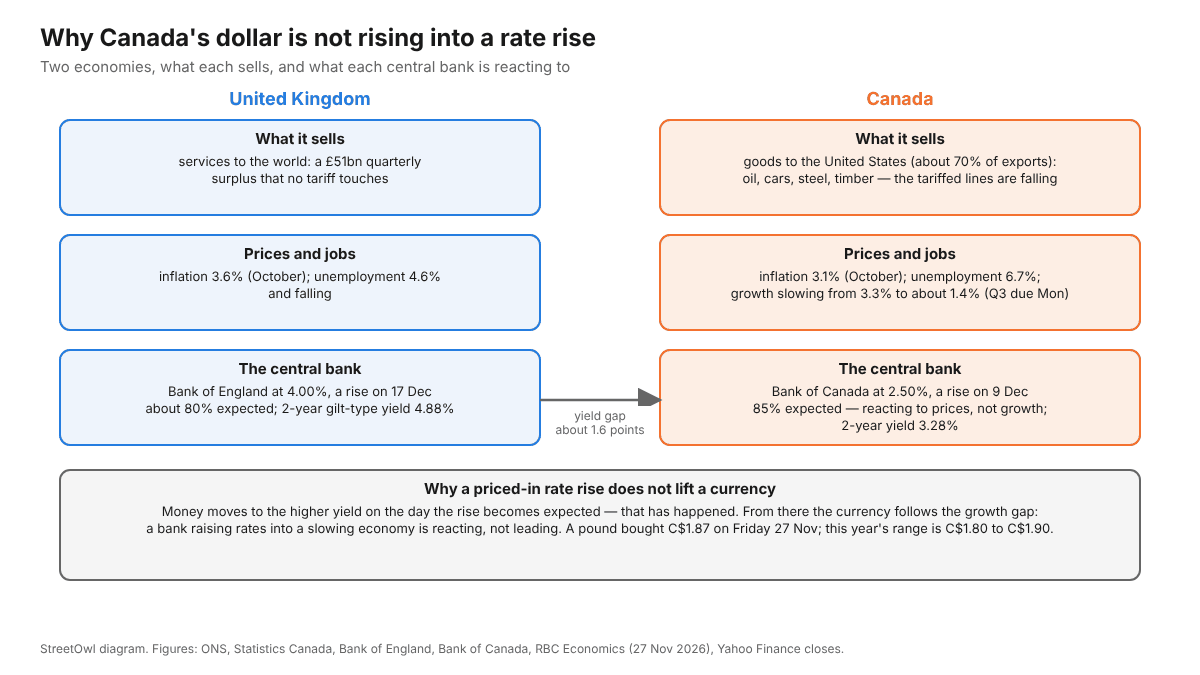
Britain sells services to the world: a surplus of about £51 billion a quarter in banking, insurance, law, software and the rest, none of it touched by a tariff. Canada sells goods, and about seven in ten of them go to one customer, the United States. Since American tariffs began the taxed lines have been falling: steel, timber and cars. Exports fell again in the third quarter; imports fell more, so trade as a whole added a little to growth, but the engine is turning more slowly.
The result is in the growth numbers due on Monday 30 November. Canada's economy grew at an annual rate of 3.3% in the second quarter, a pace one bank economist called unsustainably fast; the forecasts for the third quarter cluster at 1.3% to 1.5%, against the Bank of Canada's own estimate of 2% made in October. September's first estimate showed output shrinking 0.1%.
A rate rise for the wrong reason
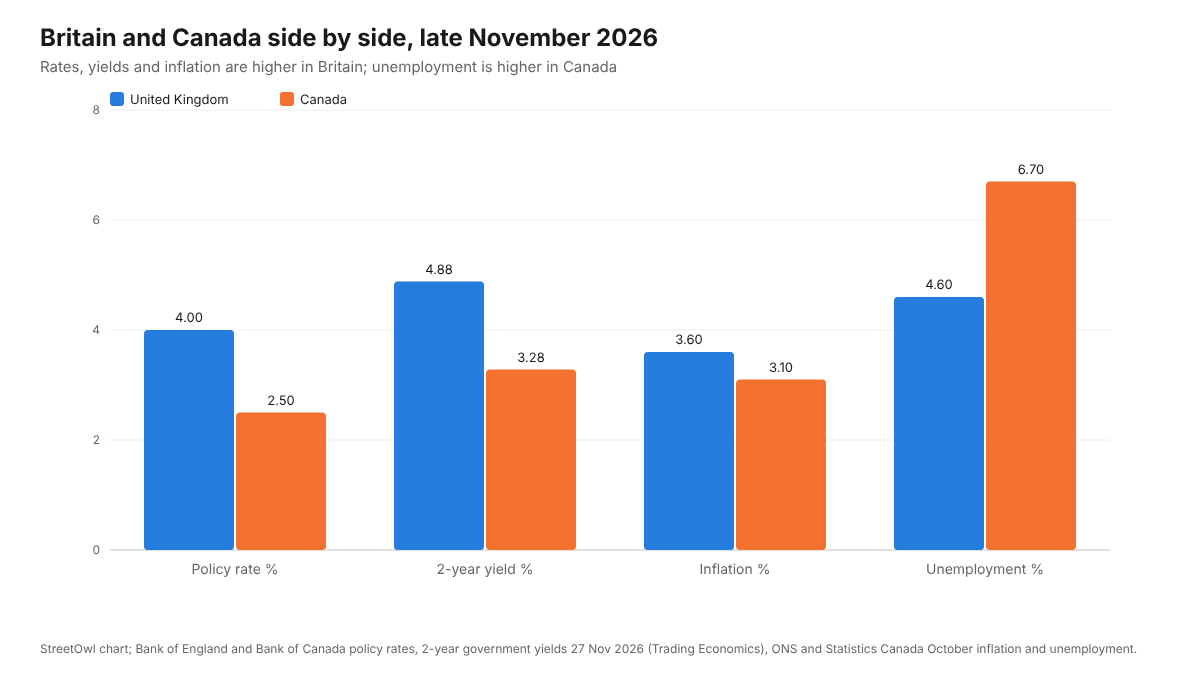
Despite that, money markets put an 85% chance on the Bank of Canada raising its rate from 2.50% on 9 December, because inflation sits at 3.1% and the Bank is reacting to prices, not to growth. The Bank of England is doing the same thing with better numbers behind it: its rate is 4.00%, a rise on 17 December is about 80% expected, inflation is 3.6% and unemployment is 4.6% and falling, against 6.7% in Canada. On two-year government bonds Britain pays about 4.9% and Canada about 3.3%, a gap of roughly 1.6 points.
Here is the mechanism. A currency gets the benefit of a rate rise on the day the rise becomes expected, because that is when money moves to the higher yield; by the time the central bank acts, the move has happened. What the currency does after that follows the growth gap: a central bank raising rates into a slowing economy is reacting to the past, and traders treat the rise as the last rather than the first. Canada's oil price is lower too, with crude back near $83 a barrel after the autumn spike, so the oil cheque that props up its dollar is smaller. And the tariff truce talks with Washington run to a 31 December deadline.
What is being watched this week
Monday's growth figure is the test. A print near 1.5% confirms the picture above; a print at or above 2%, followed by a strong jobs report on Friday 4 December, would make December's rise the first of several and change the story. Speculators' bets, from the US regulator's weekly report as of 17 November, were modestly against both currencies: net short the pound by about 14% of open contracts and net short the Canadian dollar by about 13%, with the loonie the least bet-against it has been in three years.
A pound bought C$1.87 on Friday 27 November, in a range this year of C$1.80 to C$1.90.
What it means for a British household
For holiday money, a pound buying C$1.87 is near the top of this year's range, so Canada is a little cheaper for British visitors than it was in the spring; StreetOwl's Holiday money board on the Travel tab shows what £100 buys. Britain imports little directly from Canada that reaches a household bill, but Canadian oil, grain and timber are priced in dollars, and a weaker loonie keeps those world prices a touch lower than they would otherwise be.
Sources
- RBC Economics, Canada's GDP, jobs data to test case for December rate hike, 27 November 2026
- Financial Post via Yahoo Finance, Canadian GDP growth fell by more than half in the third quarter, economists believe, 27 November 2026
- Newsquawk, Week in focus 30 November to 4 December 2026, 27 November 2026
- CFTC Commitments of Traders, futures only, report for 17 November 2026
- Trading Economics, two-year government bond yields, 27 November 2026
This piece was drafted by AI from the public sources named, then read and approved by Michael Rossi before it went up. It explains why a currency moves; it is not advice to buy or sell any currency and is not financial advice.
← Back to StreetOwl