Why Britain's submarines are stuck in port, and why the dockyard that fixes them keeps getting busier
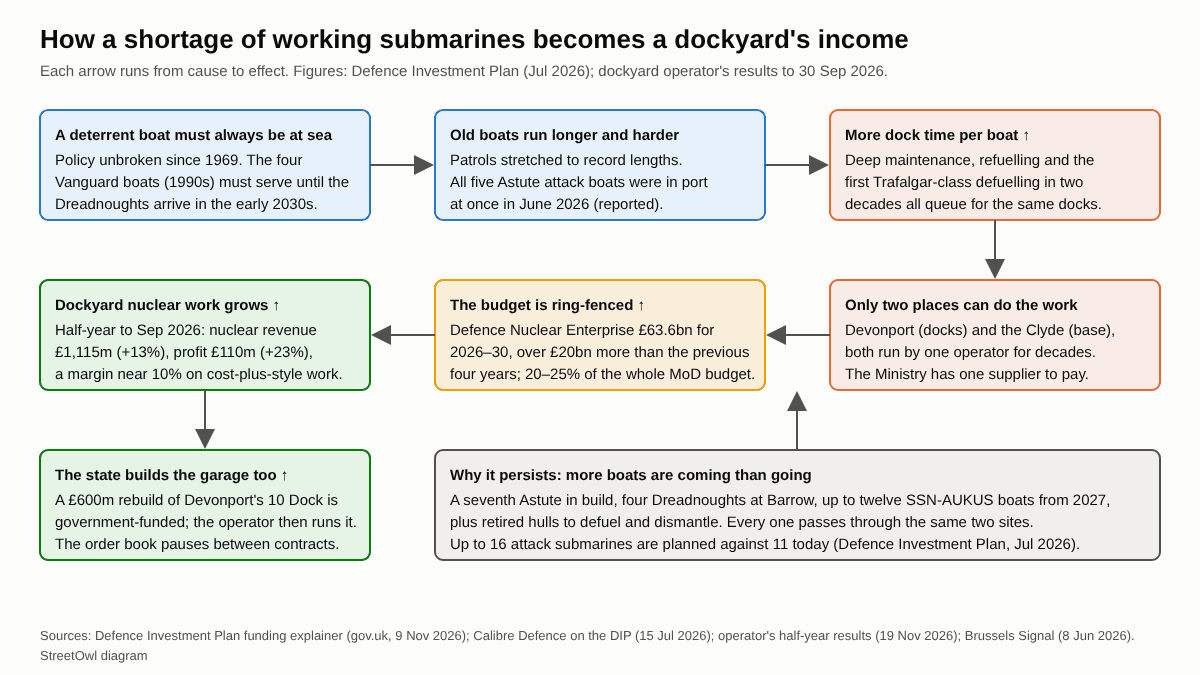
The deterrent must always be at sea, so old boats run longer, so they need more dock time, so the only two sites that can do the work are paid more each year from a budget Whitehall has ring-fenced.
Two facts that belong in one sentence
In June, by the Telegraph's account, all five of Britain's Astute-class attack submarines were tied up in port at the same time, and the Royal Navy set itself the job of getting three back to high readiness by the end of the year. On 19 November the company that runs the only two places in the country where a nuclear submarine can be maintained reported that its nuclear work had grown 13% in six months and its profit from it 23%. The breakdown and the growth are one machine.
A nuclear-powered boat cannot be fixed in an ordinary shipyard. Deep maintenance and refuelling happen in the docks at Devonport in Plymouth; day-to-day servicing happens at the Faslane base on the Clyde. Both sites have been run by the same private operator for decades under contract to the Ministry of Defence, which owns the boats and the problem and has exactly one supplier for the fix.
Why the queue for the docks only gets longer
Britain has kept a deterrent submarine at sea without a break since 1969. The four Vanguard boats that carry it date from the 1990s and must keep patrolling until the four Dreadnoughts now being built at Barrow arrive in the early 2030s. Patrols have stretched to record lengths, and a boat that stays out longer needs more work when it comes home.
Behind them is a growing list of boats that will need the same docks: a seventh Astute still in build, up to twelve SSN-AUKUS attack boats from a 2027 steel cut, and the retired Trafalgar-class hulls that must be defuelled, the first for two decades. The Defence Investment Plan published in July plans for up to 16 attack submarines against 11 today. The state is even paying for the facilities: a roughly £600m rebuild of Devonport's 10 Dock is government-funded, and the operator will then run it.
The one budget line that cannot be cut
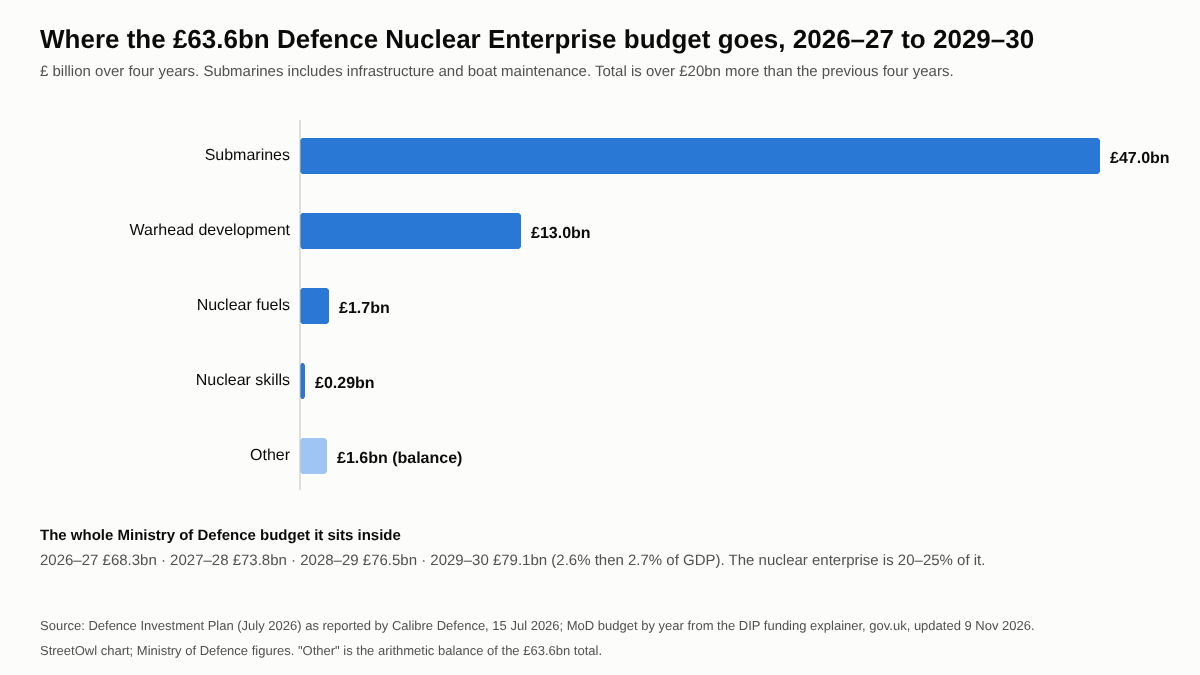
The Defence Investment Plan ring-fenced £63.6bn for the Defence Nuclear Enterprise over 2026-27 to 2029-30, more than £20bn above the previous four years. Of that, £47bn is for submarines, including infrastructure and boat maintenance; £13bn is for warhead development, £1.7bn for nuclear fuels and £290m for skills. The enterprise is 20-25% of the whole Ministry of Defence budget, which itself rises from £68.3bn this year to £79.1bn by 2029-30 (2.6% of GDP, then 2.7%).
When the plan had to find savings it reportedly cancelled frigates and destroyers, not boats. That is the point for the dockyards: within a defence budget that is flat as a share of the economy from 2027, the nuclear line grows, and the work is paid for availability and hours rather than as a fixed-price product. The operator's nuclear division made about £110m of profit on £1,115m of revenue in the half-year to September, a margin near 10%, while the group as a whole made 8.4%.
What the order book is really saying
The figure that looked worst in the results was the order book, £8.9bn against £9.9bn a year earlier. It is a gap between contracts rather than a fall in demand. The old support programme for the two naval bases expired on 31 March 2026, the five-year successor covering the Clyde, Devonport and the handover from Vanguard to Dreadnought is due to be signed in November, and the work has been running on short bridging extensions. When the new contract signs, the order book jumps.
Who gains and who pays is unusually clear. The taxpayer pays, through a budget that has been placed beyond the reach of ordinary spending rounds. Plymouth and the Clyde gain the jobs, several thousand at each site. The Navy gains boats back at sea only as fast as the docks can turn them round, which is why the same shortage that embarrasses the fleet fills the dockyard's diary for the rest of the decade.
Sources
- Defence Investment Plan funding explainer, gov.uk, updated 9 Nov 2026
- Calibre Defence, The Defence Investment Plan and the UK's nuclear deterrent, 15 Jul 2026
- Stockopedia, Daily Stock Market Report (dockyard operator's half-year results), 19 Nov 2026
- Brussels Signal, 8 Jun 2026
- The Telegraph, 7 Jun 2026
- Ministry of Defence, £121 million investment into future submarines (Trafalgar-class defuelling), gov.uk, Nov 2023
- Ministry of Defence, naval base management contracts, gov.uk, 1 Oct 2014
This piece was drafted by AI from the public sources named, then read and approved by Michael Rossi before it went up. It describes how one thing moves another; it names no investment and is not financial advice.
← Back to StreetOwl