Why Britain's care-home fees keep rising: the bed shortage machine
Britain is not building care homes while the number of people over 85 climbs, so beds stay fixed, fees rise about 8% a year, and the landlords whose rents are linked to inflation are paid more safely every year.
The beds are not being built
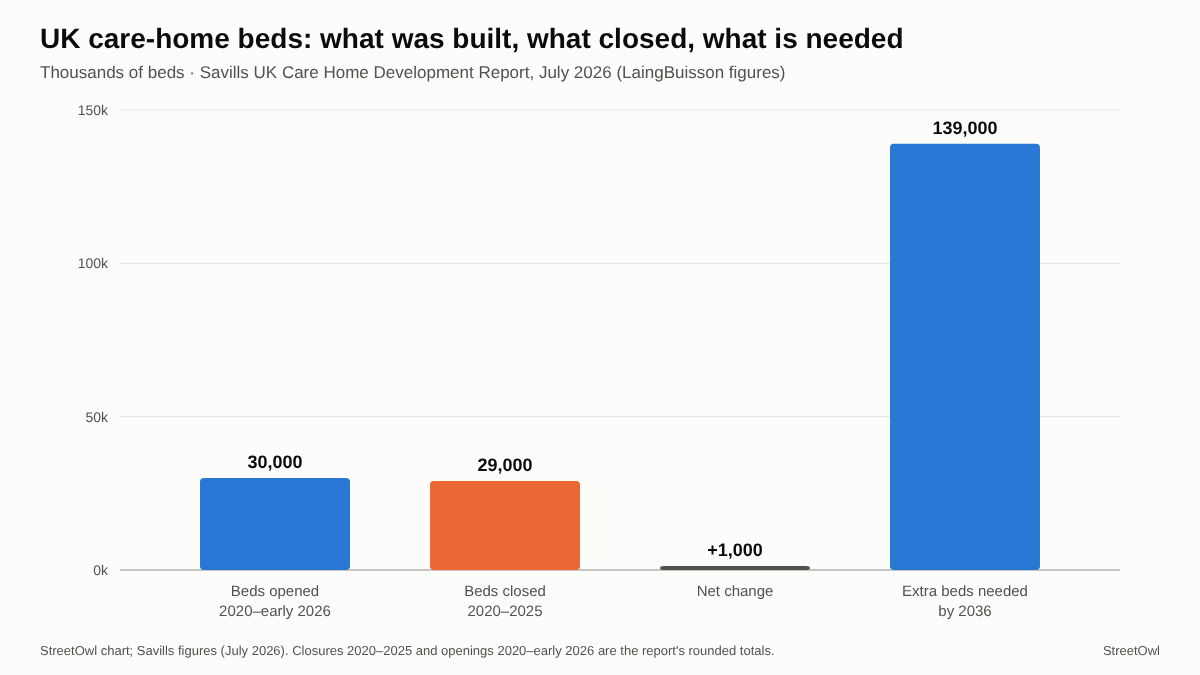
Britain has about 480,800 care-home beds in 11,143 homes, and that number barely moves. Total supply grew 2.4% in a decade, and Knight Frank's 2026 count found a net gain of just 136 beds since its previous review. Savills, using LaingBuisson's figures, puts it another way: roughly 30,000 beds were opened between 2020 and early 2026 and about 29,000 were closed, which it calls a "net standstill".
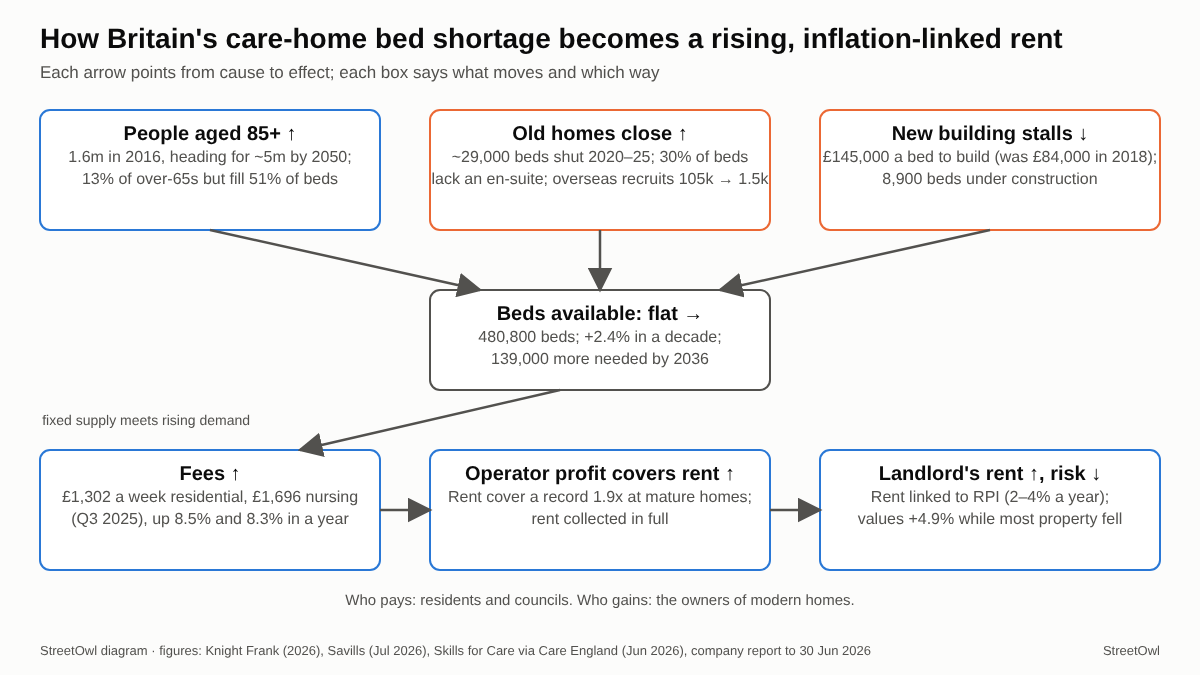
Building has stopped making sense at the margin. A new bed costs about £145,000 to build against £84,000 in 2018, so only 8,900 beds are under construction and planning approvals in 2026 are below 2025's. The homes that close are the old ones: 30% of UK beds still lack an en-suite bathroom, and those are the buildings that cannot charge today's fees.
The people who need them keep arriving
People aged 85 and over are 13% of the over-65s but fill 51% of the beds, and that group is the fastest-growing in the country: 1.6 million in 2016, heading for nearly 5 million by 2050. Savills reckons 139,000 extra beds are needed by 2036, 30% of today's stock. Knight Frank says the market hits capacity before the end of this decade.
Fixed supply meeting rising demand does the obvious thing to price. Average private fees were £1,302 a week for residential care and £1,696 for nursing care in the third quarter of 2025, up 8.5% and 8.3% in a year (Carterwood figures in the Savills report). Councils, which pay for roughly half of residents, lifted their rates by about 3.5% for 2026/27; Buckinghamshire's published uplift is typical.
Why the staffing crisis makes the survivors stronger
The care-worker visa closed to overseas applicants in July 2025. International recruits into care roles fell from an estimated 105,000 in 2023/24 to 1,500 in 2025/26, according to Skills for Care data quoted by Care England. Everyone reads that as the sector's crisis, and for the weakest homes it is.
But it is the marginal, under-staffed, non-en-suite home that closes, and every closure sends its residents, and their fees, to the home next door. So the operators who own modern homes see occupancy and fees rise at the same time. That shows up in a number the landlords watch: at one listed landlord's mature homes, the operators' earnings now cover the rent 1.9 times, a record.
Who ends up collecting
The rent on a modern care home is typically linked to the retail prices index, collared and capped at 2% to 4% a year. With inflation at 3% to 4%, rents rise at the cap, and a tenant whose fees are growing 8% pays comfortably. Rents up and risk down is why care-home values rose 4.9% like-for-like in the year to June 2026 while most British commercial property fell.
Money from abroad has noticed. One large American healthcare landlord bought the property behind four British operators, 649 homes in all, for about £6.4 billion in October 2025, and the Competition and Markets Authority accepted divestment undertakings on 10 September 2026. Another American landlord bought a London-listed care-home portfolio in 2025 at a 32.8% premium to its share price, calling the UK "the early innings of a demand-supply imbalance". The people who pay are residents and councils; the people who gain are whoever owns the modern beds.
Sources
- Savills, UK Care Home Development Report, July 2026
- Knight Frank, Healthcare Development Opportunities 2026
- Care Home Professional, UK faces 350,000 care home bed shortfall, 22 August 2025
- Care England on Skills for Care workforce data, 26 June 2026
- Buckinghamshire Council, annual fee uplift for adult social care providers 2026 to 2027
- Competition and Markets Authority, undertakings in lieu decision on four care-home portfolio acquisitions, 10 September 2026
- US healthcare landlord, recommended cash acquisition of a UK care-home landlord, 11 March 2025
- QuotedData, care-home landlord annual results to 30 June 2026, 22 September 2026
- County Councils Network and LaingBuisson, modelling the impact of Fair Pay policies, 2 February 2026
This piece was drafted by AI from the public sources named, then read and approved by Michael Rossi before it went up. It describes how one thing moves another; it names no investment and is not financial advice.
← Back to StreetOwl