Why Britain pays twice for every windy night in Scotland, and who is paid to fix it
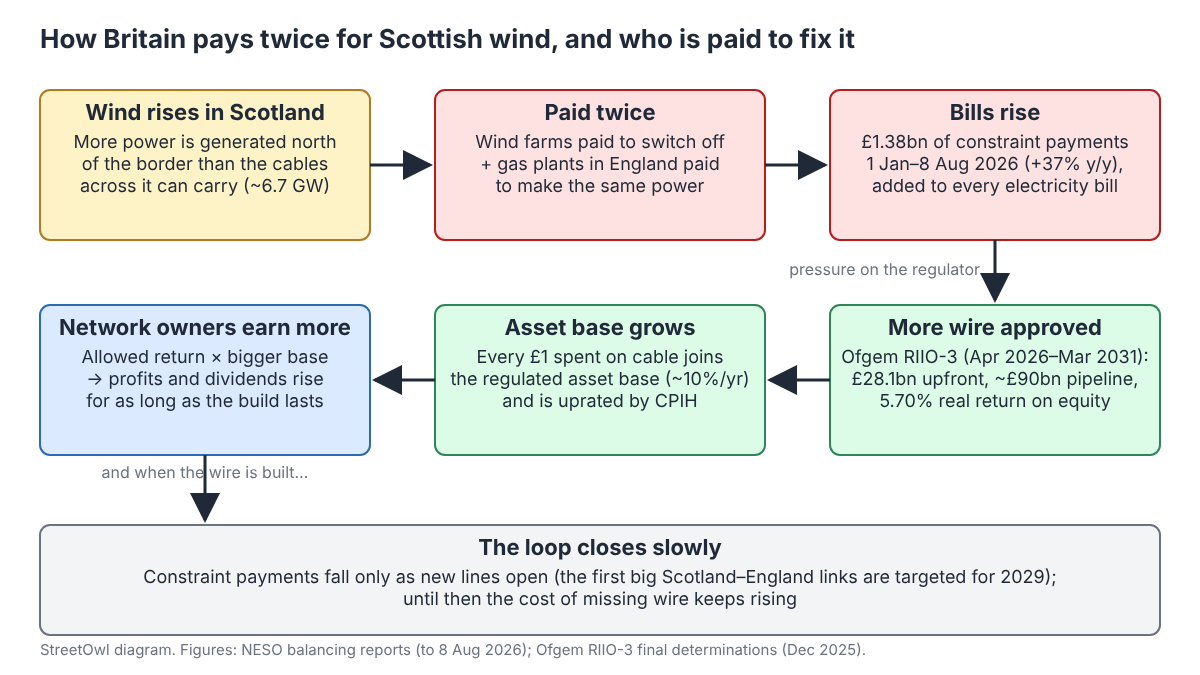
Scotland makes more wind power than the cables to England can carry, so wind farms are paid to switch off and gas plants are paid to switch on, so bills rise, so the regulator approves more wire, and the companies that own the wires earn a fixed return on an asset base that grows with every mile they lay.
The bottleneck
Here is a machine that runs every windy night. When the wind blows hard over Scotland, more power is generated north of the border than the cables across it can carry: the main crossing, which the system operator calls the B6 boundary, moves about 6.7 gigawatts. So the control room pays Scottish wind farms to switch off, then pays gas plants in England to switch on and make the same electricity again. Both payments land on every household's electricity bill under the heading of balancing costs.
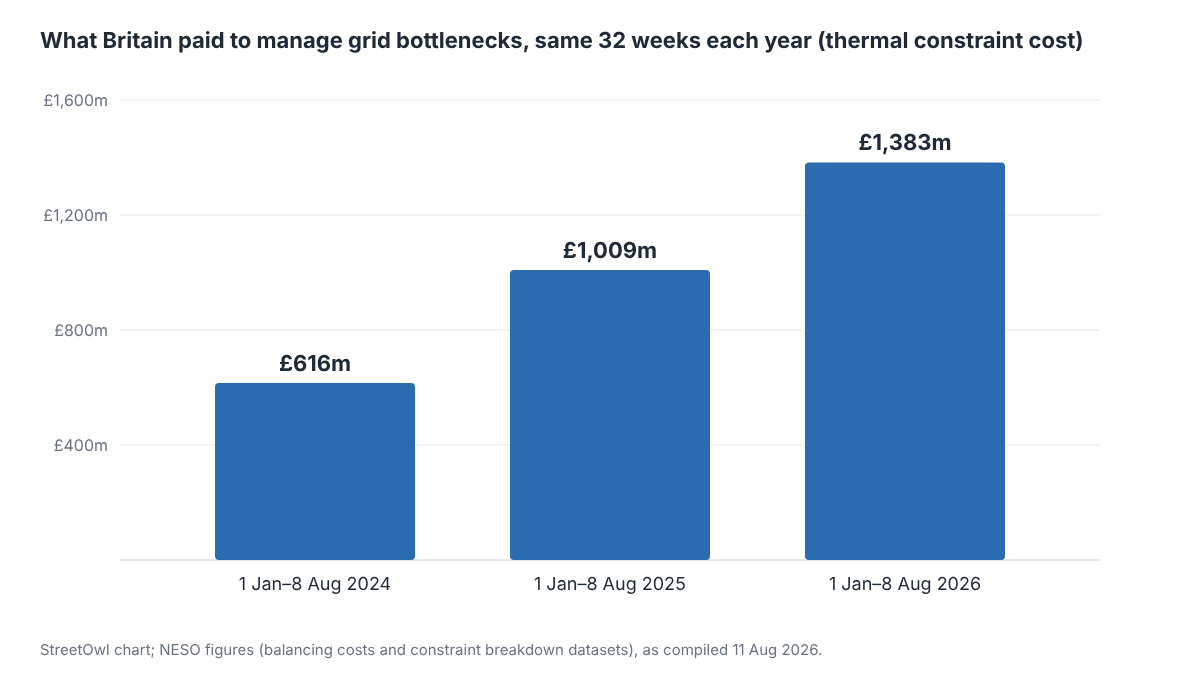
The sums are no longer small. In the first 32 weeks of 2026 these thermal constraint payments came to £1.38bn, up 37% on the same stretch of 2025 and more than double the same period of 2024; June 2026 alone cost £225m across all constraint types. Wind output on the transmission network was up 22% on a year earlier, so there was simply more electricity trying to cross a boundary that had not grown. The government's own delivery plan, published in April 2026, expects the bill to peak at around £7bn a year by 2030 unless more lines are built. Every pound of it is, in effect, the price of a missing cable.
Who is paid to lay the wire
The cure is transmission, and transmission in Britain is a regulated monopoly: three network owners run the high-voltage grid under licence, one for England and Wales, one for the north of Scotland and one for the south of Scotland. They cannot set their own prices. Instead the regulator, Ofgem, runs a five-year price control that decides how much they may invest and what return they may earn on it.
The current control, RIIO-3, began on 1 April 2026 and runs to 31 March 2031. Ofgem approved £28.1bn of upfront investment, with a wider pipeline of about £90bn that can be released as projects are ready, and set the allowed return on equity for electricity transmission at 5.70% after inflation. The overall cost of capital allowed, around 5.6%, compares with 2.81% under the previous control, because interest rates everywhere have risen. In short, the regulator has decided the bottleneck is worth paying to remove, and has set the price of removing it.
How the asset base turns capex into profit
This is the step that makes the machine compound. A network owner does not earn its return on this year's spending; it earns it on everything it has ever built that is still in service, a figure called the regulated asset value. Every pound of approved spending on a new line joins that base the moment it is spent, and the whole base is uprated each year by CPIH inflation. The allowed return is then applied to the bigger, inflation-adjusted number.
The largest of the three owners spent a record £11.6bn across its networks in the year to March 2026 and has committed at least £70bn over the five years to March 2031. It guides to its asset base growing about 10% a year, to earnings per share growing 13–15% in the current year and 8–10% a year after that, and to a dividend that rises with CPIH. The owner of the north-of-Scotland wires reported transmission profits up 75% last year on a £33bn investment plan to 2030. One rung down the chain, the civil-engineering contractors that dig the trenches and string the lines have 15 grid-upgrade projects in design, most of which move into construction within 18 months.
Why the pressure to build has just gone up
On 23 June 2026, in the heatwave, Britain's grid frequency sagged to 49.657 hertz against a normal band of 49.8 to 50.2, the French interconnector flipped from import to export because power was dearer in France, and the control room cut exports to the Netherlands for two hours. Nobody lost supply, but Ofgem's inquiry update on 19 October found that five network limits were breached that evening, and its conclusions are due in January 2027.
Whatever those conclusions say, a grid that nearly ran out of headroom is an argument for more grid, faster, and the regulator has already said it will fund projects pulled forward from 2031 to 2030 to cut the constraint bill. The first large new Scotland–England links are targeted for 2029; until they open, the cost of the missing wire keeps rising, and so does the asset base of the companies being paid to lay it.
Who gains and who pays
Households pay twice today, through balancing costs on every bill, and will pay a return on the new lines for decades through network charges. The network owners and their shareholders earn the allowed return on a growing base; the contractors and cable makers earn the construction margin. Scottish wind farms are paid to switch off today and will be paid to generate once the lines exist. What could change the arithmetic: a regulator or court cutting the allowed return, a rise in real interest rates that makes a 5.7% real return look ordinary, a company needing fresh equity to fund the build, and the worldwide queue for high-voltage cable and transformers, which decides whether the money can be spent on time.
Sources
- Tim Harper, UK wind curtailment costs pass £1 billion in 2026 (NESO data), 11 Aug 2026
- Ashurst, RIIO-3: Ofgem's final determinations at a glance, Dec 2025
- Ofgem, RIIO-3 Final Determinations, 4 Dec 2025
- National Grid plc, full-year results to 31 March 2026, 14 May 2026 (as reported by Josh Thompson)
- AJ Bell, SSE delivers top-end earnings and higher dividend as capex picks up, 28 May 2026
- Scottish Construction Now, Balfour Beatty AGM trading update, 7 May 2026
- Ofgem, inquiry into electricity system operation during the June 2026 heatwave, update, Oct 2026
- NESO, June 2026 monthly balancing cost report
This piece was researched with AI from the public sources named and written up and checked by Michael Rossi before it went up. It describes how one thing moves another; it names no investment and is not financial advice.
← Back to StreetOwl