Why Brazil's real fell 8% in a day while its oil exports hit a record
Brazil now sells more crude oil than soybeans and runs a record trade surplus, yet its currency dropped 8% on Monday because the election result changed what investors expect the government to spend, not what the country earns.
A political result, and a currency move in a morning
On Sunday 25 October 2026 Brazil re-elected President Lula by 51.8% to 48.2% over Flávio Bolsonaro, a result the markets had bet against. When trading opened on Monday the dollar jumped from R$4.99 on Friday to about R$5.42 within minutes, touched R$5.60 during the day and closed near R$5.38, a fall of about 8% for the real. The São Paulo stock market fell 13.9% and was halted for half an hour, and the Treasury cancelled two of its bond auctions for the week. Bolsonaro has not conceded and is contesting the count in court; the electoral court has confirmed the result.
For a British traveller the move was simple: a pound bought about R$6.66 on Friday and about R$7.20 on Monday night.
What Brazil sells, and to whom
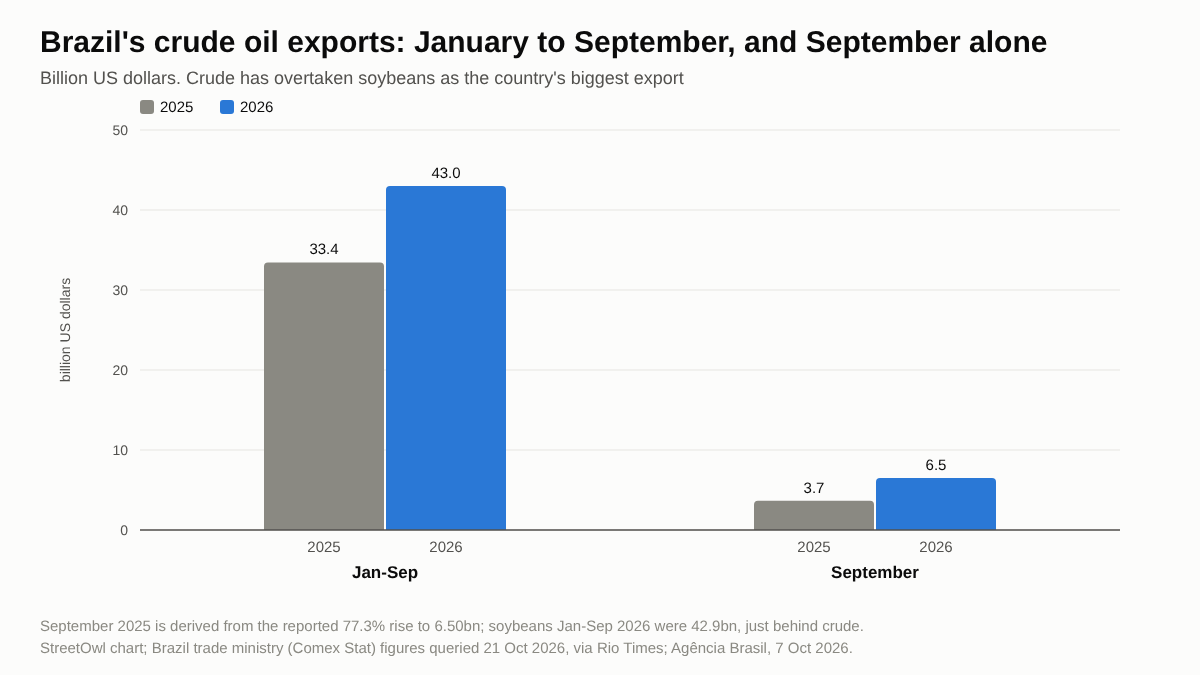
Brazil has become one of the few large oil exporters outside the Gulf. Crude production reached a record 4.24 million barrels a day in March 2026, four-fifths of it from deep 'pre-salt' fields that the national oil company says break even below 35 dollars a barrel. In the first nine months of 2026 crude exports were worth 43.0 billion dollars, up 28.6% on a year earlier, and in September alone 6.5 billion dollars, up 77%, as Brent oil rose towards 115 dollars while Gulf tankers were being attacked. Crude has just overtaken soybeans as the country's biggest export.
Half of those barrels (50.7%) go to China, 7% to India and about a fifth to the European Union through Rotterdam, Spain and Portugal: the buyers are the economies that cannot rely on Gulf supply. The nine-month trade surplus was 62.4 billion dollars, up 35%, and the oil surplus alone was 31.2 billion dollars, roughly half of it. September's surplus of 7.74 billion dollars was two and a half times the figure for September 2025.
What Brazil buys
The weak leg is fertiliser. Brazil imports 88% of what its farms use, including 95% of its nitrogen and 96% of its potash, and the Gulf is the world's largest exporter of urea and ammonia. Fertiliser prices have risen faster than soybean and maize prices since the Middle East conflict began, and the buying season for the 2026/27 soybean crop is open now. So Brazilian farmers pay the Gulf premium while Brazilian oil companies collect it; on balance the country gains, which is why the surplus is a record despite the fertiliser bill.
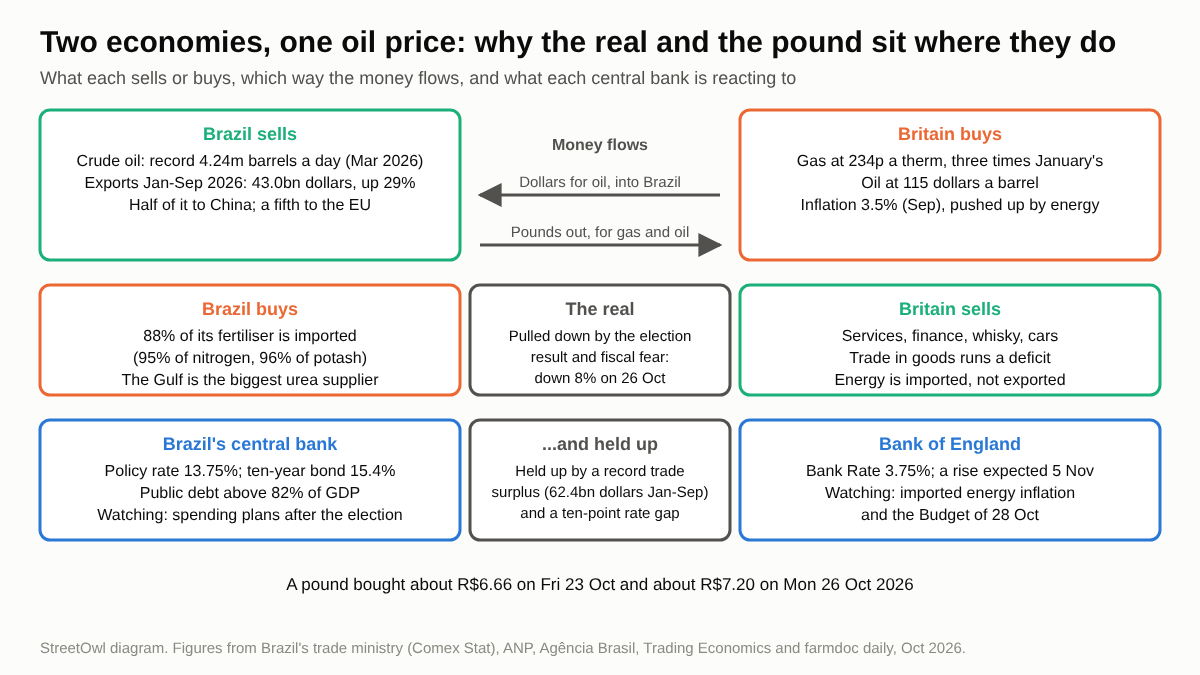
Britain sits on the other side of both trades. It buys its gas at 234p a therm, three times the January price, and its oil at 115 dollars, and its September inflation of 3.5% was pushed up by energy.
What is holding the real down, and what is holding it up
Pulling it down: investors had expected a Bolsonaro government to cut spending, and now expect more spending under Lula, with public debt already above 82% of GDP and a budget-surplus goal of 1.3% of GDP not due until 2030. Brazil's ten-year bond already yields 15.4%, so the market demands a large premium for that risk. And the US Federal Reserve is expected to raise rates in December, which pulls money out of every emerging market at once.
Holding it up: the central bank's policy rate of 13.75%, ten points above Bank Rate even after the rise the Bank of England is expected to make on 5 November, and that record trade surplus. The dated events that could change the picture are Lula's choice of finance minister, the Brazilian rate decision on 4 November, the US rate decision on 28 October, and any settlement between the United States and Iran that brings the oil price down.
What it means for a British household
Holiday money first: £100 bought about R$720 on Monday against about R$666 on Friday, so Brazil just became roughly 8% cheaper for a British visitor; StreetOwl's Holiday money board on the Travel tab shows what £100 buys. Then the shopping basket: Britain's coffee, orange juice and much of the soy that feeds its livestock come largely from Brazil, and a weaker real tends to lower their price in pounds over the following months, though it also makes Brazil's imported fertiliser dearer, which works the other way with a longer lag.
Sources
- Al Jazeera, Brazil's real sinks after Lula's re-election victory, 26 October 2026
- Rio Times, Brazil's real sinks 8% after Lula win, 26 October 2026
- Rio Times, Brazil financial morning call, 27 October 2026
- Trading Economics, Brazilian real, 26 October 2026
- Rio Times, Brazil oil exports top soy at US$43 billion in nine months (Comex Stat), October 2026
- Agência Brasil, Brazil's trade balance posts USD 7.74bn surplus in September, 7 October 2026
- Discovery Alert, Brazil's record oil production (ANP data for March 2026)
- farmdoc daily, Middle East conflict revives concerns over fertilizer dependence in the US and Brazil, April 2026
- B3 Bora Investir, Copom calendar 2026
- Trading Economics, British pound, 27 October 2026
- Trading Economics, UK natural gas, 26 October 2026
- Trading Economics, Brent crude oil, 27 October 2026
- FXStreet, British pound slips as Fed decision and UK budget test sterling bulls, 26 October 2026
This piece was researched with AI from the public sources named and written up and checked by Michael Rossi before it went up. It explains why a currency moves; it is not advice to buy or sell any currency and is not financial advice.
← Back to StreetOwl