Why Australia's dollar is being paid while the Swiss franc is being borrowed
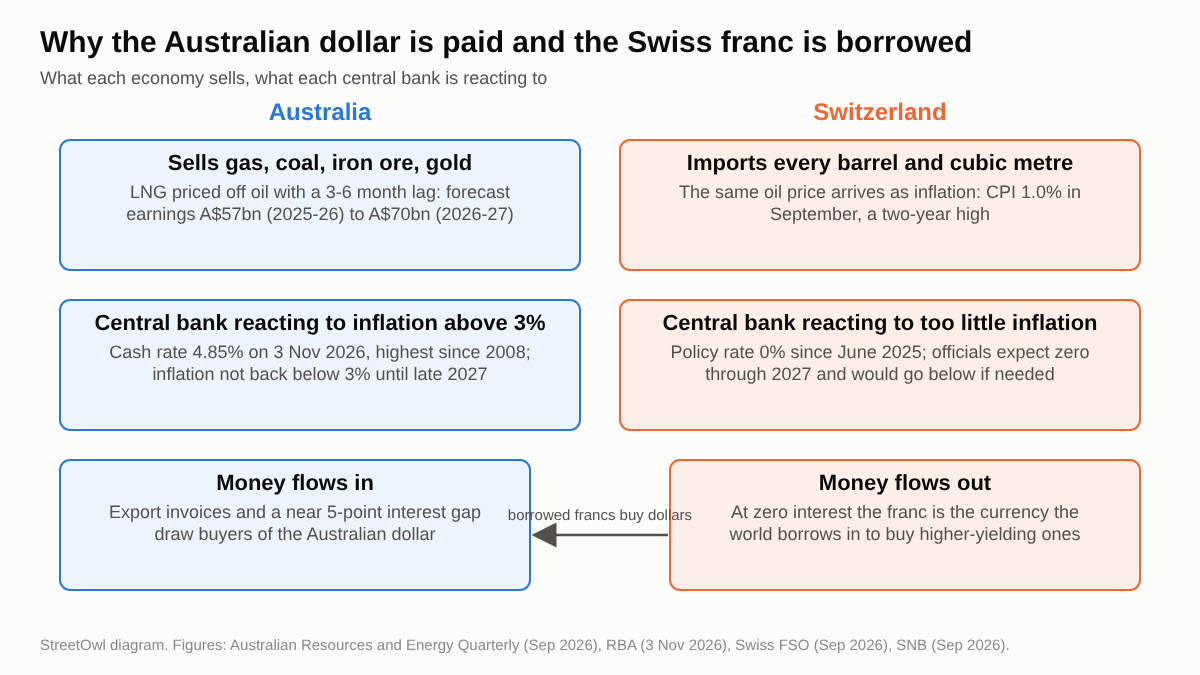
Australia sells gas on contracts that follow the oil price with a lag, so this year's expensive oil is landing in its invoices now and its central bank keeps raising rates; Switzerland imports every barrel and holds its rate at zero, so the franc has become the currency the world borrows.
On 3 November the Reserve Bank of Australia raised its cash rate to 4.85 per cent, the highest since December 2008 and the fifth rise this year, on a six-to-three vote. It expects inflation to stay above 3 per cent for the coming year and not to reach the top of its target band until late 2027, three quarters later than it forecast in August. The reason it gave was partly the Middle East: global oil supply disruptions are keeping fuel and commodity prices high.
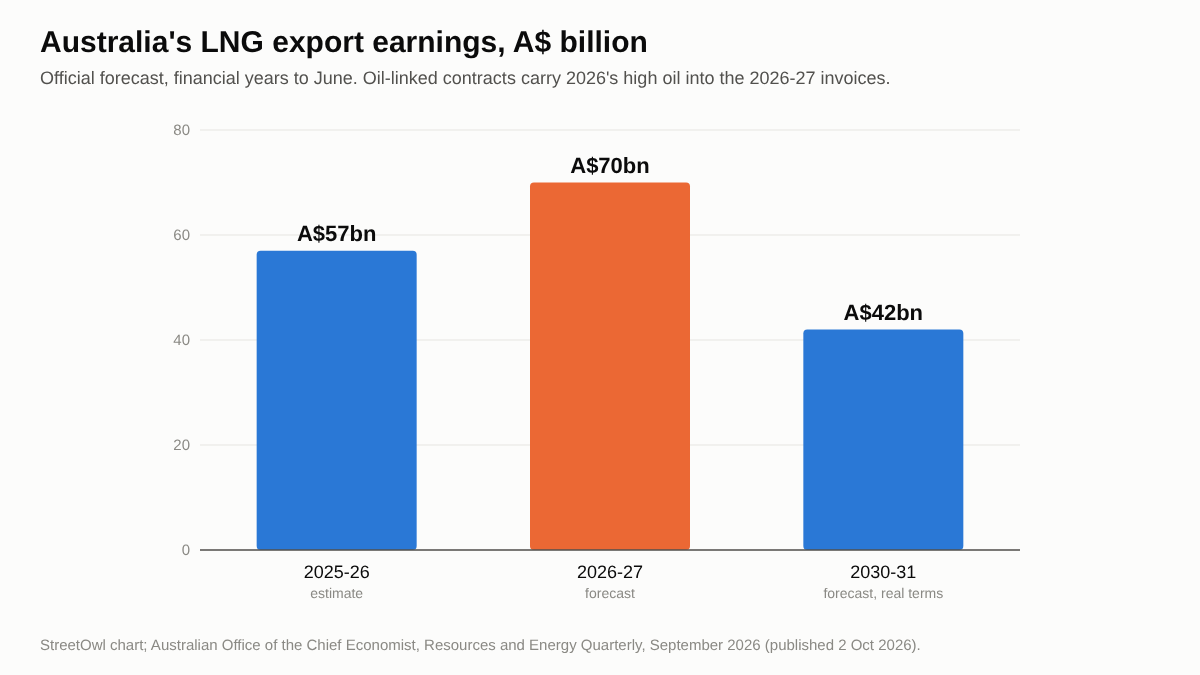
That same oil price is Australia's income. The country sells liquefied natural gas to Japan, China, Korea and Taiwan on long contracts indexed to oil with a lag of three to six months, so the invoices for the second half of 2026 and the first quarter of 2027 carry the $100-plus oil of the spring and summer even as spot cargoes wobble on peace talk. The Office of the Chief Economist's September quarterly puts LNG export earnings at A$57bn in 2025-26, rising to A$70bn in 2026-27, within a record A$422bn of resources and energy exports, and expects the lift to last through roughly 2027.
The mirror image
Switzerland imports every barrel of oil and every cubic metre of gas it uses, so the same price arrives there as inflation it does not want. Swiss consumer prices rose 1.0 per cent in the year to September, the fastest since 2024, driven by transport, energy and a weaker franc. The Swiss National Bank has kept its policy rate at zero since June 2025, its officials expect it to stay there through 2027, and they have said they would take it below zero if needed.
A currency that pays nothing becomes the one the world borrows. Investors sell francs to buy currencies that pay more, and nearly 5 percentage points separate Australian and Swiss short-term rates. The franc has drifted all year: a franc bought A$1.89 at the end of December 2025 and A$1.71 at the end of September, and on 2 November an Australian dollar bought 0.579 francs, inside a one-year range of 0.529 to 0.587.
What could change it
Australia's trade surplus narrowed to A$495m in August from A$1.35bn in July, but on a 22 per cent jump in capital-goods imports and a 91 per cent jump in gold imports rather than on weaker fuel exports; coal exports rose 4.7 per cent and other mineral fuels 2.8 per cent. September's figures are due on 5 November. Iron ore unit values fell 4.4 per cent in August, a reminder that China's demand is the other half of the Australian story. A settlement in the Gulf that took oil back to $80 would shrink the 2027 invoices, though not the ones already written. And in any sudden fright the franc still attracts money seeking safety, whatever its interest rate.
For a British household the pound bought A$1.91 and CHF 1.10 on 2 November. The Holiday money board on StreetOwl's Travel tab shows what £100 buys in each; if Australia's dollar keeps being paid, an Australian holiday gets dearer and a Swiss one no cheaper. Britain imports little from either country that reaches the weekly shop, so the effect is felt at the bureau de change rather than at the till.
Sources
- Reserve Bank of Australia, monetary policy decision, 3 Nov 2026
- ABC News, RBA lifts interest rates to highest level in 18 years, 3 Nov 2026
- Discovery Alert on the Resources and Energy Quarterly, September 2026, 5 Oct 2026
- Reuters via Yahoo Finance UK, Australia trade surplus shrinks in August, 30 Sep 2026
- Trading Economics, Swiss inflation hits two-year high, 1 Oct 2026
- CNBC, Swiss National Bank holds rates at 0%, 24 Sep 2026
- OFX, CHF to AUD exchange rate history, 2 Nov 2026
This piece was researched with AI from the public sources named and written up and checked by Michael Rossi before it went up. It explains why a currency moves; it is not advice to buy or sell any currency and is not financial advice.
← Back to StreetOwl