Why a Wall Street sell-off is sold through the Australian dollar first, and what Wednesday's inflation number does to it
When US shares fall overnight the Australian dollar is the liquid currency Asian markets sell, the yen-funded carry trade unwinds through it, and speculators who were already betting against it add to the fall; only a dated reason, such as Wednesday's inflation print, makes them change their minds.
What happened on Friday, and where it landed
On Friday 20 November 2026 the S&P 500 fell 3.7% and the Nasdaq 5.3%, and the VIX, Wall Street's measure of expected swings, closed near 36. The first currency to feel it was not the dollar or the pound but the Australian dollar, which was the weakest major currency of the week. One Australian dollar bought C$0.955 on Friday, down from C$0.993 on 14 October, a fall of 3.8% in five weeks.
That order of events repeats whenever Wall Street sells off, and the reason is in the plumbing of the currency market rather than in anything Australia did.
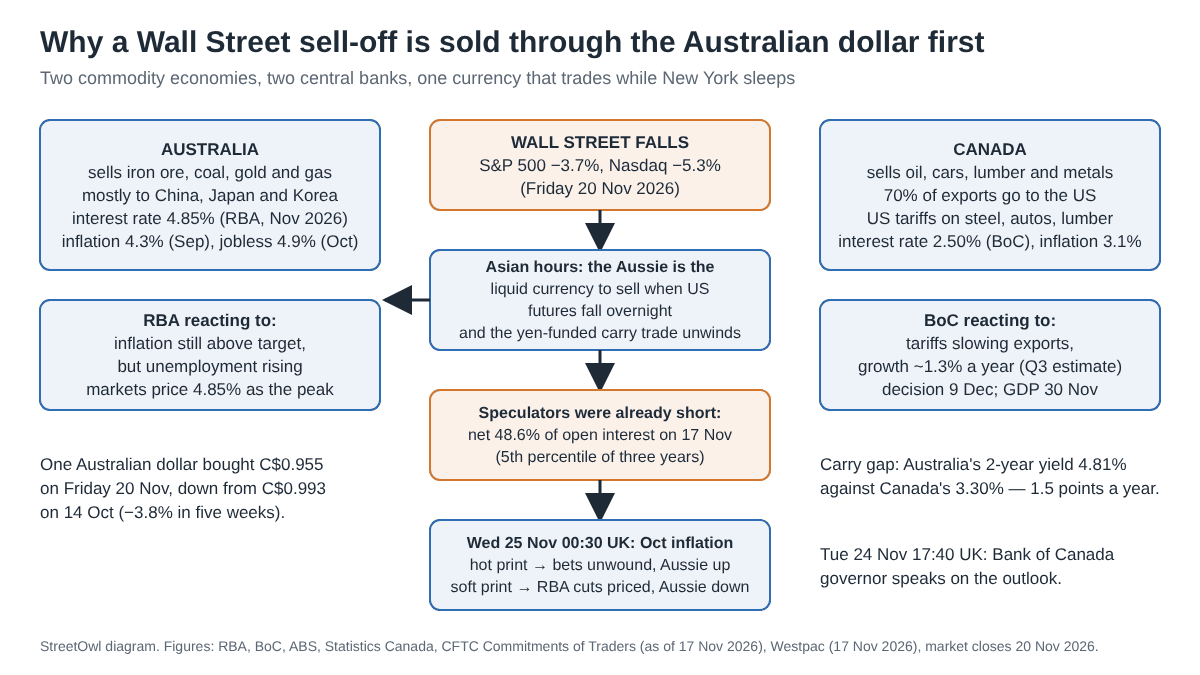
Three gears
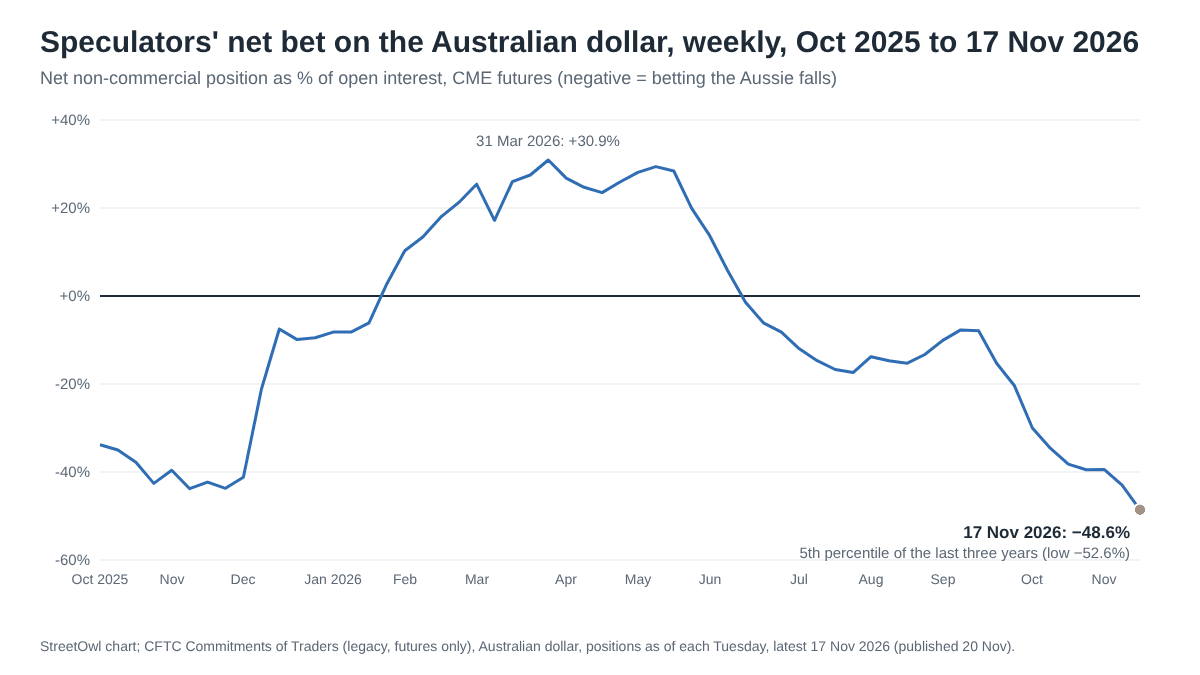
First, time zone and liquidity. When US share futures fall after New York closes, the dealers and funds in Sydney, Tokyo and Singapore want a quick, deep market in which to cut risk. The Australian dollar is one of the few that trades heavily in those hours, so it carries the first move. Second, the carry trade. Australia's central bank rate is 4.85% after four rises this year, Japan's is a fraction of that, so investors have borrowed yen to hold Australian dollars and collect the gap. On a bad day that trade is unwound: the Australian dollar has fallen from ¥114.95 to about ¥105.5 since its peak. Third, the crowd. Speculators were already betting against the Australian dollar before Friday: on 17 November their net short was 48.6% of all open contracts in the Chicago futures market, the heaviest in a year and in the bottom twentieth of the last three years. A market that is already short falls faster when news arrives, and it rises sharply when the shorts are forced to buy back.
Canada sits on the other side of the pair for a different reason. Seven tenths of Canada's exports go to the United States, and US tariffs on steel, cars and lumber have cut the volumes; the Bank of Canada's rate is 2.50%, inflation 3.1%, and Statistics Canada reports the July-to-September national accounts on 30 November, with private forecasts near 1.3% annualised growth. The Bank's governor speaks on the outlook on Tuesday 24 November at 17:40 UK time.
Wednesday's number
The event that can turn the Australian dollar is dated: the Australian Bureau of Statistics publishes October's monthly consumer price index at 00:30 UK time on Wednesday 25 November. Westpac expects headline inflation of 4.8% over the year, up from 4.3% in September, with fuel up 8.2% in the month, and the trimmed mean, the measure the Reserve Bank of Australia watches, at 3.7% from 3.6%.
Money markets price 4.85% as the peak of the Reserve Bank's cycle, with about a third of a point of cuts over the next year, after unemployment rose to 4.9% in October and the November business survey fell to its weakest since 2021. A trimmed-mean reading of 0.4% in the month or higher keeps cuts off the table and leaves the carry intact, which is what makes the shorts buy back. A reading of 0.3% or lower brings cuts forward and the currency falls again. In a week when shares are still falling, the carry unwind can swamp an inflation surprise for a day or two.
What it means for a British household
A pound bought about A$1.97 on Friday 20 November, close to its best level of the year, so Australian holiday money is cheaper than it was in the summer; StreetOwl's Holiday money board on the Travel tab shows what £100 buys today. Against the Canadian dollar a pound bought C$1.88, in a range this year of C$1.80 to C$1.90.
Britain imports little directly from Australia that reaches the weekly shop, but Australian coal, gas and iron ore set world prices that feed into British energy and steel costs; a weaker Australian dollar tends to go with weaker commodity prices, which is mildly good news for bills.
Sources
- CFTC, Commitments of Traders, CME futures only, bets as of 17 November 2026
- ActionForex, AUD faces asymmetric CPI downside risk, 23 November 2026
- Westpac IQ, October CPI preview, 17 November 2026
- Continuum Economics, Canada Q3 GDP preview, 13 November 2026
- Bank of Canada, speech by Governor Tiff Macklem, 24 November 2026
- Reserve Bank of Australia and Bank of Canada policy rates; ABS labour force October 2026; exchange-rate closes 20 November 2026 (fundamentals_fx daily files)
This piece was drafted by AI from the public sources named, then read and approved by Michael Rossi before it went up. It explains why a currency moves; it is not advice to buy or sell any currency and is not financial advice.
← Back to StreetOwl