Why a record year for student numbers has not lifted student rents
More British 18-year-olds than ever went to university this autumn, but the rent on a student room is set by the late-booking international postgraduate, and that queue has thinned, so the blocks are full and the rent is flat.
Two queues at every university
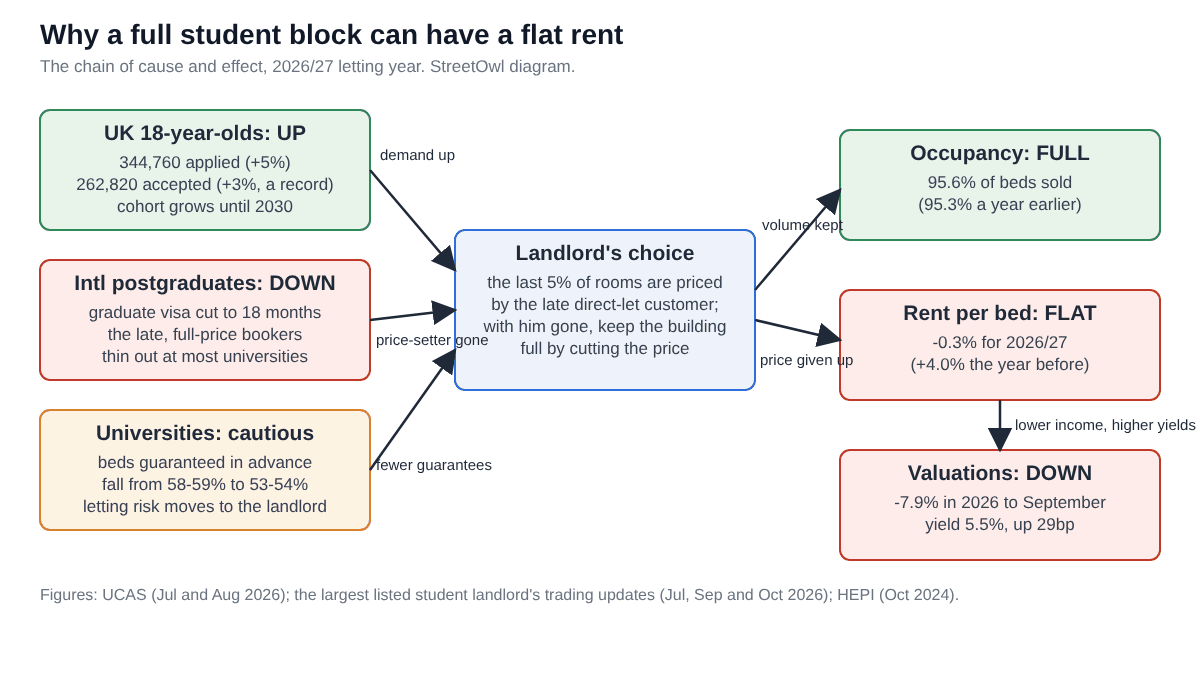
Every British university runs two queues of students, and they are moving in opposite directions. The first is UK 18-year-olds. A record 344,760 of them applied this cycle, up 5% on last year, and 262,820 were accepted in August, up 3% and the highest ever (UCAS, July and August 2026). The cohort keeps growing until 2030 because of the mid-2000s baby bulge, after which it falls by about 7% to 2035 (HEPI, October 2024).
The second queue is international postgraduates, mostly from China, who book late, pay full rent and sign nothing with the university. That queue shortened after the post-study work visa was cut from three years to eighteen months. The largest listed student landlord says postgraduate demand is down at all but the very best universities (trading update, 8 October 2026).
Who sets the price of a student room
A purpose-built student block is let in two ways. Most 18-year-olds arrive through a nomination agreement, a bed the university has guaranteed at a contracted price. The late international postgraduate is the direct-let customer who takes the last few rooms at whatever the market will bear. The rent on the whole building is set by that last customer, not by the first.
Remove the late bookers and the landlord has a choice: leave rooms empty or fill them by cutting the price. Universities, short of money, also guaranteed fewer beds this year: the share of the largest landlord's beds covered by nominations fell from 58-59% to 53-54%, which moves the letting risk from the campus to the landlord.
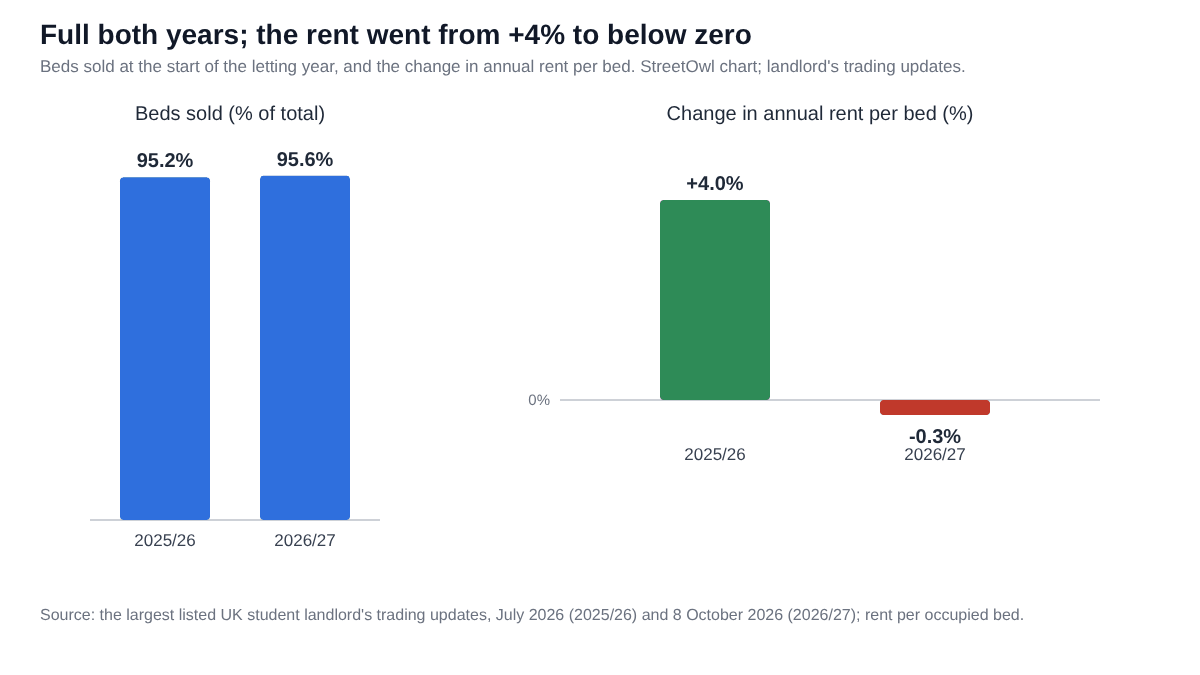
The result for 2026/27 is a full building and a flat rent. 95.6% of beds were sold against 95.3% a year earlier, the annual rent per bed fell 0.3% after rising 4.0% the year before, and like-for-like income grew 0.6%. Earnings per share are guided 7-10% lower than in 2025.
Why the valuers followed
Property is valued on the income it earns and the yield buyers demand. With income flat and interest rates higher, the landlord's main fund lost 7.9% of its value in the nine months to September 2026 as its yield rose 29 basis points to 5.5%, and net asset value per share fell from 986p in June 2025 to 865p in June 2026. Borrowing rose to 36% of asset value after an acquisition, and the cost of that debt is heading from 3.9% to 4.3%.
Three things do not change for four years. The 18-year-old cohort rises until 2030, and UK undergraduates are 82% of the landlord's demand. Almost nobody is building: the largest landlord's own pipeline ends with its Glasgow scheme and it is selling 15,000-20,000 lower-growth beds. And universities under financial strain cannot build halls themselves, so when the late queue returns, guaranteeing beds with a private landlord is their cheapest route.
What a general reader should take from it: a student room costs what the last person to book is willing to pay. A record intake of first-years fills the buildings; it does not, by itself, raise the rent. The rent moves when the late, full-price bookers come back, and a visa rule in Whitehall decides that as much as any demographic chart.
Sources
- UCAS, Quarter of a million UK 18-year-olds gain place at university or college, 13 August 2026
- UCAS, Record number of UK school leavers head into the results period with an offer, 16 July 2026
- HEPI, Student Demand to 2035, October 2024
- Unite Group, trading update and Q3 fund valuations, 8 October 2026
- Unite Group, interim results for the half-year to 30 June 2026, 28 July 2026
- Alliance News via AJ Bell, Unite Group shares fall amid stable occupancy but soft income growth, 17 September 2026
This piece was drafted by AI from the public sources named, then read and approved by Michael Rossi before it went up. It describes how one thing moves another; it names no investment and is not financial advice.
← Back to StreetOwl