Why a five-point tax on fruit machines closes bookmakers but barely dents the casino next door
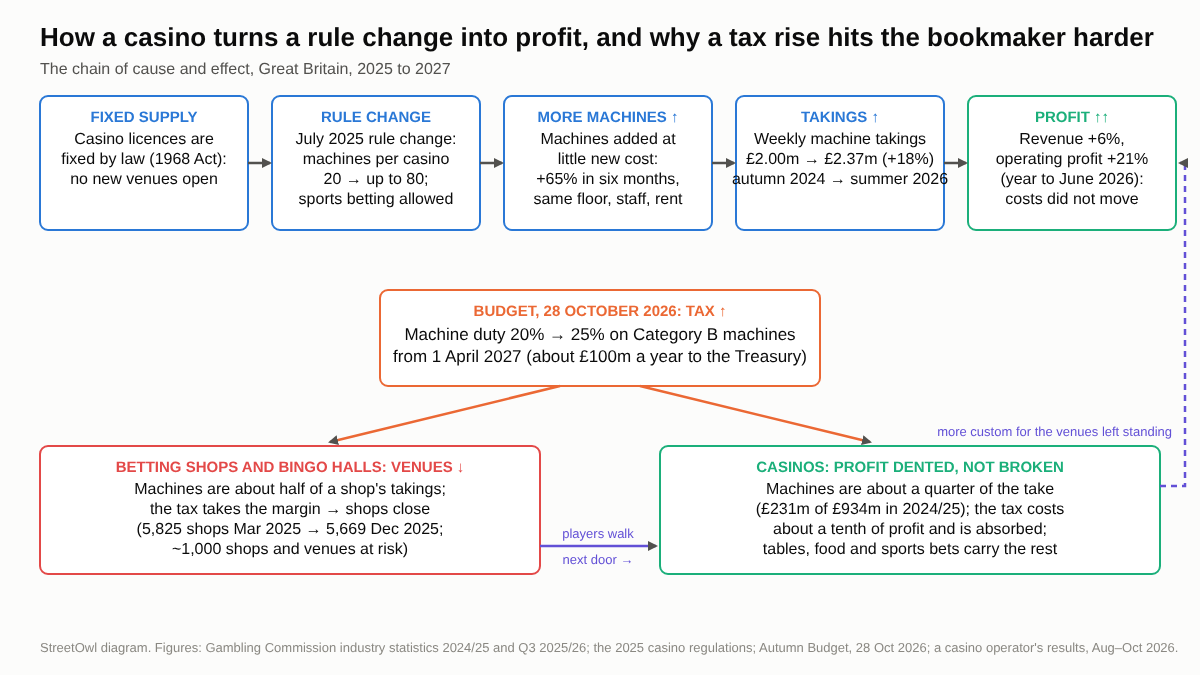
Casino licences are fixed by law, a 2025 rule change let each casino run four times as many machines on the same floor, so takings and profit rose with little new cost; the Budget's duty rise takes a slice of that, but it takes a far bigger slice from betting shops, where machines are half the business, so shops close and their players walk to the venues left standing.
A tax rise that lifted the shares
On 28 October 2026 the Chancellor raised Machine Games Duty, the tax on the takings of gaming machines, from 20% to 25% on the Category B machines found in casinos, betting shops and bingo halls. It starts on 1 April 2027 and the Office for Budget Responsibility expects it to raise about £100m a year. The gambling trade had spent the autumn warning that a rise to 40% was coming, and on Budget day the shares of the main land-based operators rose by between 4% and 9%: a tax increase, greeted with relief, because a bigger one had been feared.
That relief is the surface. The machine underneath is about licences, floor space and which venues can carry a tax and which cannot.
The supply of venues is fixed, and shrinking
Land-based gambling in Britain is a fixed-supply business. Most casinos trade on licences issued under the 1968 Gaming Act, and no new ones are granted; a handful of casinos were added under the 2005 Act and that door is also closed. Betting shops need a premises licence and nobody is opening them: the Gambling Commission counted 5,825 in March 2025 and 5,669 nine months later. Bingo halls are closing faster still; the largest chain has gone from 72 clubs in 2021 to 41.
The pot being shared out is growing. Takings at Britain's land-based casinos rose 7.9% to £933.8m in the year to March 2025, and about a quarter of that, £231.5m, came from gaming machines. A fixed number of doors and a growing pot means the gambling pound concentrates on whoever is left standing.
The rule change nobody outside the trade noticed
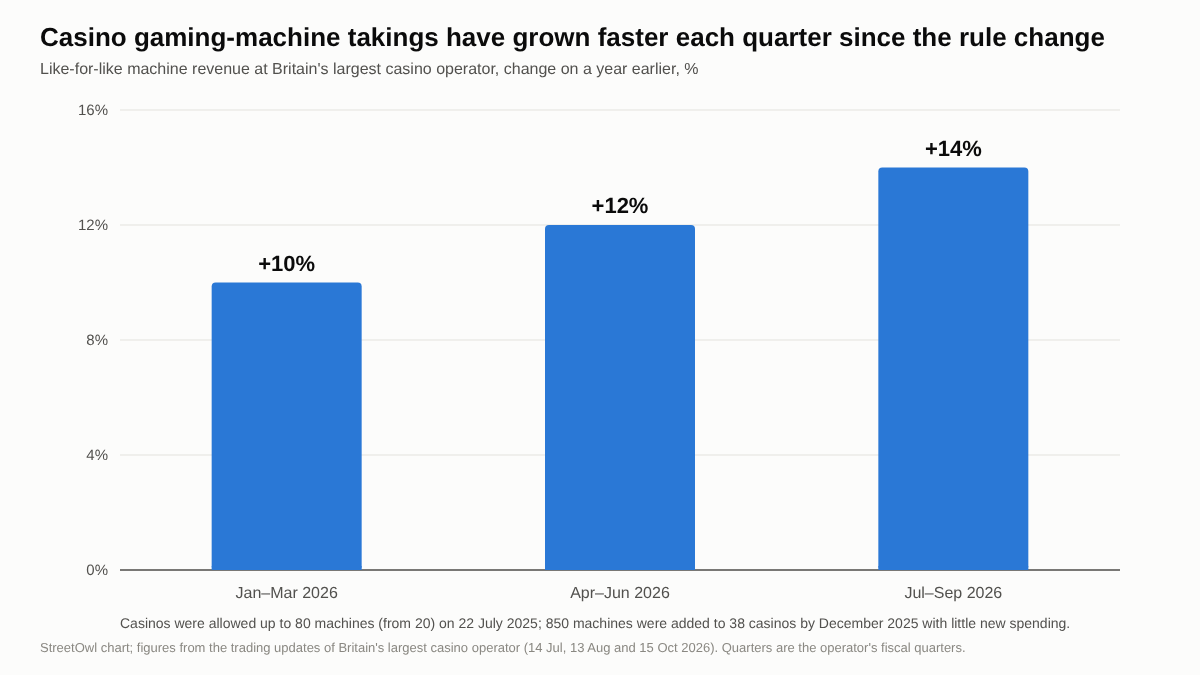
On 22 July 2025 the government let the old 1968 Act casinos run five machines for every gaming table, up to 80, instead of a flat 20, and allowed them to take sports bets on the floor. Britain's largest casino operator put 850 extra machines into 38 of its casinos within six months, a 65% increase, with what it described as minimal capital spending. The floor, the staff, the rent and the licence were already paid for.
The effect shows in the takings. Average weekly machine revenue across its casinos went from £2.00m in the autumn of 2024 to £2.37m by the summer of 2026, and machine revenue grew 10%, then 12%, then 14% in successive quarters. Because the costs did not move, its operating profit rose 21% on revenue up 6% in the year to June 2026. That is what economists call operating leverage, and here it was created by a change in the rules rather than by a single new customer.
Why the same five points hurts a shop more than a casino
The duty is charged on what the machines take. In a casino, machines are roughly a quarter of the takings; tables, food and drink and now sports betting make up the rest. In a betting shop, machines are around half of revenue, and the shop has little else to lean on. So the same five-point rise is a trim for a casino, where the largest operator puts the cost at about £9m a year, roughly a tenth of its profit, and a closure notice for a marginal bookmaker.
The closures are already under way. One bookmaker shut 270 shops in the year to October; another counts a £25m annual hit to its shop estate; the Betting and Gaming Council says around 1,000 shops and venues are at risk. Every closed shop sends its machine players to the surviving venues nearby, and casinos can now take their football bets as well. For the venues that remain, a tax that was expected to shrink the sector is instead a redistribution of their competitors' customers.
What could change it
Two consecutive Budgets have raised gambling taxes: remote gaming duty on online casinos went from 21% to 40% in April 2026, and a third rise next November would hit casinos as hard as the 40% that was feared this time. The extra machines are a step, not a slope: by next summer the comparison is against floors that already have them, and growth settles back to what players spend per visit. Scotland is excluded from the casino reforms. And machines are played with disposable income, which inflation heading towards 5% is squeezing.
The numbers that will tell are the quarterly machine takings of the big casino operators, HMRC's monthly Machine Games Duty receipts once the new rate starts in April 2027, and the Gambling Commission's count of betting shops, which says how many players are being sent next door.
Sources
- CasinoBeats, 29 October 2026 — Machine Games Duty: Budget pulls Category B machines into 25% rate from April 2027
- Gambling.com, October 2026 — UK Budget lifts Machine Games Duty to 25%, not the feared 40%
- Irwin Mitchell, 24 July 2025 — Land-based casino regulations come into force
- Gambling Commission, 25 November 2025 — Industry statistics, April 2024 to March 2025
- Gambling Commission, 4 June 2026 — Industry statistics, quarterly report Q3 2025/26
- Britain's largest casino operator, 13 August 2026 — Full-year results to 30 June 2026
- Britain's largest casino operator, 15 October 2026 — First-quarter trading update
- Britain's largest casino operator, 28 October 2026 — Autumn Budget impact
This piece was drafted by AI from the public sources named, then read and approved by Michael Rossi before it went up. It describes how one thing moves another; it names no investment and is not financial advice.
← Back to StreetOwl