Why a closed strait has sent Asia back to the fuel Britain gave up
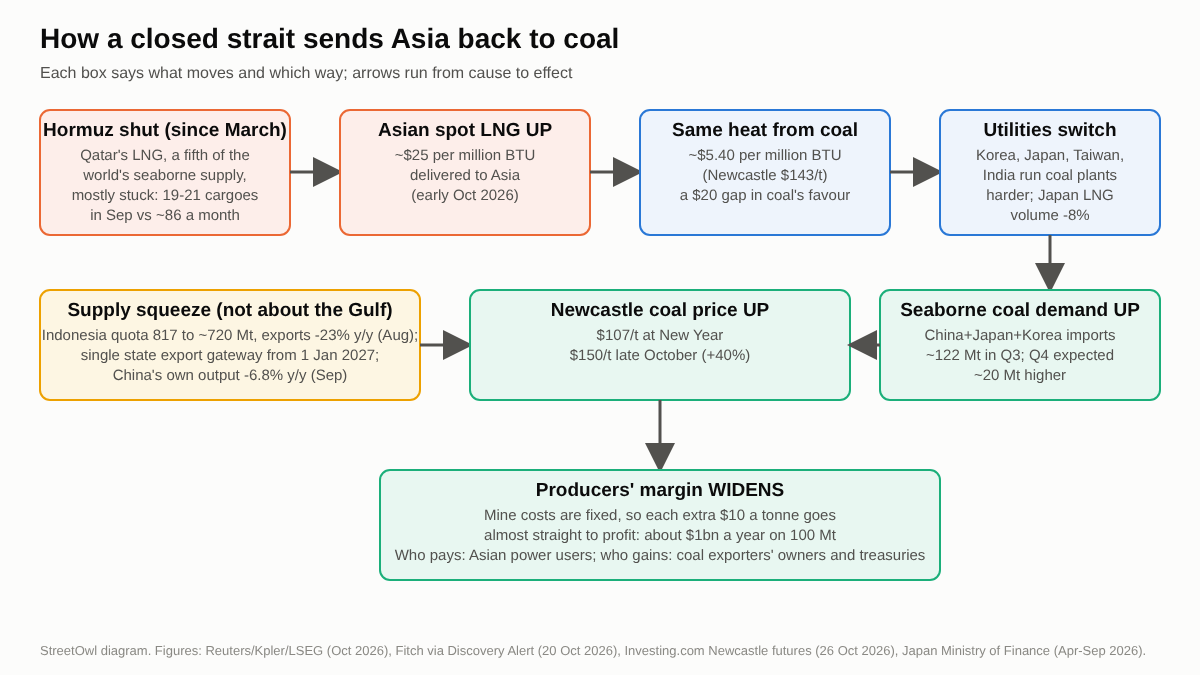
Hormuz is shut, so Qatar's gas cannot reach Asia, so gas by ship costs five times what coal costs for the same heat, so power stations burn coal instead, so coal exporters earn more on every tonne.
A power station buys heat, not fuel
Before the war a utility in Korea or Japan could choose between gas and coal on price and on politics. Since the Strait of Hormuz closed in March there has been no choice. Qatar supplies about a fifth of the world's seaborne liquefied natural gas, and almost all of it has been stuck behind the strait: 18 cargoes left in the first six months of the war against 509 a year earlier, September's 19 to 21 exits were the best month yet and still some 80% below the roughly 86 a month of normal times, and QatarEnergy has extended force majeure on deliveries to early December. Two of the fourteen production trains at Ras Laffan were damaged and will take about three years to repair.
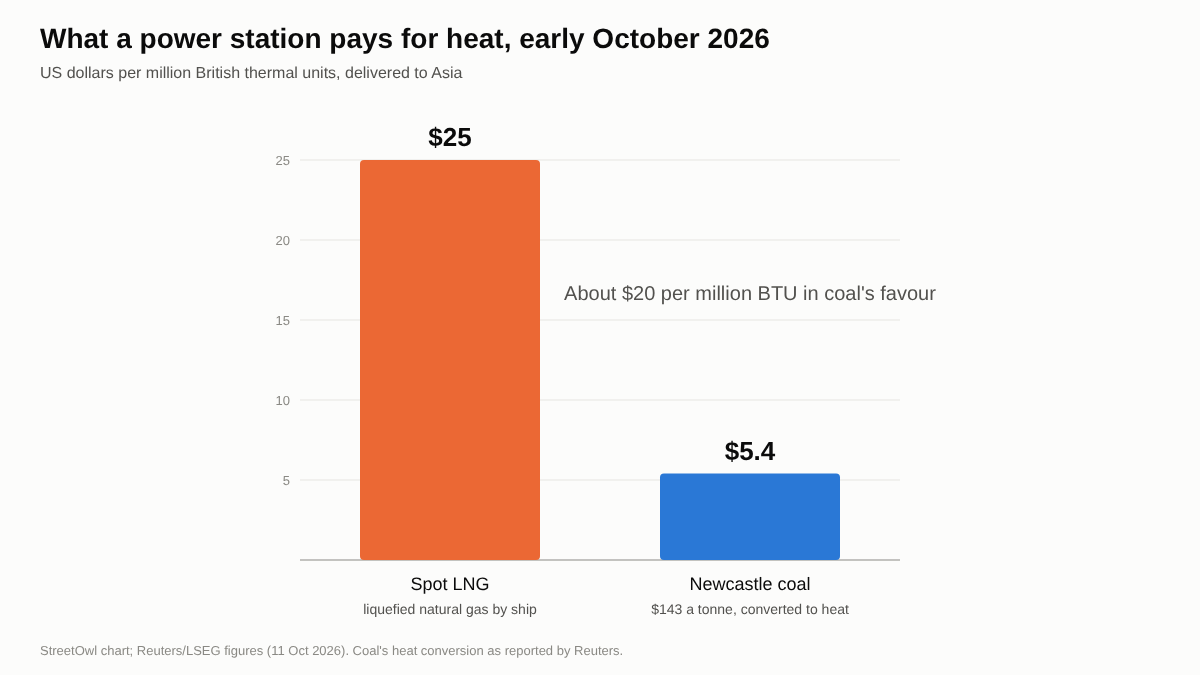
The result is a price gap that decides what gets burned. Spot LNG delivered to Asia was about $25 per million British thermal units in early October, according to LSEG figures reported by Reuters. Newcastle coal, the Asian benchmark, at $143 a tonne delivered the same heat for about $5.40. A utility with a coal plant runs it flat out and goes shopping for coal.
The demand shock, in customs data
Reuters, using Kpler ship-tracking, has China, Japan and South Korea importing about 122 million tonnes of seaborne coal in the third quarter and expects the fourth quarter, when winter heating demand arrives, to run about 20 million tonnes higher. South Korea's September imports were up 21% on the year. Japan's Ministry of Finance data for April to September show LNG imports down 8.4% by volume even as the bill for them rose 13.5%: that is what fuel-switching looks like in a trade return.
The supply squeeze has nothing to do with the Gulf
At the same moment, the two biggest sources of coal are tightening for their own reasons. Indonesia, the world's largest exporter, cut its 2026 production quota from 817 million tonnes towards 700 to 750 million, is raising the share producers must sell at home from 25% to perhaps 30%, and from 1 January 2027 routes every export through a single state gateway. Its August exports were 36.1 million tonnes, down 23% on the year, and its third quarter was the weakest since 2021. China's own mines produced 6.8% less in September than a year earlier and 3.5% less over the year to date, so its utilities lean harder on imports when they need them.
A demand shock meeting a supply squeeze is why Newcastle coal began the year near $107 a tonne and closed at $149.75 on 26 October, a rise of about 40%.
Why the price goes straight to the margin
A coal mine's costs are mostly fixed: the wages, the diggers, the railway and the port cost about the same whether the coal sells for $100 or $150. So almost every extra dollar on the price is an extra dollar of profit. For a producer of 100 million tonnes a year, each $10 on the benchmark is worth roughly $1 billion a year. Exporters' half-year results, which covered a period when prices were lower, show margins of under $20 a tonne on thermal coal; the second half is being sold into a market $30 to $40 a tonne higher.
Who pays is Asian electricity users and the treasuries that subsidise them; who gains is the owners of coal mines in Australia, Indonesia, South Africa and Colombia, and the governments that collect royalties on them. For Britain, which closed its last coal-fired power station in 2024 and buys gas instead, the coal revival is a modest relief: every cargo of LNG that an Asian utility no longer needs is one that can come to Europe.
What would change it
A reopened strait would reverse the switch, but slowly: force majeure runs to December, the damaged trains are out for years and winter demand is ahead. Indonesia's quota for 2027 is due around the turn of the year and is the single biggest swing; a generous number or a delayed gateway would loosen supply. And China is importing less seaborne coal than a year ago, down 5.9% in September, so the marginal buyers are Korea, Japan, Taiwan and India, smaller and more price-sensitive markets.
Sources
- Reuters via The Daily Star, Asia's coal imports set to surge as LNG stays costly, 11 October 2026
- Investing.com, Newcastle coal futures historical data, 26 October 2026
- Discovery Alert, Fitch sees thermal coal prices staying high as Indonesia squeezes, 20 October 2026
- Reuters via OE Digital, LNG flows through Hormuz hit seven-month high, 2 October 2026
- Business Today, LNG traffic through Hormuz returns but remains 80% below pre-war levels, 2 October 2026
- OilPrice.com, Japan's trade deficit doubles as Hormuz crisis hikes energy import costs, 21 October 2026
- Canadian Mining Journal, War-driven LNG squeeze revives thermal coal, 24 March 2026
This piece was researched with AI from the public sources named and written up and checked by Michael Rossi before it went up. It describes how one thing moves another; it names no investment and is not financial advice.
← Back to StreetOwl