Why a cheaper barrel of oil helps New Zealand's dollar and hurts Canada's
New Zealand sells milk and buys all its fuel from abroad, Canada sells crude oil, so a 15% fall in the oil price in one week is a gift to one currency and a loss to the other; the election has just removed one of the kiwi's risks and left another until 27 November.
What each country sells
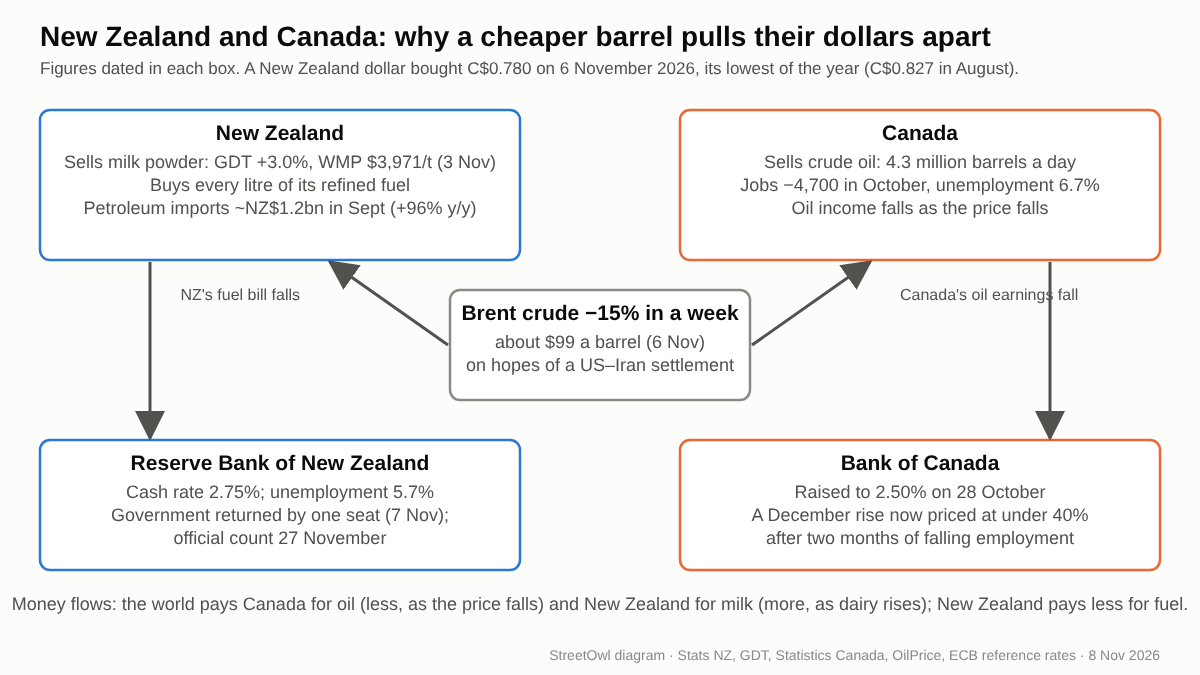
Two countries, two very different shopping lists. New Zealand's biggest export is dairy, and the Global Dairy Trade auction on 3 November rose 3.0%, with whole milk powder at $3,971 a tonne, going into the November and December peak of the milking season. New Zealand has no oil refinery and buys every litre of petrol, diesel and jet fuel from abroad: its petroleum imports were about NZ$1.2bn in September, nearly double a year earlier, because the Gulf war had doubled the price of what it must import.
Canada sells crude oil, about 4.3 million barrels a day, and its dollar rises and falls with the price of that oil. Last week Brent crude fell 15% to around $99 a barrel on expectations of a settlement between the United States and Iran. That one move lowers New Zealand's import bill and lowers Canada's export earnings at the same time, before either central bank does anything.
What the central banks are reacting to
The Bank of Canada raised its rate to 2.50% on 28 October. Nine days later Statistics Canada reported that employment fell by 4,700 in October after a fall of 68,000 in September, and that unemployment had risen to 6.7%, a six-month high; markets now put the chance of another rise in December at under 40%. The Reserve Bank of New Zealand holds its rate at 2.75% with unemployment at 5.7%. Both banks decide again on 9 December.
New Zealand also voted on Saturday. On the preliminary count the governing National Party and its two partners have 67 of 131 seats, where 66 is a majority; about 399,000 special votes, 14% of the total, are still to be counted, and the official result comes on 27 November. A continuity government that campaigned on returning the budget to surplus is the outcome currency markets tend to prefer, but a one-seat margin leaves three weeks in which it could become a negotiation.
What the exchange rate has done
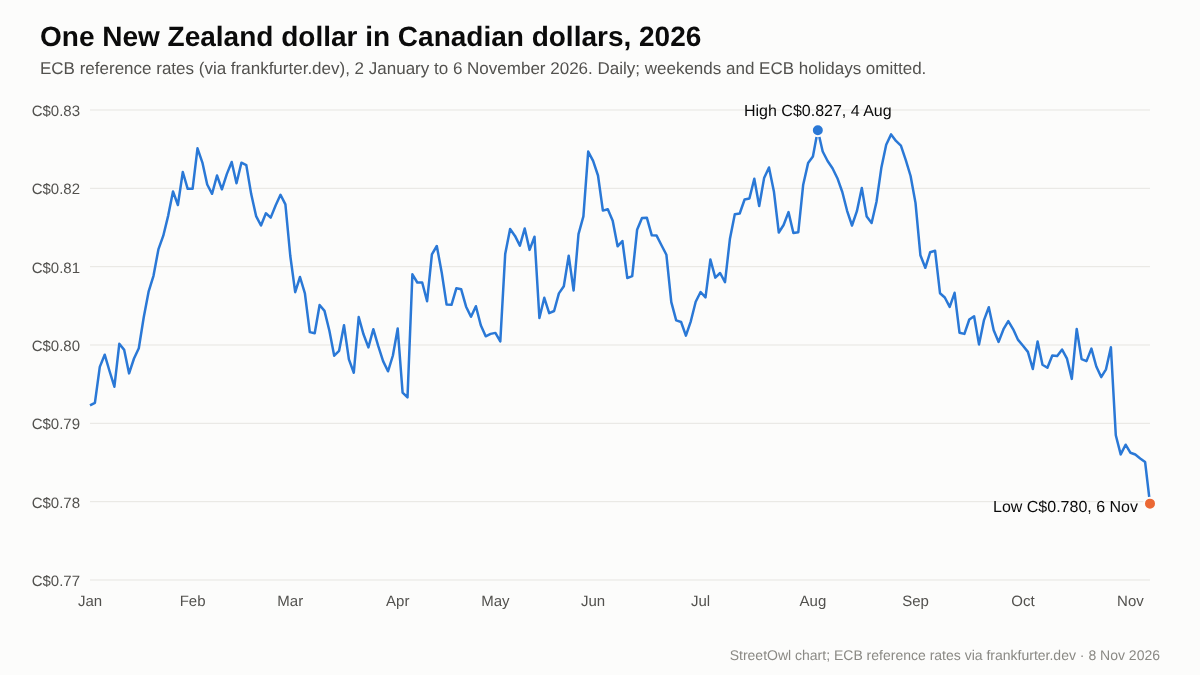
A New Zealand dollar bought C$0.780 on 6 November at the European Central Bank's reference rate, its lowest of 2026; it bought C$0.827 on 4 August and has averaged about C$0.81 this year. The fall came in the last ten days, as Canada raised rates and New Zealand did not, and then as the kiwi slid with other commodity currencies in Thursday's technology sell-off. The oil, dairy and jobs figures above all arrived after that fall.
The dated events that could change the picture: the next dairy auction on 18 November; New Zealand's trade figures around 20 November, which will show whether the fuel bill has started to fall; the official election result on 27 November; Canada's jobs report on 5 December; and the two rate decisions on 9 December. An oil price back above $110, if the talks fail, would turn the arithmetic the other way.
What it means for a British household
The pound bought NZ$2.41 on Friday, the most this year; its range in 2026 has been NZ$2.25 to NZ$2.41. So £100 buys about NZ$241, roughly NZ$16 more than it did in February, and a visit to New Zealand is as cheap in sterling terms as it has been all year. Against the Canadian dollar the pound bought C$1.88, in a range this year of C$1.80 to C$1.90. StreetOwl's Holiday money board on the Travel tab shows what £100 buys in both. Britain imports little from either country that reaches a household bill directly, though New Zealand lamb and butter are sold in a currency that has just got cheaper against the pound.
Sources
- Electoral Commission (New Zealand), 2026 general election preliminary results, 7 November 2026
- Al Jazeera, New Zealand's governing coalition holds slim majority in preliminary count, 7 November 2026
- Statistics Canada, Labour Force Survey, October 2026, 6 November 2026
- OilPrice.com, oil traders are already pricing in peace, 6 November 2026
- European Central Bank reference rates via frankfurter.dev, NZD to CAD and GBP, 2 January to 6 November 2026
- European Central Bank reference rates via frankfurter.dev, euro crosses, 30 October to 6 November 2026
This piece was researched with AI from the public sources named and written up and checked by Michael Rossi before it went up. It explains why a currency moves; it is not advice to buy or sell any currency and is not financial advice.
← Back to StreetOwl