Why 2027 is the year the mortgage clock goes off
Millions of cheap fixed-rate deals written in 2021–22 and 2025 all end in 2027, so a record number of households must refinance at about 6%, and the people who arrange those loans are paid on every one.
A fixed-rate mortgage has a clock inside it
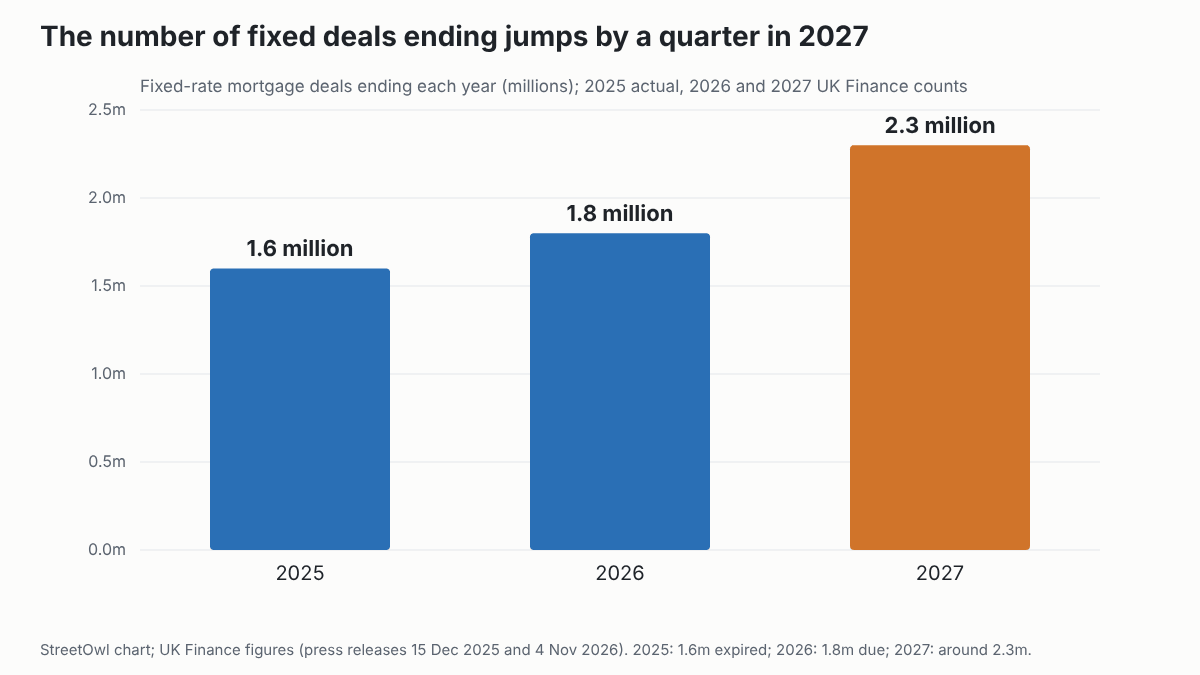
Britain has 8.47 million residential mortgages and 87% of them, 7.37 million, are on a fixed rate, according to UK Finance's data update of 4 November 2026. Every fix has an end date. UK Finance's analysis counts around 2.3 million fixed deals expiring during 2027, against 1.8 million due in 2026 and 1.6 million that expired in 2025.
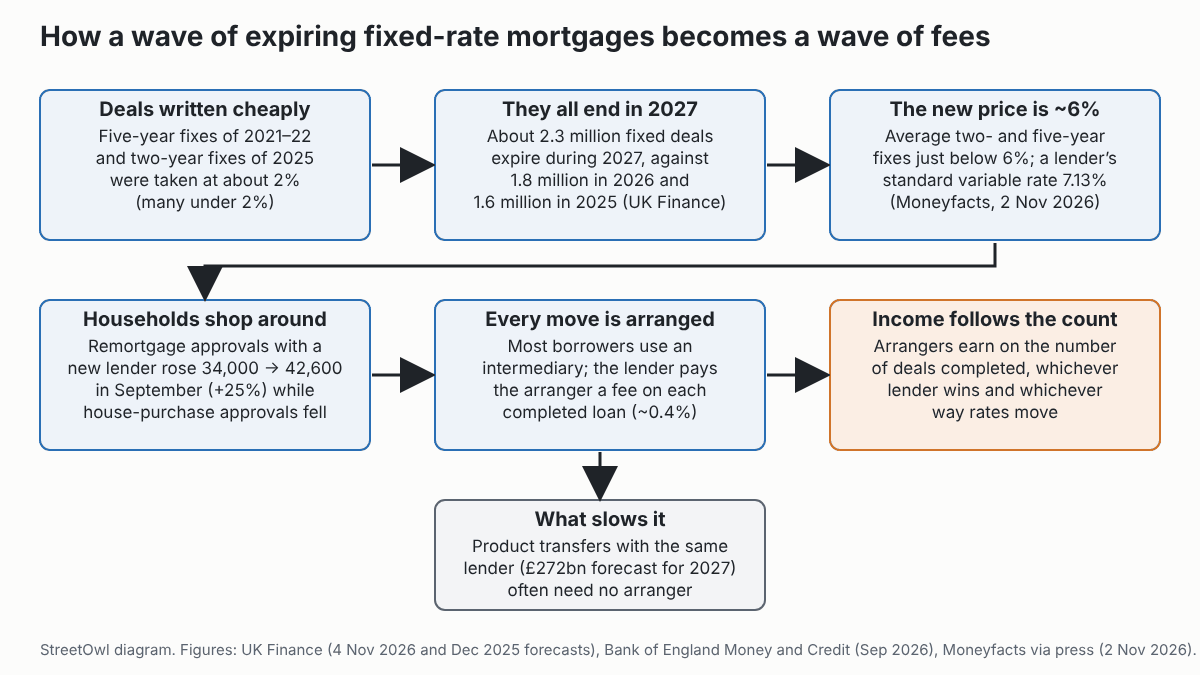
The jump is arithmetic rather than forecast. The five-year deals written in the cheap-money years of 2021 and 2022 and the two-year deals written in 2025 both run out in the same twelve months. Nothing the Bank of England decides this winter changes how many clocks go off next year.
Every ending is a decision, and the price has trebled
A household whose fix ends has three doors. It can drift on to its lender's standard variable rate, 7.13% on Moneyfacts' average of 2 November 2026. It can take a product transfer, a new deal with the same lender. Or it can remortgage to another lender.
The 2021–22 borrowers took their loans at around 2%; the average two- and five-year fixes now sit just below 6%. On a £200,000 repayment loan over 25 years, 2% costs about £848 a month and 6% about £1,289, so the incentive to shop around is as strong as it has been in a generation.
The Bank of England's Money and Credit figures for September 2026 show the wave already breaking. Approvals for remortgaging with a different lender rose from 34,000 in August to 42,600, a 25% jump in a month, while approvals for house purchase fell to 53,400, the lowest since December 2023 and 19% down on a year earlier. Refinancing is rising into a quiet buying market.
Who is paid on the count
Most new mortgages in Britain are arranged through an intermediary rather than at a bank branch. The lender pays the arranger a procuration fee on each completed loan, typically a fraction of a per cent of the sum borrowed, and the arranger usually sells protection insurance alongside. One large network's half-year figures show the shape: completions up 16% to £16.5bn, with remortgages up 29% and product transfers up 44% while purchases fell 1%; fees from lenders up 12%.
The arranger does not care which lender wins or which way rates move. It is paid on the number of deals completed, and the number for 2027 is already known. Lenders see the same event from the other side: a maturity is a moment when a customer may leave, so the fee is the price of keeping or winning them.
What slows the machine
Not every ending becomes a shopped transaction. UK Finance forecasts £272bn of product transfers in 2027 against £80bn of remortgages to a new lender, and a transfer with the same lender can be done in a few clicks with no arranger at all. A sharp fall in rates would also soften the shock and the shopping. The September data, with transfers and remortgages both rising fast, suggest the shopping is winning for now.
Sources
- UK Finance, 4 November 2026: mortgages data update
- UK Finance, 15 December 2025: Mortgage Market Forecasts 2026-2027
- Bank of England, 29 October 2026: Money and Credit, September 2026
- Mortgage Solutions, 29 October 2026: Mortgage approvals for house purchases continue to slide
- Mortgage Advice Bureau, 23 July 2026: trading update (RNS)
- Investing.com, 25 September 2026: Mortgage Advice Bureau H1 2026 results coverage
- London FS, 7 November 2026: fixed-rate deals ending in 2027 (Moneyfacts averages, 2 November)
This piece was drafted by AI from the public sources named, then read and approved by Michael Rossi before it went up. It describes how one thing moves another; it names no investment and is not financial advice.
← Back to StreetOwl