When enrichment runs short, reactors burn more uranium
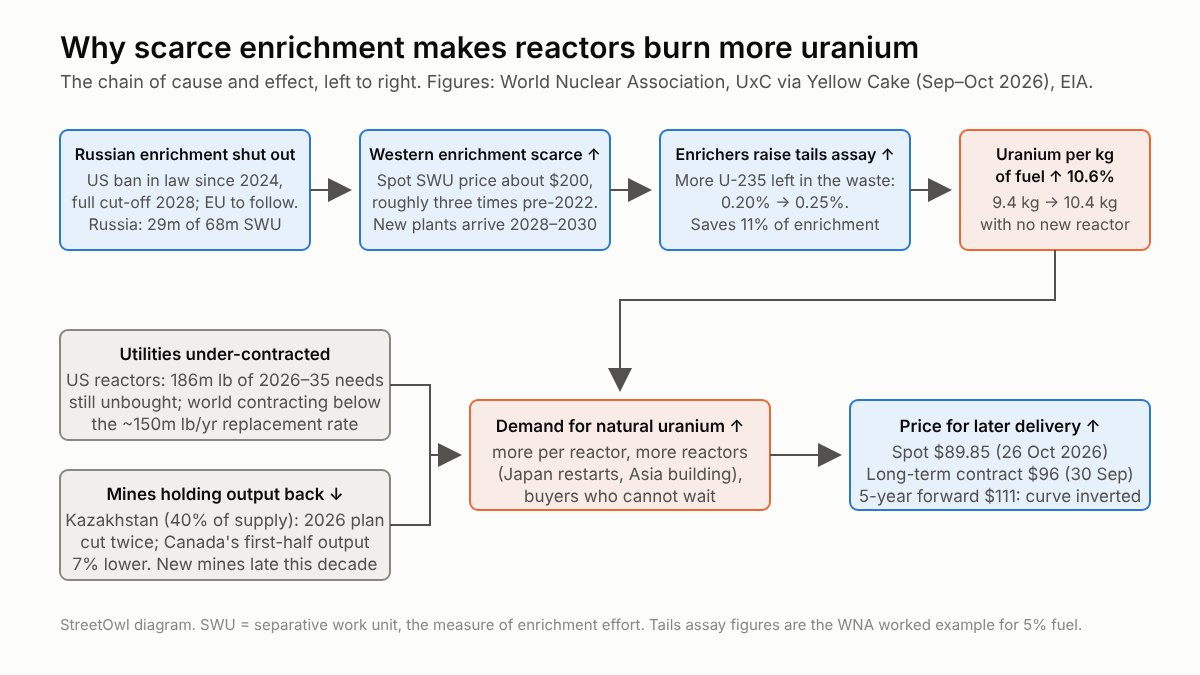
Russian enrichment is being shut out of Western fuel supply, so enrichment work is scarce and dear, so the plants that remain leave more uranium in their waste and need about a tenth more natural uranium for every kilogram of fuel, which is why the price for uranium delivered in five years' time is now higher than the price today.
The price that tells you something is wrong
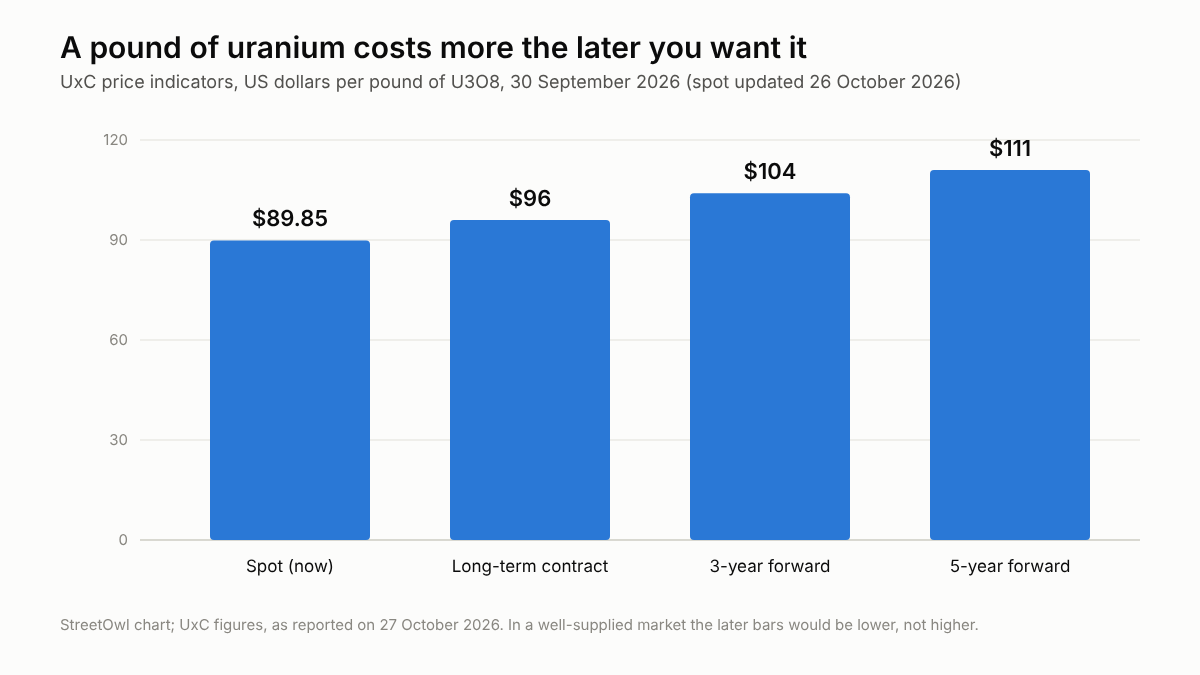
Most commodities cost less for delivery next year than for delivery today when the market is well supplied, because whoever holds the stock has to pay to store it and would rather part with it now. Uranium is doing the opposite. The industry's benchmark indicators, published by the consultancy UxC and reported on 27 October 2026, put the spot price at $89.85 a pound on 26 October, the long-term contract price at $96 on 30 September, and the three- and five-year forward indicators at $104 and $111. Buyers are paying more for uranium in 2029 than for uranium now.
That is the market's way of saying that future supply looks scarcer than present supply. The usual explanation offered is new reactors, and there are plenty of those: two-thirds of the reactors under construction in the world are in Asia, about forty of them in China, and Japan brought its large reactors back into commercial operation in the spring of 2026. But the sharper reason sits one step further up the fuel chain, in the enrichment plant.
Why reactors shrug at the price
A nuclear power station buys its fuel two to three years ahead of using it and signs contracts that run five to ten years. Uranium is a small slice of what nuclear electricity costs to make, so the operator barely notices whether it pays $70 or $110 a pound, and cares enormously about whether the material turns up at all. Demand therefore hardly moves with price; what moves is the urgency of the buying.
The urgency has been building for a while. The US Energy Information Administration's 2025 survey of American utilities found 174 million pounds under contract against maximum requirements of 360 million pounds for the years 2026 to 2035, leaving about 186 million pounds still to be bought. Worldwide, the volume signed in long-term contracts in 2025 was put at somewhere between 82 and 116 million pounds, against roughly 150 million pounds a year that reactors actually consume. A market that contracts below its consumption for several years running is one where the shortfall must eventually be bought, and the only open question is the price.
The second bottleneck is the enrichment plant
Natural uranium is only 0.7 per cent of the fissile isotope U-235; reactor fuel needs around 5 per cent. The job of concentrating it is enrichment, measured in separative work units, or SWU. Russia's state nuclear group owns about 29 million of the world's 68 million SWU of capacity. In 2024 the United States passed a law banning Russian enriched uranium, with a full cut-off in 2028 and only limited waivers before then, and the European Union's energy plan is heading the same way. Western enrichment work has become scarce as a result, and the spot price of a SWU has roughly tripled since 2022 to about $200.
When enrichment is the scarce input, an enricher does something that changes the uranium market without a single new reactor being built: it raises the tails assay, the amount of U-235 it leaves behind in the depleted waste stream. The World Nuclear Association's worked example for 5 per cent fuel shows the arithmetic. At a tails assay of 0.20 per cent, a kilogram of fuel needs 8.9 SWU and 9.4 kilograms of natural uranium. At 0.25 per cent it needs 7.9 SWU and 10.4 kilograms. Lifting the tails by a twentieth of a percentage point saves 11 per cent of the enrichment work and burns 10.6 per cent more uranium. The industry calls this overfeeding.
It is the exact reverse of the 2010s. Then, enrichment was cheap and plentiful, so enrichers ran their plants the other way, underfeeding: they extracted extra uranium from their own tails and sold it, flooding a market already flattened by Fukushima with a secondary supply that nobody had mined. Overfeeding removes that secondary supply and adds a primary demand on top. It persists until new Western enrichment capacity arrives, and that is dated: Europe's largest enricher is adding 2.5 million SWU across three sites, its American plant is licensed to grow from 4.3 million to 10 million SWU, and the new French capacity phases in between 2028 and 2030.
The mines are not rushing to help
Kazakhstan produces about 40 per cent of the world's mined uranium, and its state producer's plan for 2026 is 27,500 to 29,000 tonnes, cut twice from the original target under a stated policy of value over volume; the physical constraint on its wells, which leach uranium out of the ground with acid, is a shortage of sulphuric acid. Canada's largest producer mined 16.2 million pounds in the first half of 2026, about 7 per cent less than in the same period of 2025, and its second-quarter share of output fell 15 per cent. New Canadian mines are planned for later this decade, not next year.
On the other side of the ledger, the Gulf crisis has turned nuclear from a climate argument into an energy-security one. A single 1 GW reactor displaces about 850,000 tonnes of liquefied natural gas a year, which is why Japan's restarts matter to the gas market as well as the uranium one. The International Atomic Energy Agency's high case has world nuclear capacity reaching 1,045 GW by 2050, roughly two and a half times today's fleet.
Who gains, who pays
The gainers are whoever already holds uranium or the right to mine it: the stock sitting in Canadian and French storage, the low-cost wells in Kazakhstan, the mines in Saskatchewan, and the Western enrichers, whose scarce work is now priced accordingly. The payers are the utilities, and through them, very slightly, the people who use nuclear electricity. Because fuel is such a small part of the cost of a reactor, a doubling of the uranium price adds only a little to the cost of a unit of nuclear power; the larger cost falls on anyone trying to build or restart a reactor on a timetable, who must now queue for enrichment as well as for fuel.
What would end it is also clear. A settlement in Ukraine that loosened the enrichment ban would bring Russian SWU back, flip overfeeding into underfeeding again, and remove several million pounds of uranium demand overnight; the SWU price, more than the reactor count, is the number to watch. Kazakhstan's cuts are a choice rather than geology, and the choice can be reversed. And the uranium price has already doubled from its 2023 lows; the spot peak of $100.25 in January 2026 faded within weeks.
Sources
- Yellow Cake plc, quarterly operating update (UxC price indicators, Kazatomprom guidance, Cameco output), 27 October 2026
- World Nuclear Association, Uranium enrichment (tails assay worked example, capacity by company)
- Discovery Alert, Uranium at US$96/lb: why scarcity is driving the rally (EIA 2025 Uranium Marketing Annual Report figures, SWU prices), September 2026
- Urenco, Enrichers are gearing up for growing demand, 21 April 2026
- Cameco, second-quarter 2026 results (SEC Form 6-K), 31 July 2026
- S&P Global Platts via Hellenic Shipping News, Oil and LNG turbulence to spur nuclear revival, 18 May 2026
- The Deep Dive, Kazatomprom cuts 2026 uranium guidance, 7 October 2025
This piece was researched with AI from the public sources named and written up and checked by Michael Rossi before it went up. It describes how one thing moves another; it names no investment and is not financial advice.
← Back to StreetOwl