The tax rule that turned bookkeeping into a subscription: how Making Tax Digital works
HMRC has lowered the income line for compulsory digital tax filing three Aprils in a row, so nearly three million sole traders and landlords must keep their books in recognised software, so a monthly software fee becomes a cost of being self-employed and the companies that write the software collect it for as long as the rule stands.
A product bought because the law says so
Most software is bought because someone wants it. Since 6 April 2026 a slice of British software has been bought because the law requires it. Making Tax Digital for Income Tax obliges every sole trader and landlord whose qualifying income is above a set line to keep their records in HMRC-recognised software and to send four quarterly updates a year through it, on 7 August, 7 November, 7 February and 7 May, before the final return.
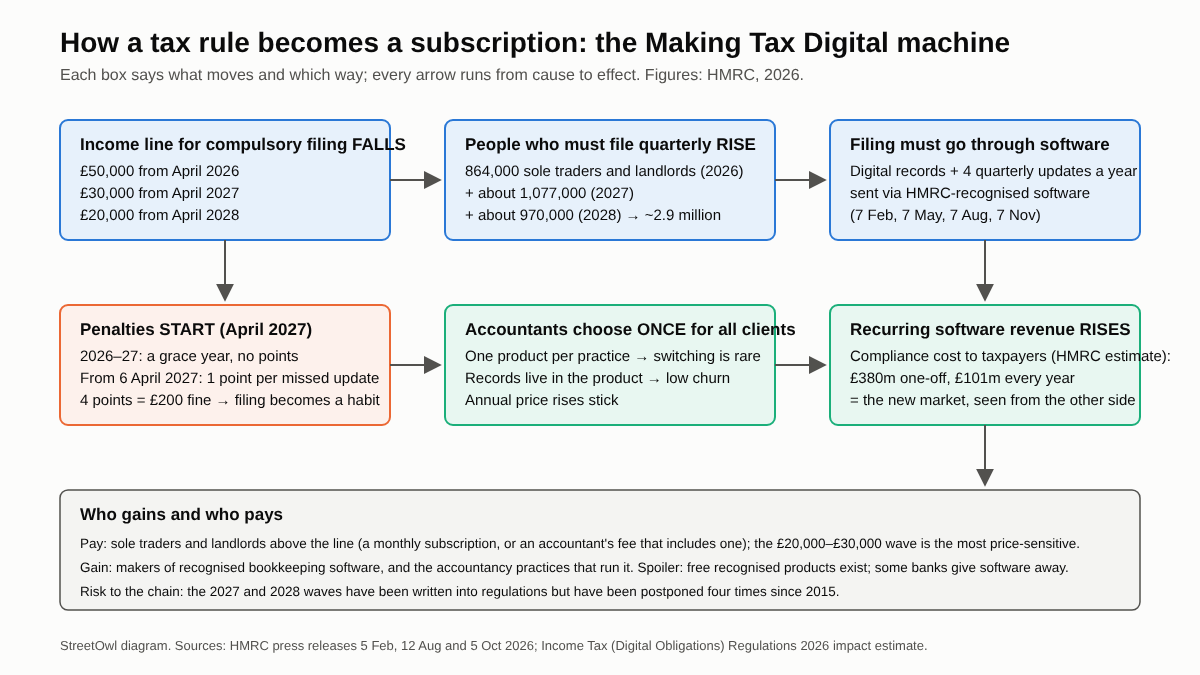
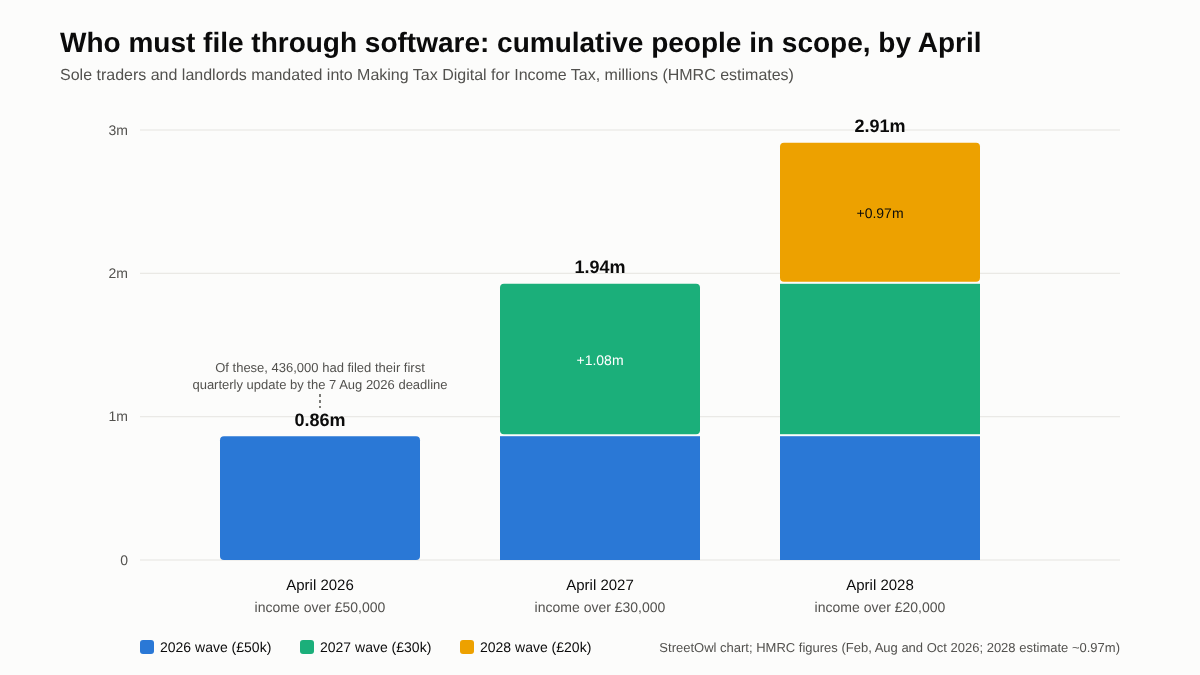
The line falls every April. It was £50,000 from April 2026, which HMRC said in February 2026 covered 864,000 people. It drops to £30,000 from 6 April 2027, which HMRC estimated on 5 October 2026 would bring in about 1,077,000 more. It drops again to £20,000 from April 2028, adding roughly 970,000 more. That is close to 2.9 million people who will have to pay for, or be given, a piece of software they did not choose.
Why it keeps going once it has started
The first deadline passed on 7 August 2026. By 12 August HMRC said more than 570,000 people had signed up and 436,000 had sent their first quarterly update. The second update was due on 7 November.
Three things turn a one-off purchase into a standing one. First, the penalty clock: 2026–27 is a grace year with no penalty points, but from 6 April 2027 every missed quarterly update earns a point and four points cost £200, so the habit of filing is being fixed at the same moment the second wave arrives. Second, the channel: the taxpayer rarely picks the software. Their accountant does, once, for every client in the practice, so switching is rare. Third, the records live inside the product, which makes leaving awkward and lets the annual price rise stick.
HMRC's own impact estimate for the rule puts the one-off cost to taxpayers at £380 million and the ongoing cost at £101 million a year. Seen from the other side of the counter, that is the size of the market the rule created.
Who gains, who pays, and what could stop it
The people who pay are sole traders and landlords above the line, either directly for a subscription or through an accountant's fee that includes one. The people who gain are the makers of recognised bookkeeping software and the accountancy practices that run it for their clients, whose work grows with every wave.
Two things cap the gain. HMRC's list of recognised products includes free ones, and at least one high-street bank gives bookkeeping software to its business customers at no charge, so the £20,000 to £30,000 wave, the most price-sensitive, may not pay full price. And the timetable has slipped before: the scheme was announced in 2015 and postponed four times before it started. The 2027 and 2028 waves are written into regulations, but a Treasury that wanted to could move them again.
The fall in software-company valuations earlier in 2026 rested on the idea that artificial-intelligence tools will replace paid software seats inside companies. The filing rule works differently: the seat is a taxpayer, the number of seats is set by statute, and every return has to pass through software that holds HMRC's own API credentials. A computer program can do the bookkeeping, but it still needs the pipe.
Sources
- HM Revenue & Customs, 12 August 2026: 436,000 sole traders and landlords make their tax digital
- HM Revenue & Customs, 5 October 2026: sole traders and landlords earning more than £30,000 urged to act now
- ByteStart, 5 February 2026: 864,000 sole traders and landlords face new MTD reporting rules from April 2026
- FinancialAdvice.net, 30 March 2026: 2028 is confirmed, MTD threshold cut to £20,000 pulls nearly one million more into the digital tax regime
- HM Revenue & Customs policy paper: Making Tax Digital for Income Tax Self Assessment for sole traders and landlords
This piece was drafted by AI from the public sources named, then read and approved by Michael Rossi before it went up. It describes how one thing moves another; it names no investment and is not financial advice.
← Back to StreetOwl