The platform is paid twice: a slice of every pound you invest, and the spread on every pound you leave in cash
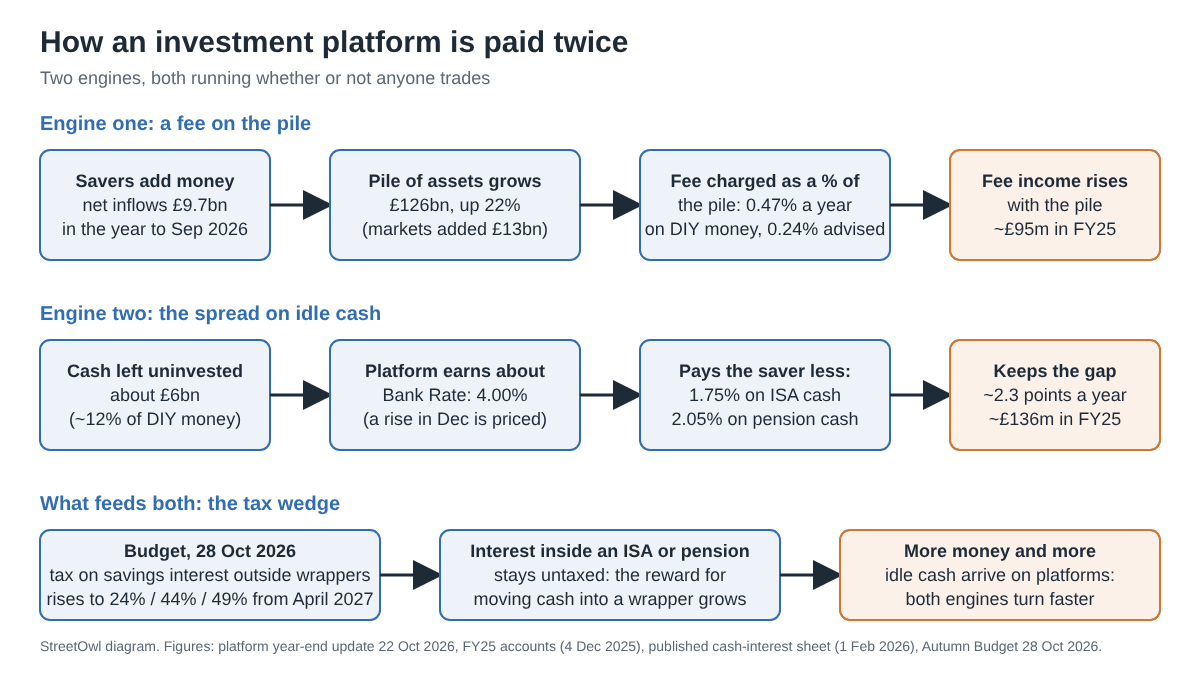
Savers add money and markets lift it, so the pile a platform holds grows and the percentage fee on it grows with it; cash left idle earns the platform close to Bank Rate while the saver is paid less, so the gap is the platform's; and a higher tax on savings interest outside ISAs and pensions pushes more money into both engines.
A shop that does not sell what it looks like it sells
An investment platform looks like a shop that sells share dealing. The accounts of one of Britain's largest say otherwise. Dealing commission is the small engine. The two big ones are a percentage charged on everything customers hold, and the difference between what the Bank of England pays on cash and what the platform passes on to the customer. Both run whether or not anyone trades, and both have just been given more fuel.
The scale is now large. At 30 September 2026 that platform held a record £126bn for 796,000 customers, up 22% and 24% in a year. Its customers added a net £9.7bn in the year, 37% more than the year before, and rising markets added another £13bn without anyone lifting a finger.
Engine one: a fee on the pile
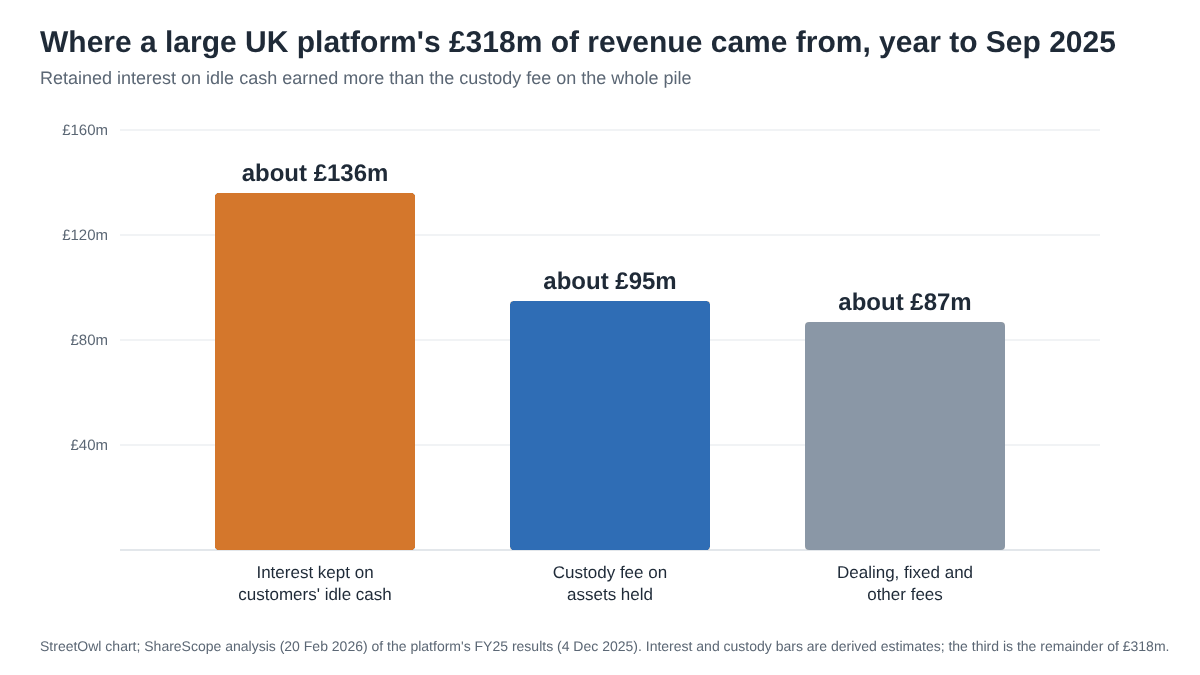
The custody fee is charged as a percentage of assets. In the year to September 2025 the do-it-yourself book earned the platform about 47p for every £100 held and the adviser-introduced book about 24p, according to an analysis of its accounts published in February 2026. The pile grows two ways, by new money and by market prices, and the fee grows with it either way. Custody fees were about £95m that year; by the company's own footnote, a 10% move in markets changes them by about £9.5m.
Who pays: every saver, in proportion to what they hold, and mostly without noticing because the charge is taken from the account rather than billed. Who gains: the platform, and through it the people who own it.
Engine two: the spread on idle cash
Customers keep money uninvested while they decide, about £6bn across that platform; do-it-yourself investors hold roughly 12% of their money as cash. Since 1 February 2026 the platform has paid 1.75% a year on cash in a stocks-and-shares ISA and 2.05% on cash in a pension, while Bank Rate has been 4.00%. Its own disclosures say it expects to earn between 0.10 points below and 0.15 points above base rate on ISA and dealing-account cash.
The retained gap averaged 2.26 points in the year to September 2025, about £136m, more than the custody fee on the whole pile. That is the mechanical part. Every quarter-point the Bank of England adds is worth roughly £15m a year on £6bn before any of it is passed on, and how much is passed on is the platform's decision. Money markets price a further rise in December.
The tax wedge that feeds both
The Budget of 28 October 2026 raised the tax on savings interest earned outside tax wrappers by four percentage points, not the two announced a year earlier: 24% at the basic rate, 44% at the higher rate and 49% at the additional rate from the new tax year, with the personal savings allowance left at £1,000. Interest and gains inside an ISA or a pension stay untaxed, so the reward for moving money into a wrapper grew overnight.
The same Budget scrapped the planned £12,000 cap on cash ISAs and the planned 22% charge on cash held inside stocks-and-shares ISAs. That removed a forced migration from cash ISAs into investment ISAs, but it also removed a threat to the second engine: cash inside an investment ISA keeps earning the platform its spread, untaxed to the saver.
Why it compounds, and what would stop it
Costs are mostly people and technology, and they do not rise with the pile. The platform's revenue was £317.8m in the year to September 2025 on an operating margin of about 44%, and its revenue has nearly quadrupled since 2016. When assets grow faster than costs, profit grows faster than assets.
Three things turn the machine the other way. A falling stock market shrinks the pile and, more importantly, slows the flow of new money: on Friday 20 November 2026 the S&P 500 fell 3.7% and the Nasdaq 5.3%. A regulator deciding that platforms keep too much of the spread on customers' cash would hit the second engine directly. And interest-rate cuts in 2027 would narrow the gap between what the platform earns on cash and what it pays.
Sources
- Investment platform operator, year-end trading update (RNS), 22 October 2026
- Investment platform operator, final results for the year to 30 September 2025 (RNS), 4 December 2025
- ShareScope (Maynard Paton), Screening for my next quality winner, 20 February 2026
- Investment platform operator, Interest rates we pay on cash, effective 1 February 2026
- interactive investor, Autumn Budget 2026: what it means for your money, 28 October 2026
- Which?, Stocks and shares ISA cash interest tax cancelled in Autumn Budget 2026, 28 October 2026
- ActionForex, market overview, 23 November 2026 (Friday's US market falls)
This piece was drafted by AI from the public sources named, then read and approved by Michael Rossi before it went up. It describes how one thing moves another; it names no investment and is not financial advice.
← Back to StreetOwl