The office nobody built: why London rents keep rising while almost nothing goes up
Building offices stopped paying when build costs and 5 per cent gilts met a 3.75 per cent yield, so starts collapsed, so the best space in London has run out, so the rent on it rises at each review, and the owners of full buildings collect it with a lag that compounds.
Four years from decision to tenant
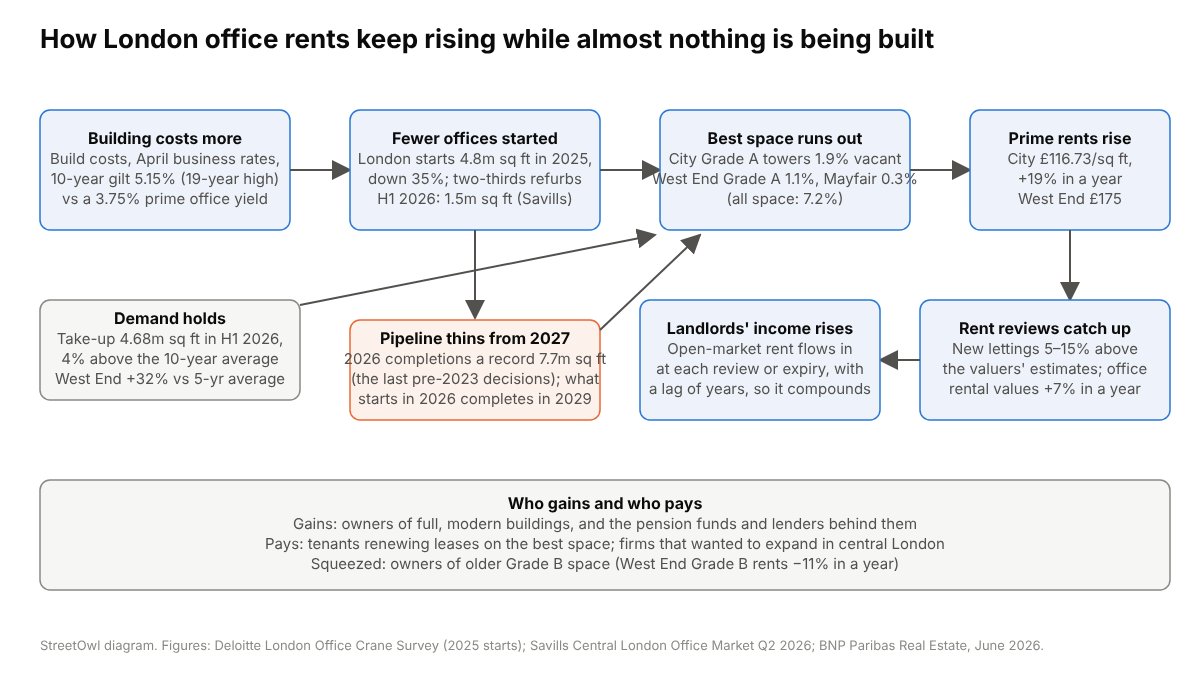
An office takes four or five years from the decision to build to a tenant moving in, so what is let in 2029 was decided in 2025. In 2025 almost nobody decided. Deloitte's London Office Crane Survey counted 4.8m sq ft of new starts last year, down 35 per cent, and two-thirds of that was refurbishment rather than new building. Savills has the first half of 2026 at 1.5m sq ft of starts across central London: 0.9m in the City, all of it seven refurbishment schemes, and 676,000 sq ft in the West End, down 40 per cent.
The reason is arithmetic. Build costs have not come down, business rates rose in April, and the 10-year gilt is 5.15 per cent, a 19-year high, while a prime West End building yields 3.75 per cent. Nobody borrows at 6 per cent to build something that returns less than 4 unless the rent on the finished building is very high indeed.
The tenants did not stop coming
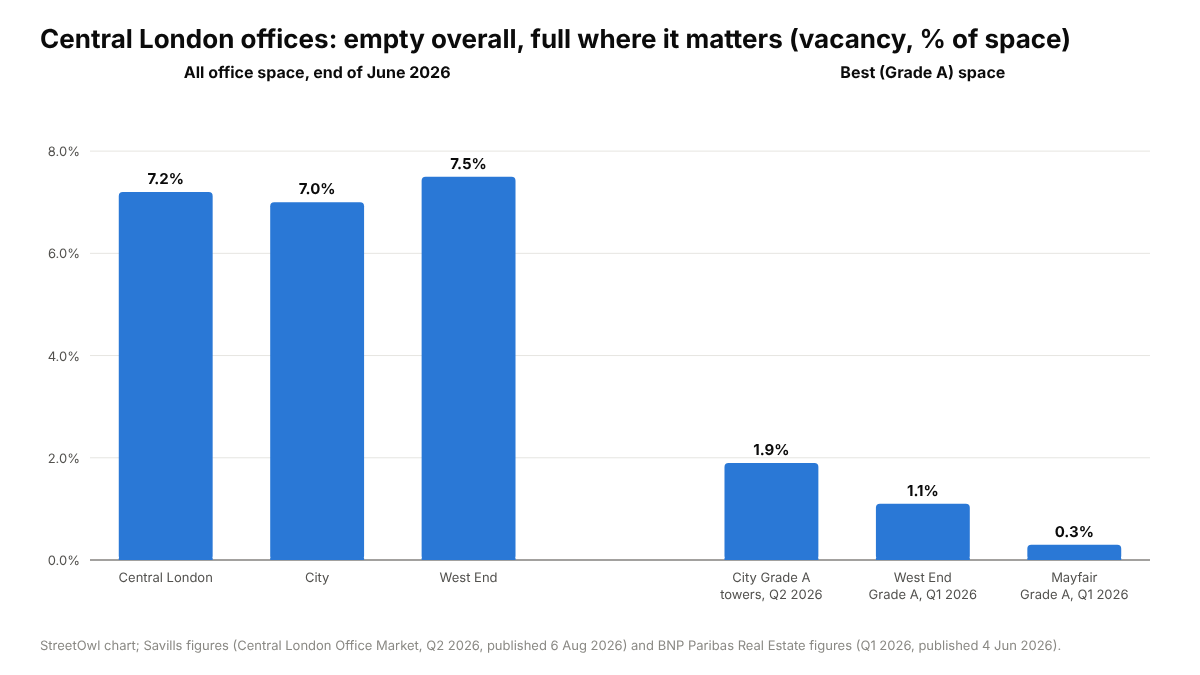
Central London take-up was 4.68m sq ft in the first half of 2026, 4 per cent above the ten-year average, and West End take-up ran 32 per cent above its five-year average. Active demand in the City alone is 13.9m sq ft. The headline vacancy rate of 7.2 per cent hides where the shortage is: the City's Grade A towers are 1.9 per cent vacant, West End Grade A space is 1.1 per cent and Mayfair 0.3 per cent, while older Grade B space in the West End has lost 11 per cent of its rent in a year.
The best buildings are effectively full, so their price is set by whoever will pay the most. City prime rents are £116.73 a square foot, up 19 per cent in a year; the West End is £175.
How the rent reaches the owner
Every lease carries a review or an expiry, so the open-market rent flows into the owner's income with a lag of a few years, which is why it compounds. The listed West End landlords have been letting space at 5 to 15 per cent above what their own valuers estimated a few months earlier, re-gearing leases at 5 per cent above the old rent, and reporting office rental values up 7 per cent in a year, the most in a decade, at occupancy near 99 per cent. One reports 17 per cent more rent in its buildings than tenants currently pay, waiting for the lease events that release it.
2026 is a record year for completions, 7.7m sq ft, which is the last of the pre-2023 decisions arriving. From 2027 the pipeline thins to what was started this year, which is almost nothing, and the shortage of the best space gets worse before it gets better.
Who gains and who pays
The owners of full, modern buildings gain, and so do the pension funds and lenders behind them. Tenants renewing on the best space pay, as do firms that wanted to expand in central London and find nothing to take. Owners of older space are squeezed: it is their rent that is falling, and the cost of refurbishing it to the standard tenants now demand is the same cost that stopped the new starts.
What could change it: the gilt. Property yields follow government bond yields with a lag, and a 3.75 per cent prime yield below a 5.15 per cent gilt is not a stable gap; valuations can fall even while rents rise. The other brake is the 2026 lump itself: 4.9m sq ft completes in the second half, only about a quarter of it pre-let, so the vacancy figures for the end of the year may tick up before the drought shows.
Sources
- Savills, Central London Office Market Q2 2026, 6 August 2026
- Savills, Central London Office Market Watch, 6 August 2026
- BNP Paribas Real Estate, Office scarcity is reshaping London's geography, 4 June 2026
- Building, New office starts fell 35% in London last year, Deloitte survey shows, 2026
- Derwent London, Third quarter business update, 5 November 2026
- British Land, Q2 trading update, 15 October 2026
- Landsec, Results for the year ended 31 March 2026, 14 May 2026
- QuotedData, REIT review, 9 November 2026
- Trading Economics, UK gilt yields, 6 November 2026
This piece was drafted by AI from the public sources named, then read and approved by Michael Rossi before it went up. It describes how one thing moves another; it names no investment and is not financial advice.
← Back to StreetOwl