The kilns are going cold: why a brick not made this winter is a price rise in 2028
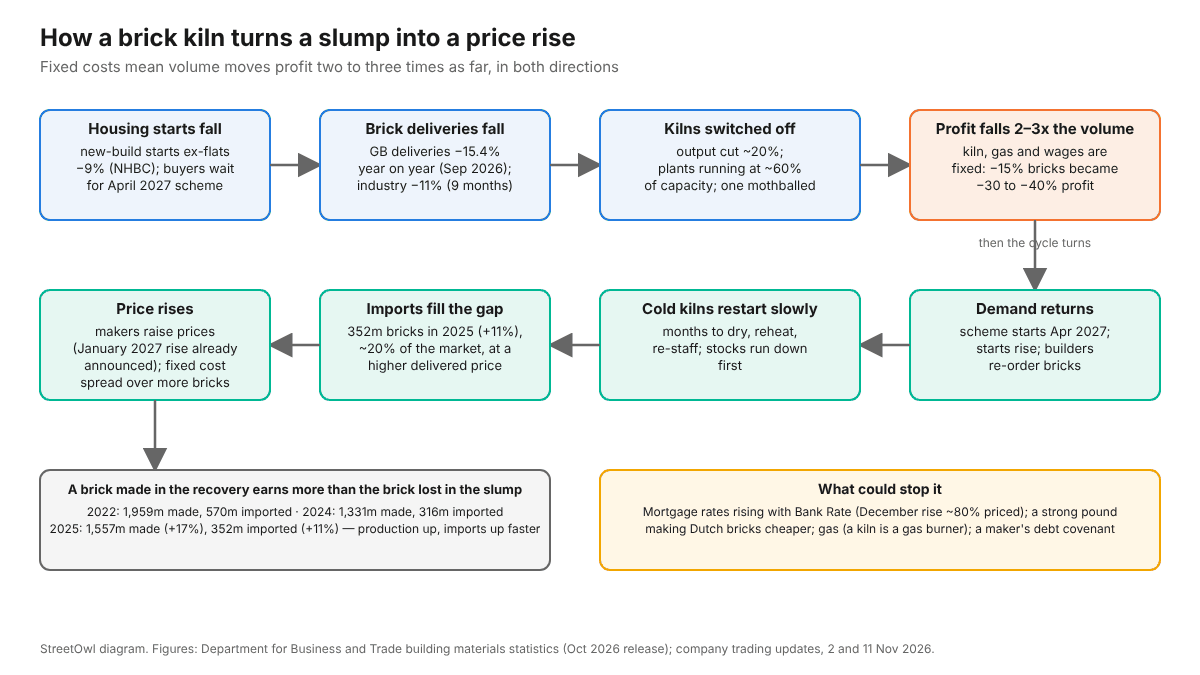
House-building has slowed, so brick deliveries have fallen 15%, so the kilns are being switched off; when building returns, cold kilns restart slowly and imports set the price, so bricks cost more.
A kiln never stops, so its costs never fall
A brick is clay, gas and a kiln that runs around the clock at about 1,000°C. The gas contract, the wages and the depreciation on the plant cost the same whether the kiln fires a hundred bricks or a hundred thousand. That makes brick-making one of the most volume-sensitive trades in the country: when sales fall a little, profit falls a lot, and the same lever works in reverse.
This autumn is showing the down side. Government figures published on 4 November put deliveries of bricks in Great Britain in September 15.4% below a year earlier and 4% below August. One large maker said the UK market was running about 17% down in July and August and its own third-quarter sales came in 22% below its plan; another said industry despatches for the first nine months were 11% down. At the first, a 15% fall in revenue over the half-year became a 28% fall in operating profit, and its full-year profit guidance was cut by about a quarter.
What makers do when demand falls: switch off
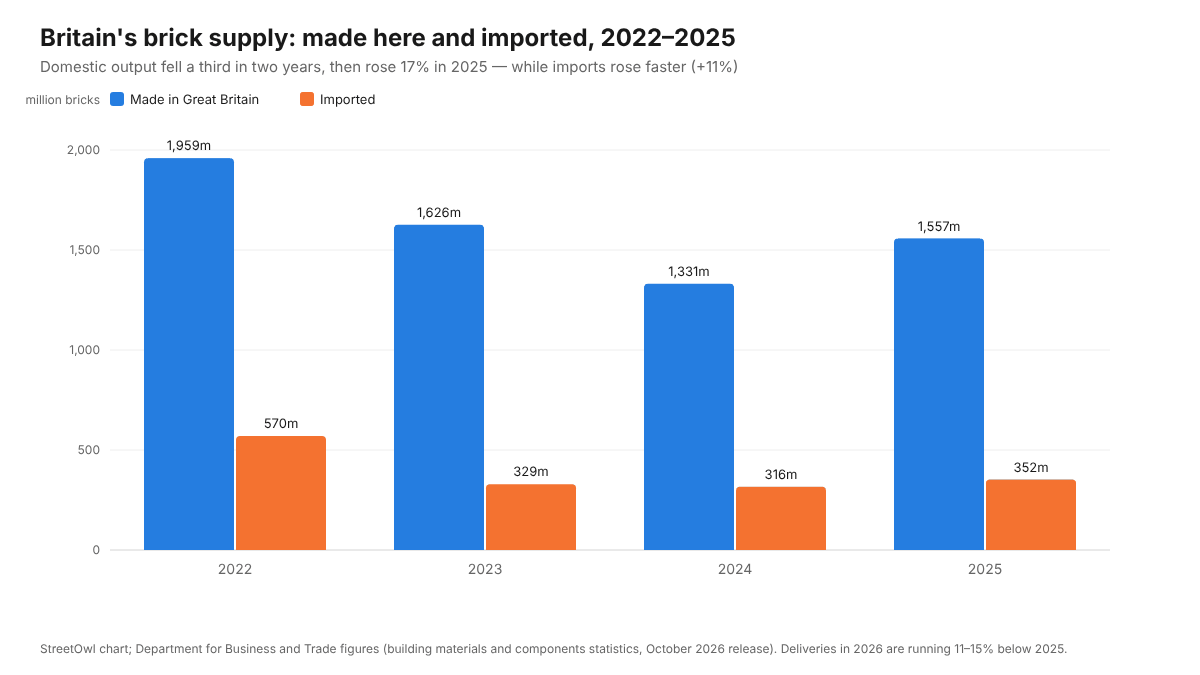
The only quick response to a slump is to stop firing. One maker has cut production by about a fifth; another is running at about 60% of its installed capacity with a whole works mothballed. Britain has been here before. Domestic production was 1,959 million bricks in 2022, 1,626 million in 2023 and 1,331 million in 2024, a fall of a third in two years, before rising 17% to 1,557 million in 2025.
The 2025 recovery carries the lesson. A kiln that has been cold cannot simply be switched back on: it has to be dried out and brought up to temperature over weeks, the clay pit and the shift pattern restarted, the workforce rehired. So when demand returned, imports grew faster than home production. Imports rose 11.4% to 352 million bricks in 2025, about a fifth of the market, most of them from the Netherlands and Belgium at a higher delivered price because they travel by ship and lorry.
Why the next upturn arrives as a price rise
Put the two halves together. In the slump the makers lose money because their fixed costs are spread over fewer bricks. In the recovery, demand comes back faster than the cold kilns can, stocks run down, and the price is set by the imported brick that fills the gap. One maker has already announced price rises for January 2027 into a market that is 11% smaller than last year. Every brick fired in the recovery therefore earns more than the brick that was not fired in the slump: the fixed cost is spread over more of them, and the price is higher.
The trigger is house-building. New-home starts, excluding flats, are about 9% down on a year earlier, and a government decision has made the wait longer: the new first-time-buyer equity loan, which applies to new-build homes only, starts in April 2027, so buyers who qualify have a reason to hold off until then. Both makers say that pause is weighing on demand now. When the scheme opens, it channels demand into exactly the kind of home that is built from bricks.
What could stop it
Three things. Mortgage rates: the Bank of England is expected to raise interest rates again in December, and dearer mortgages could push the recovery in house-building out by a year, leaving the makers burning cash at 60% of capacity. The pound: at its strongest against the euro since 2016, it makes Dutch bricks cheaper, which blunts the price rise; and bricks are not covered by the carbon border charge that starts in January, so no border levy helps the home kiln. Gas: a kiln is a gas burner, and wholesale gas is dear this winter, so a maker that has not fixed its 2027 gas price pays for the recovery twice.
For a household, the effect is slow and real: brick prices feed the cost of a new home two years after the kilns go cold, and the government's own material price index for new housing was already up 5.4% in the year to September.
Sources
- Department for Business and Trade, Building materials and components statistics: October 2026 commentary, 4 November 2026
- Construction Wave, brickmaker profit warning, 2 November 2026
- Hargreaves Lansdown / Sharecast, brickmaker cuts profit guidance, 2 November 2026
- East Midlands Business Link, brickmaker lowers profit expectations, 11 November 2026
- Investing.com, brickmaker half-year results call transcript, 28 July 2026
This piece was drafted by AI from the public sources named, then read and approved by Michael Rossi before it went up. It describes how one thing moves another; it names no investment and is not financial advice.
← Back to StreetOwl