The combustion engine is dying slowly, and the slower it dies the more its exhaust-catalyst makers earn
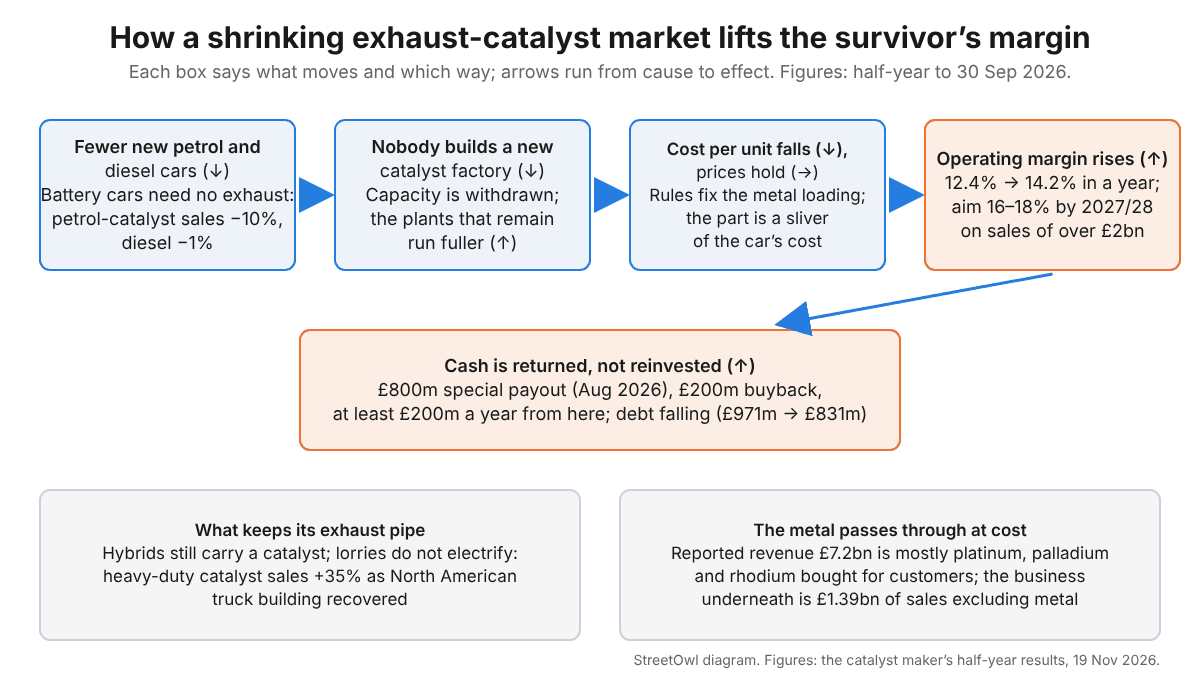
Battery cars are shrinking the market for exhaust catalysts, so nobody builds new catalyst factories, so the plants that remain run fuller and their margins rise even as sales fall.
The part the law makes you buy
Every petrol, diesel or hybrid car sold into a market with emissions rules carries a catalytic converter: a ceramic brick coated with platinum, palladium and rhodium, bolted into the exhaust. The rules set how much metal goes on it, the carmaker cannot leave it out, and it is a sliver of the car's cost, so it is not where the buyer haggles. Only a handful of firms in the world make them, and one of the largest is British, in Hertfordshire.
The metal passes through at cost. The British maker's reported revenue for the half-year to 30 September 2026 was £7.2bn, most of it precious metal bought on customers' behalf; the business underneath was £1.39bn of sales excluding metal.
A shrinking market with no new entrants
Everyone knows the market is shrinking. Battery cars need no exhaust, and the maker's own half-year figures, published on 19 November 2026, show light-duty petrol catalyst sales down 10% and diesel down 1%. What the 'melting ice cube' label misses is what shrinkage does to the survivors. Nobody builds a new catalyst factory into a falling market, so capacity is withdrawn, the plants that remain run fuller, and the maker stops spending to grow and starts spending to be cheap.
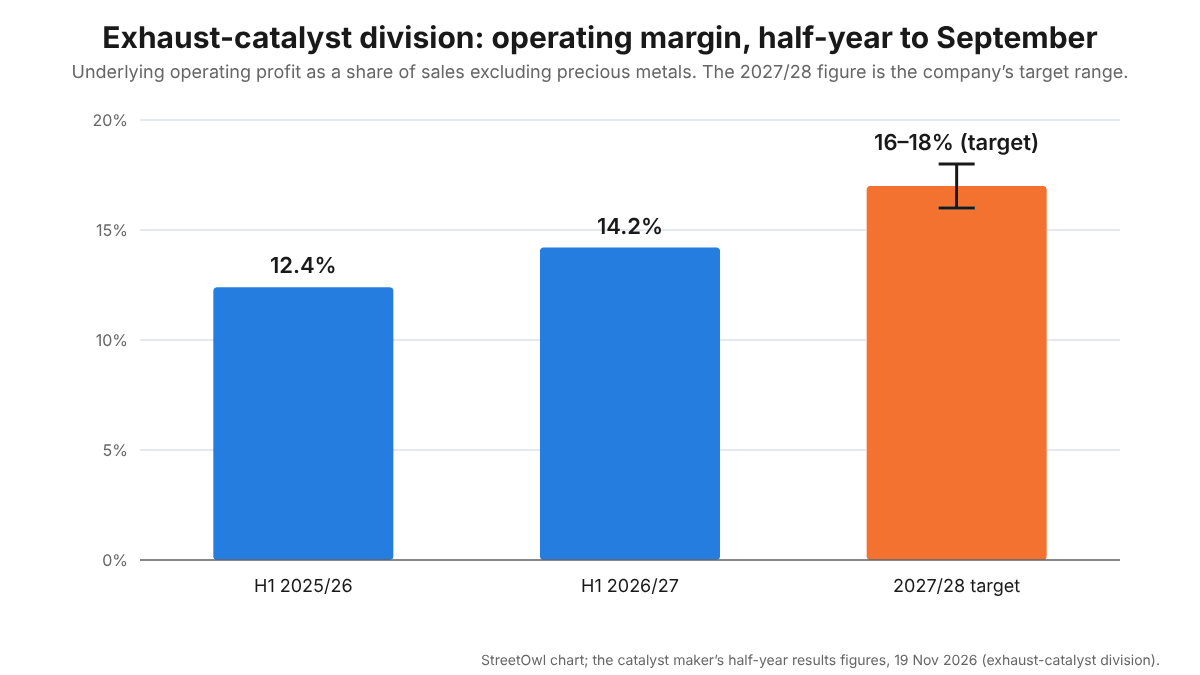
The result shows in the numbers. The exhaust-catalyst division's sales rose 9% to £1,161m in the half (heavy-duty diesel sales rose 35% as North American lorry building recovered; lorries do not electrify), its underlying profit rose 25% to £165m, and its margin went from 12.4% to 14.2%. The company's own explanation was that the margin gain mainly reflected higher volumes, while raw-material inflation was offset by 'commercial and operational excellence', which is to say prices held while costs fell. The target is a 16–18% margin on more than £2bn of sales by 2027/28. A hybrid, note, keeps its exhaust pipe.
The refinery, the turbine and the metal
A second engine sits beside the first. The same company runs a refinery that takes spent catalysts and industrial scrap and recovers the metal for a fee: sales of £239m and profit of £68m in the half, a 28.5% margin. The fee is earned whatever the metal does; the metal recovered above provision is a bonus that follows prices with a lag. Average platinum was 47% higher than a year earlier over the half, palladium 25% and rhodium 47%, worth £20m of extra profit, and about £35m for the full year if prices stay at end-October levels.
That bonus is already fading. Platinum peaked at $2,923 an ounce on 26 January 2026 and by early November was near $1,630, 44% lower, and the World Platinum Investment Council's September quarterly turned its 2026 forecast from a 297,000-ounce shortage into a 265,000-ounce surplus as investors sold. A third engine is new: a business bought this year makes the catalysts that strip nitrogen oxides from gas turbines, the kind data centres are now installing beside them, and contributed about £20m of profit over eight months.
Where the money goes
A business that is shrinking well does not reinvest; it pays out. After selling a chemicals-catalyst arm for an enterprise value of £1.325bn (completed 17 July 2026), the maker paid an £800m special dividend on 28 August, is buying back £200m of shares (£72m done by 13 November) and has promised at least £200m a year to shareholders from here. Net debt fell to £831m from £971m a year earlier. Full-year profit guidance was raised on 19 November from 'low to mid single digit' to 'high single digit' growth.
Who gains and who pays: shareholders in the surviving catalyst makers gain for as long as the engine's decline is slow; the metal miners gain when car production holds and lose when investors leave platinum; carmakers pay a little more per part in a market with fewer suppliers; and the pace of the whole thing is set not in Hertfordshire but by the regulators in Brussels and Beijing who decide how fast the petrol engine goes.
Sources
This piece was drafted by AI from the public sources named, then read and approved by Michael Rossi before it went up. It describes how one thing moves another; it names no investment and is not financial advice.
← Back to StreetOwl