The broker's three engines, and the one that just restarted
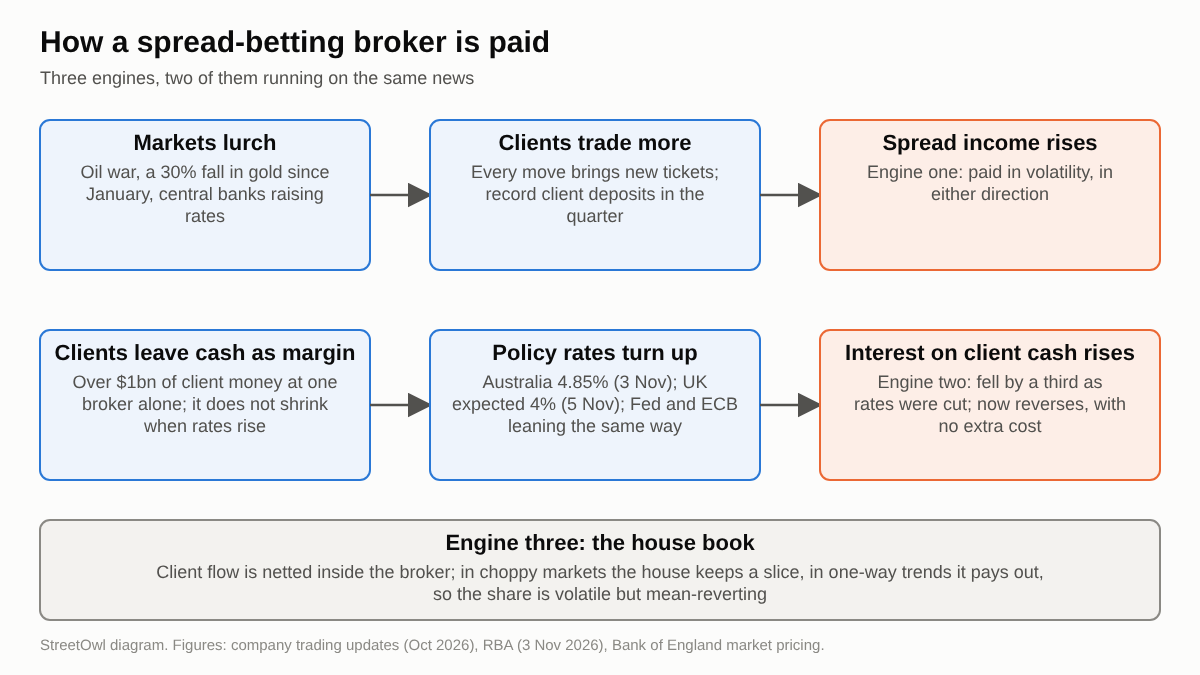
Markets lurch, so people trade more and park more cash with their brokers; central banks are raising rates again, so that parked cash earns more, and the broker is paid twice by the same news.
Spread-betting and contract-for-difference brokers are the firms that let ordinary people bet on the price of gold, oil, shares or currencies without owning any of them. Most of the year's headlines have been bad for them: one large London-listed broker reported third-quarter revenue down 14 per cent in October, and the sector's shares have roughly halved from their highs. Yet the machine underneath has three engines, and two of them are being fed by the same news that frightened everyone.
The first engine is activity. A broker earns a spread or a commission on every trade, and people trade when prices move. This year prices have moved a great deal: oil has swung with the war in the Gulf, and gold, which peaked at $5,608 an ounce in January, was $3,920 on 3 November, a one-year low. One London-listed broker took a record $1.9bn of client deposits in the three months to September and signed up 27 per cent more new customers than a year earlier.
The engine everyone forgot
The second engine is interest. To keep a bet open a client must leave cash with the broker as margin, and brokers hold that cash in bank deposits and short-dated government bills that pay roughly the central bank's policy rate. One broker alone holds more than $1bn of segregated client money and $775m of its own. As central banks cut rates through 2025, that income shrank: the same broker's interest income fell from $50.7m to $32.1m over the first nine months of the year, a drop of more than a third, and another reported its net interest income down 22 per cent in the first quarter.
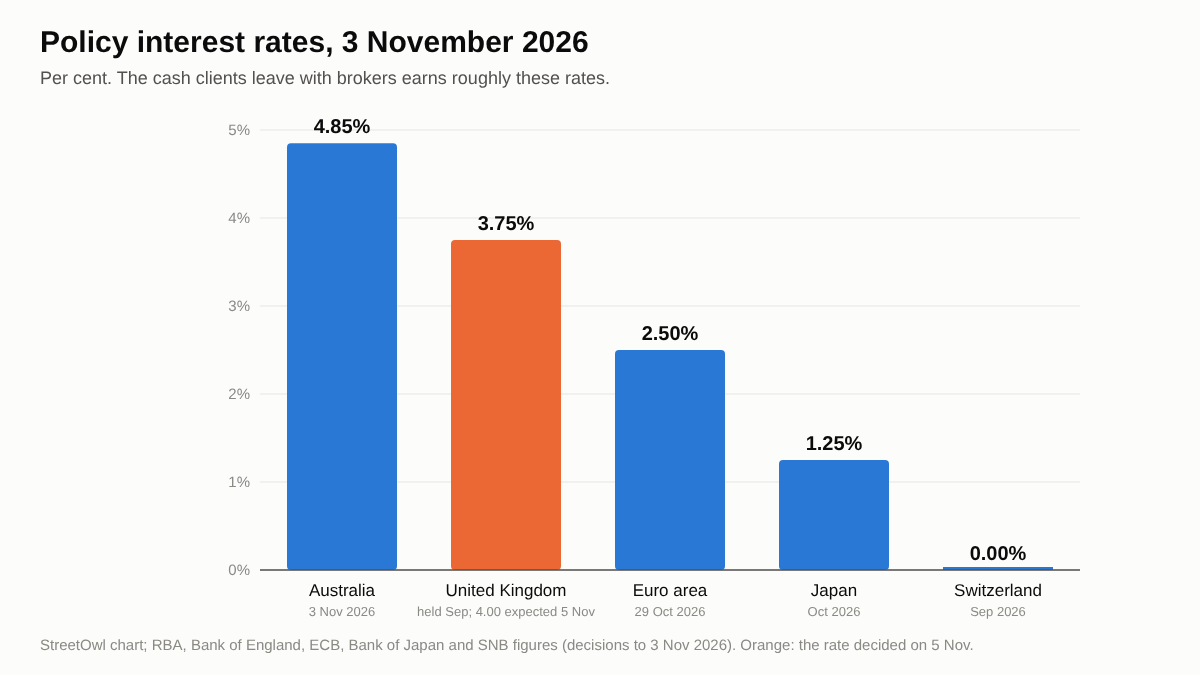
That line is now reversing, because the oil shock has turned the rate cycle. The Reserve Bank of Australia raised its cash rate to 4.85 per cent on 3 November, the highest since 2008. The Bank of England is expected to raise Bank Rate from 3.75 to 4 per cent on 5 November. The European Central Bank has been raising, and the Bank of Japan is at 1.25 per cent and signalling more. Only Switzerland, at zero, is standing still. Client cash does not shrink when rates rise, so every quarter-point adds to the interest a broker earns at no extra cost, with a lag of a few weeks.
The engine that cuts both ways
The third engine explains the bad quarter. Brokers do not pass every client trade to the open market; most flow is netted inside the firm, and because clients as a group tend to lose a little over time, the broker keeps a share of what they bet. In a choppy market that share is high. In a one-way market, such as gold's long slide this year, clients who simply bet on the trend win, and the broker's internal book pays out. That is what cut one firm's retention from its usual mid-80s per cent to about 70 per cent. The share swings, but it has always swung back: one broker's measure of client trading performance went from a loss of $3.6m in the third quarter of 2025 to a gain of $11.9m in the same quarter of 2026.
Who gains and who pays is simple. Active traders pay, in spreads, in commissions and in the interest their idle margin no longer earns them. Brokers and their shareholders gain, and the gain compounds because the costs of running a trading platform, the technology and the marketing, are largely fixed. What would stop it is a long calm, which would quieten the first engine, or a round of rate cuts, which would quieten the second. For the coming months the central banks have signalled the opposite.
Sources
- Reserve Bank of Australia, monetary policy decision, 3 Nov 2026
- Trading Economics, gold price, 3 Nov 2026
- London Stock Exchange RNS, broker trading updates, Oct 2026
- Investegate, third-quarter trading update, Oct 2026
- Investing.com, UK broker annual results, 4 Jun 2026
- CNBC, Swiss National Bank holds rates at 0%, 24 Sep 2026
- Bank of England, Bank Rate
This piece was researched with AI from the public sources named and written up and checked by Michael Rossi before it went up. It describes how one thing moves another; it names no investment and is not financial advice.
← Back to StreetOwl