How a shipping crisis pays the broker twice
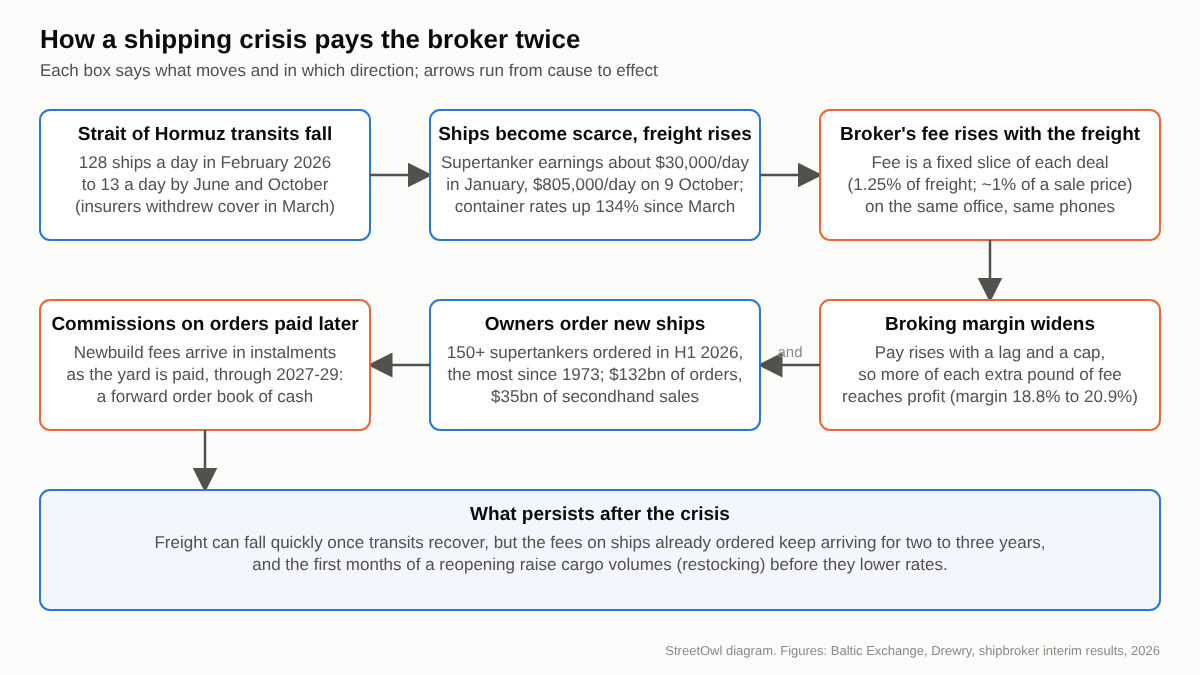
Ships stop passing Hormuz, so the ships still moving earn twenty times more, so the brokers who take a fixed slice of every charter earn twenty times more on the same phones, and then earn again, for three years, on the new ships owners order to chase those rates.
The strait that emptied
Since insurers withdrew cover on the Strait of Hormuz in March, the busiest oil lane in the world has been nearly empty. Shipbroker counts put average daily transits at 128 in February 2026, 7 in March and 13 in June; a ship-tracking count found 13 on 4 October. Before the war 130 to 135 ships a day went through.
A ship that cannot reach the Gulf is a ship that has to sail somewhere else, and often much further: routing around the Cape of Good Hope instead of through Suez adds about eight days to a voyage. The same cargo now needs more ships for more days, and the fleet is fixed in the short run, because a new vessel takes two to three years to build.
What a ship earns when ships are scarce
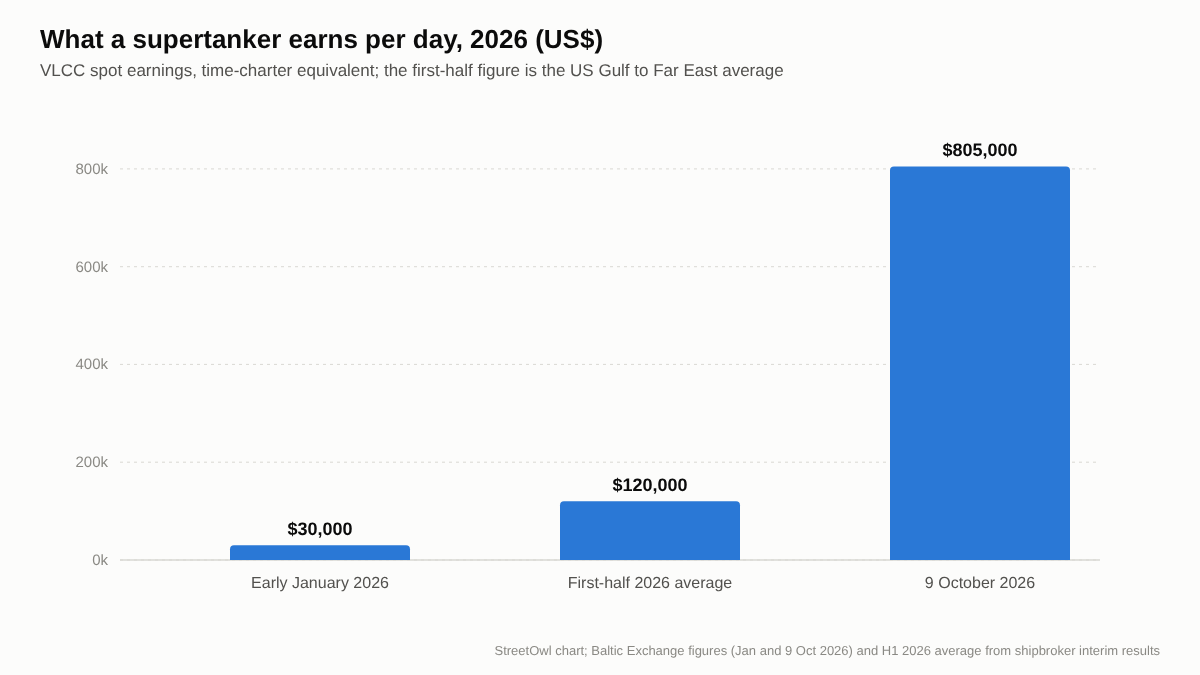
The result is the sharpest freight spike in a generation. A very large crude carrier, the 2-million-barrel supertanker, earned about $30,000 a day in early January 2026. The Baltic Exchange put its spot earnings at $805,000 a day on 9 October, and the first-half average on the US Gulf to Far East route was already $120,000 a day, up 166% on a year earlier. Container shipping followed: Drewry's World Container Index rose 134% between 5 March and 22 October, to $4,585 per 40-foot box.
Owners of ships are the obvious winners. The less obvious ones are the people in the middle of every deal.
The broker's slice
A shipbroker finds the cargo a ship and the ship a cargo, and is paid a fixed percentage of the deal rather than a fee for its time: the standard chartering commission is 1.25% of the freight or hire, and a sale-and-purchase broker takes about 1% of the price of the ship. The phone call that fixes a supertanker at $805,000 a day is the same phone call that fixed it at $30,000 a day, so the fee rises twenty-seven-fold on the same office and the same people.
Brokers' pay is the main cost and bonuses do rise, but with a lag and a cap, so more of each extra pound of fee reaches profit. The largest London broker's broking margin went from 18.8% to 20.9% between the first half of 2025 and the first half of 2026, on revenue up 39%; its profit before tax rose 56%, a record half.
Paid again, on the ships ordered to chase the rates
Freight at these levels makes owners order ships. More than 150 supertankers were ordered in the first half of 2026, the most in any year since 1973; new-ship orders as a whole ran about 30% above 2025's pace at $132bn, and more than 1,200 secondhand ships worth over $35bn changed hands. The broker takes its 1% on each sale, and on a new ship the commission is paid as the shipyard is paid, in instalments over the two or three years of construction.
That is the part of the machine that outlasts the crisis. Brokers book those future instalments as a forward order book; the largest London firm's stood at $244m at the end of 2025 and has grown since. Freight could halve tomorrow and the fees on ships ordered this year would keep arriving until 2028 or 2029.
What happens when the strait reopens
A reopening does not switch the machine off at once. Ships are scattered in the wrong places, 1,226 tankers were under sanction by the end of August and cannot carry compliant cargo, and refineries that have run down stocks for months will refill them, so the first months of peace raise cargo volumes before they lower rates.
The longer-run cost arrives later: the 150 supertankers ordered this year will be delivered in 2028 and 2029, into whatever market exists then. Too many ships chasing too little cargo is how the last tanker boom, after 2008, turned into a decade-long slump. Who gains in the meantime: shipowners, shipbrokers and shipyards; who pays: every importer of oil and goods, and through them the household filling a tank or buying anything that arrived in a box.
Sources
- Shipbroker interim results announcement (RNS), 3 August 2026
- Shipbroker interim results presentation (Hormuz transit counts), 3 August 2026
- ticker.app, shipbroker trading statement summary, 6 October 2026
- Global Strategy Files, war premium and freight data note (Baltic Exchange, Drewry, S&P Global, Windward figures), 24 October 2026
- HandyBulk, shipbrokers' commission explained
This piece was researched with AI from the public sources named and written up and checked by Michael Rossi before it went up. It describes how one thing moves another; it names no investment and is not financial advice.
← Back to StreetOwl