Fewer companies are going bust, so why are the people who wind them up busier than ever?
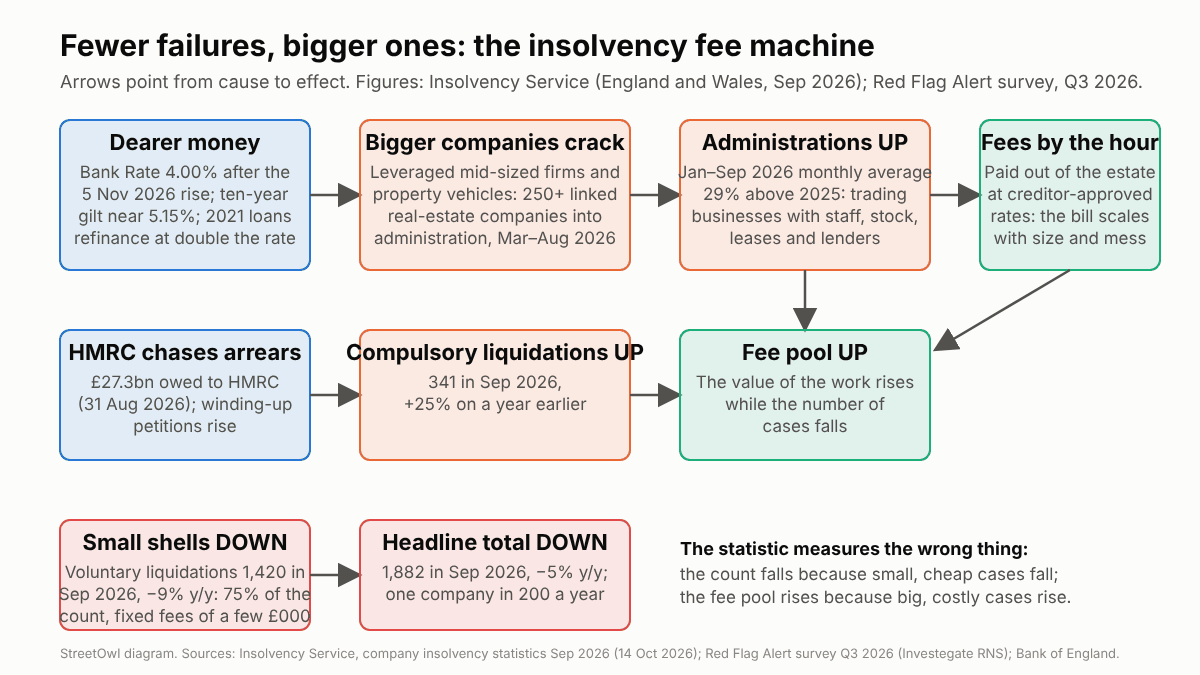
Dearer money breaks bigger companies, so the number of failures falls while the cost of each one rises, and the firms that clear up are paid by the hour out of what is left.
The headline says fewer failures
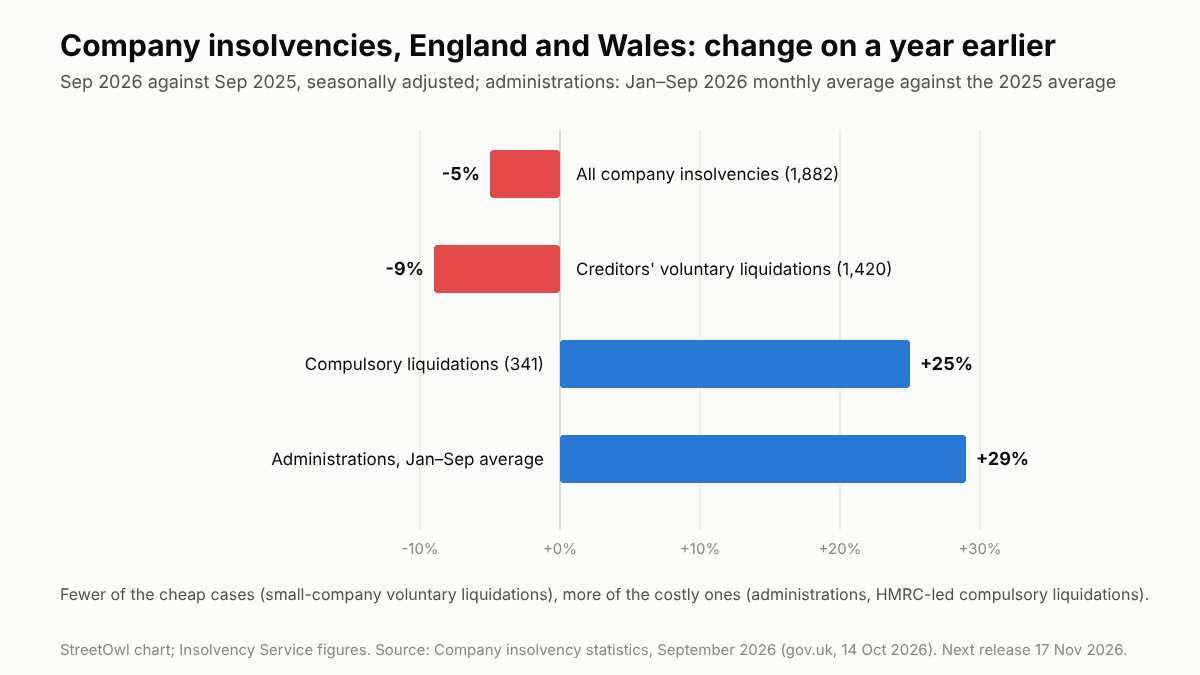
On Tuesday 17 November, at half past nine, the Insolvency Service publishes October's count of company insolvencies. September's figure for England and Wales was 1,882, 5 per cent fewer than a year earlier, and over the past twelve months about one company in 200 has entered a formal insolvency procedure, less than half the rate of the 2008–09 recession. Read on its own, that looks like a calmer economy and a quieter trade for the people who deal with failed companies.
It is neither, and the reason lies in how the trade is paid.
How the people who wind companies up are paid
An insolvency practitioner is paid out of the dead company's own estate: by the hour, at rates the creditors approve, plus a share of whatever is sold. The bill therefore scales with the size and the mess of the company, not with how many companies fail. Three quarters of September's count (1,420 of the 1,882) were creditors' voluntary liquidations, mostly tiny companies with no staff and few assets, wound up for a fixed fee of a few thousand pounds. Many are little more than shells.
The expensive work is the administration of a trading business: a chain of shops with stock, leases, lenders and a workforce. Those cases averaged 29 per cent more a month in the first nine months of 2026 than in 2025, lifted by one property group that put more than 250 connected companies into administration between March and August. Compulsory liquidations, which are mostly petitions by HM Revenue and Customs, rose 25 per cent on a year earlier to 341. Businesses owed HMRC £27.3 billion in tax arrears at the end of August, and the tax office is now the most active petitioner in the country.
Why dearer money breaks bigger companies
Bank Rate is 4 per cent after the rise on 5 November and the ten-year gilt yields about 5.15 per cent, so loans taken out in 2021 at 2 or 3 per cent are being refinanced at roughly double the rate. Small companies with no debt barely notice. The casualties are leveraged mid-sized businesses and property vehicles whose borrowings were sized for cheap money: the discount chain Poundland, with 600 shops and £1.5 billion of sales, filed notice of its intention to appoint administrators on 29 October. A record 738,144 firms were in what the trade calls significant financial distress at the end of September.
So the count goes down while the value of the work goes up. The small, cheap cases are fewer; the large, costly cases are more numerous. Nobody writes that headline, because the published statistic adds every case together as if each one were the same.
Who gains and who pays
The gainers are the insolvency practitioners, the lawyers, valuers and auctioneers who work alongside them, and the funders who buy the claims that liquidators bring against former directors. The biggest cases go to a handful of large private partnerships, and the quoted firms in the trade reported double-digit revenue growth in the year to April 2026, during which the headline count of failures fell.
Those who pay are the creditors, whose recovery shrinks by every hour billed, the suppliers and landlords left with unpaid invoices, and the staff of the businesses that close: construction, retail and hospitality accounted for 46 per cent of the past year's insolvencies. The next reading is Tuesday's release, and the line to watch is not the total but the number of administrations.
Sources
- The Insolvency Service, Commentary: company insolvency statistics September 2026, 14 October 2026
- The Insolvency Service, Company insolvencies October 2026, release announcement (17 November 2026, 9:30am)
- The Gazette, Company insolvency statistics September 2026
- LBC / PA, Poundland's future hangs in balance as administration deadline looms, 11 November 2026
This piece was drafted by AI from the public sources named, then read and approved by Michael Rossi before it went up. It describes how one thing moves another; it names no investment and is not financial advice.
← Back to StreetOwl