Cement gets a border on 1 January, and it rises every year for nine
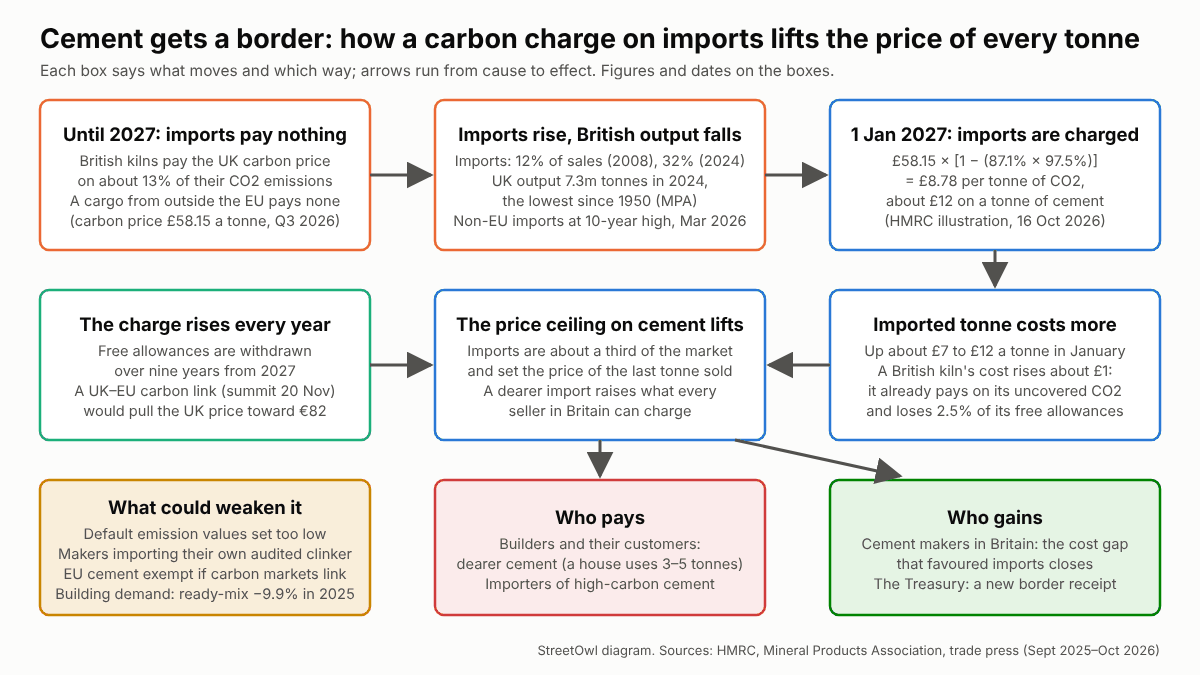
Imported cement has escaped the carbon price that British kilns pay, so imports took a third of the market; from 1 January 2027 imports are charged too, so the cheapest tonne costs more, so the price of all cement sold in Britain rises with it.
Why a third of Britain's cement now arrives by ship
Britain made 7.3 million tonnes of cement in 2024, the least since 1950 and about half the 1990 figure, according to the Mineral Products Association. Over the same years imports grew from 12 per cent of sales in 2008 to 32 per cent in 2024, and in March 2026 cement from outside the European Union reached a ten-year high.
Weak housebuilding is part of the story, but not the mechanism. A British kiln pays the UK carbon price on the share of its emissions that its free allowances do not cover. A cargo from outside the EU pays nothing. The industry puts its combined energy and climate-policy costs at £82 million, against £45 million in 2015. The cheaper tonne has been the one that crossed the sea.
What changes on 1 January 2027
On that date the UK's Carbon Border Adjustment Mechanism begins, with no phase-in, for cement, steel, aluminium, fertiliser and hydrogen. Importers of £50,000 or more of those goods a year pay a charge on the carbon emitted in making them.
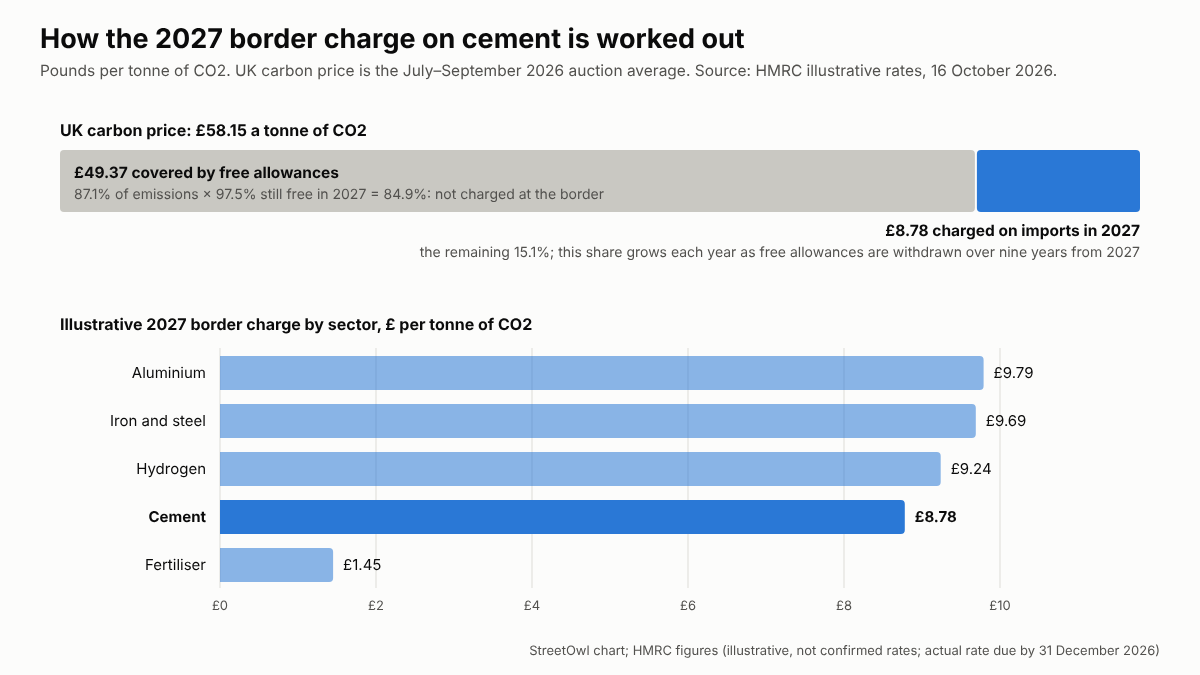
HM Revenue and Customs published a worked example on 16 October 2026. The UK carbon price averaged £58.15 a tonne of carbon dioxide between July and September. British cement makers receive free allowances for 87.1 per cent of their emissions, cut by 2.5 per cent in 2027. The charge on imports is the part that is left: £58.15 × [1 − (87.1% × 97.5%)] = £8.78 a tonne of carbon dioxide. On the default emissions figures that is about £12 on a tonne of ordinary grey cement and £12.58 on a tonne of clinker, the kiln product cement is ground from. For scale, bulk cement from Turkey was assessed at $57 a tonne at the quay in August 2025.
The figures are an illustration. The actual rate for January to March will be published before the end of December and then every quarter.
How the charge reaches the price
Imports are about a third of the market, so the imported tonne is the one that sets the price a British seller can ask. From January that tonne costs about £12 more if the importer uses the default figures, or around £7 if the overseas kiln's real emissions are audited and turn out typical, at roughly 0.8 tonnes of carbon dioxide a tonne (StreetOwl arithmetic from HMRC's rate).
A British kiln's own bill barely moves in the first year. It already pays for the emissions its allowances do not cover, and it loses only a further 2.5 per cent of them, worth about £1 a tonne of cement on the same arithmetic. So the cost gap that favoured imports closes, and the ceiling on cement prices in Britain lifts.
The ratchet
The free allowances are being withdrawn over nine years from 2027, and the formula raises the border charge with each cut. At today's carbon price the charge ends near the full £58 a tonne of carbon dioxide, roughly £80 on a tonne of cement at the default figures (StreetOwl arithmetic). British kilns' own carbon bills rise over the same years, so this is not a subsidy: it is the end of imports escaping a cost that every tonne sold here then carries.
The carbon price itself may rise. Britain and the EU are negotiating a link between their carbon markets, and the Prime Minister has said a deal on emissions trading is on the table at the summit in Brussels on 20 November 2026. The EU's price was about €82 a tonne in the third quarter, against £58 to £63 in Britain. Linked markets would pull the two together.
Who pays, and what could change it
Builders and their customers pay. A traditional four-bedroom house uses three to five tonnes of cement, so January's charge is about £36 to £60 a house; a new hospital uses nearly 8,000 tonnes and Sizewell C up to 750,000. Cement makers in Britain gain the room to raise prices, and the Treasury gains a new receipt at the border.
Three things could blunt it. Importers may use default emissions figures instead of audited ones, and a return filed that way cannot later be amended, so everything turns on whether the final defaults are set high enough; technical comments close on 13 November. A producer that ships in its own audited, low-carbon clinker pays the lower rate. And once a UK–EU link takes legal effect, cement from the EU would be exempt, though it would by then carry the EU's own carbon cost. Demand is the other unknown: ready-mixed concrete sales fell 9.9 per cent in 2025 and a further 5.9 per cent in the second quarter of 2026.
Sources
- HM Revenue and Customs, illustrative CBAM rates and worked example, 16 October 2026
- CemNet, UK outlines indicative cement CBAM costs, October 2026
- Clifford Chance, UK CBAM primer, September 2026
- CBAM Guide, UK and EU ETS linkage, 13 October 2026
- Mineral Products Association via The Construction Index, 3 September 2025
- S&P Global Energy, UK cement output and imports, 4 September 2025
- S&P Global Energy, Mineral Products Association statement, 3 July 2026
- Mineral Products Association, Quarterly Sales Volumes Survey, second quarter of 2026
This piece was researched with AI from the public sources named and written up and checked by Michael Rossi before it went up. It describes how one thing moves another; it names no investment and is not financial advice.
← Back to StreetOwl